Links go to search results. Availability varies by region.
ç˝ăç ăŽă˘ăŻă˘ăăźă
24
TV
Finished Airing
Jul 9, 2021 to Dec 17, 2021
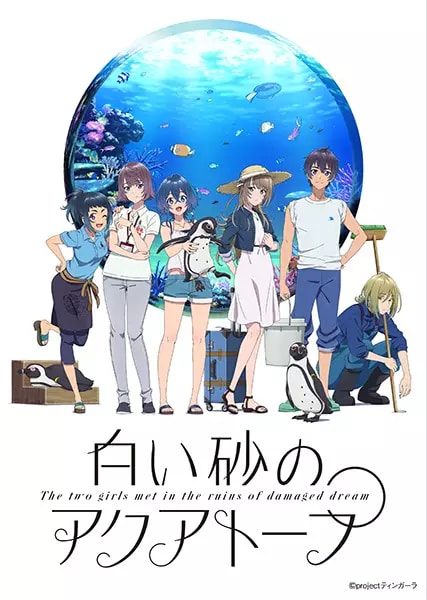
After leaving her idol career behind, Fuuka Miyazawa finds herself on a spontaneous flight to Okinawa instead of returning home to her pity party in Morioka. Bearing a heavy heart and nowhere to go, she aimlessly wanders around the area until she stumbles upon Gama Gama Aquariumâan aging aquarium on the verge of closing down. With a lack of visitors and costly but necessary repairs needed to keep its doors open, the director is faced with shutting down the establishment for good by the end of the summer. The director's aquatic life-loving granddaughterâKukuru Misakinoâcannot stand the thought of the aquarium closing and is determined to make enough money by the end of the season to keep the doors open. Seeing the unique magic of the aquarium, Fuuka begs Kukuru for a job; however, she soon finds that her lack of experience makes her more of a hindrance than anything else. At the same time, Kukuru realizes that her ambitious goal might be more than she can handle. With mounting pressure from all around them, will Kukuru and Fuuka be able to save the one place they hold close to their hearts? [Written by MAL Rewrite]
7.7/10
Average Review Score
65%
Recommend It
20
Reviews Worldwide
They're back again. After taking a half year break, Shiroi Suna no Aquatope (aka The Aquatope on White Sand) aired as one of the key projects celebrating PA Works' rich body of accomplishments. Or can it be called that? After all, P.A. Works can be a hit or miss sometimes based on their track record. But one thing is for sure, P.A. Works is no stranger in the anime industry. They've produced memorable adaptations and original works all the way back in 2008. Founded since 2000, you can bet that the studio brings their wealth of experience again to Shiroi Suna no Aquatope. Let me prefaceand say that if you're a familiar fan of P.A. Works, then you can easily tell the show dives into a slice of life story with coming of age themes. There's a bucket list to check off and of course, cute girls is among them. Shiroi Suna no Aquatope is yet, much more about cute girls doing cute things. It's about characters following their dreams and making a difference in their world. It all starts when an eighteen year old Fuka Miyazawa escapes to Okinawa and meets Kukuru Misakino, a high student with a passion for aquatic life. It doesn't take long for the two to become friends and she develops her own passion and finding her place at the Gama Gama Aquarium. With slice of life stories like this, we have to realize and set expectations clearly. The show tells a realistic story that depicts how characters live. P.A Works is known for both their realism and fantasy naturalism. But for this anime, they decided to go with realism by telling their story, and focusing on the cast with their dreams. To the surprise of no one, Kukuru and Fuka represents characters that met by fate. The director obviously set up this show for the two main cast to meet through chance and added the texture of chasing a dream as part of the plot. Watching this anime made me realize how quickly Kukuru and Fuka became close together from the very start. Despite coming from different backgrounds, it's obvious the show wanted to see how both characters develop as a pair and individually. And let's just say, both characters learn a lot from each other. What's more important is how much the two characters affect each other in their own way. With Fuka's support, Kukuru discovers herself and continues to follow her dream regardless of any obstacles in her own. Similarly, Kukuru is able to show Fuka that there's a life outside of being an idol and that becoming part of the aquarium gives her new opportunities. That's what life is about, seeking opportunities, and following dreams. With a total set of 24 episodes, the anime is structured in two parts with the first half taking place at the Gama Gama Aquarium. After certain circumstances, we get the second half of the story taking place at the Tingaara Aquarium. Despite the change in setting, the anime still retains its themes and knows no boundary about its love of aquatic life. From taking care of dolphins, nursing sea turtles, to cosplaying to attract an audience, every episode has its passion. To be honest, the anime does have its subtle yuri-tones but the relationship between Fuka and Kukuru eclipses so much more than that. One thing I want to mention about Shiroi Suna no Aquatope is that while Kukuru and Fuka are the two characters that stand out the most, the rest of the cast seems to be here and there adapting their roles in the most safe way possible. What I mean is, the majority of the cast are introduced as who they are but receive little development overall. This is especially true in the second half of the show when the Tingaara Aquarium is introduced. Characters such as Karin, Chiyu, Kuuya, among others only get some involvement with the plot. After the first half of the show, it seems they are very much overshadowed by Fuka and Kukuru. Now, I don't know how the plot was created from behind the scenes but it became obvious that the director wanted to shift its attention entirely on the two main leads. It's just a shame that there's an overemphasis on Fuka and Kukuru than almost anything else. But, don't let that distract from the gorgeous chereography and high quality stellar visuals. P.A. Works and their talent of crafting lustrious visuals is once again present in their latest work. It rewards fans with stunning quality of the aquarium waters to natural look of the outdoors. It remains that way throughout the series as there are no episodes with noticable drop in quality .Character designs are also decorated with simple yet mature look for its cast. Human emotions are protrayed with realistic expressions and every episode has its share of its behaviors. From a technical perspective, this is a breathtaking representation of classic P.A. Works anime and you're in for a treat. If there's an answer to making a solid slice of life anime this year, then it's P.A. Works. From this original TV anime of 24 episodes, we see what their talent bought to us. And with Shiroi Suna no Aquatope, the show proved itself to be a simple yet effective story. It gave us a story that matters, a story that we can find ourselves relatable to, and a story that we can all share about following dreams.
Click an episode to read its synopsis.
A sudden weight on our shoulders comes when taking a decision about our future, the myths of following a straight path to success and happiness infect our decision-making by following a unique dream. The disruption of that dream by an external force is something that is bound to happen to most of us who decided to take a path, breaking the comfort zone of following an established and known path and leaving us in a multidirectional crossroad, obnubilating our sense of future. The Aquatope on White Sand tries to untie this assimilated conflict through the usage of a mysterious yet recognizable common place, the marineworld. By using a set of parallels coming from the experiences that the animal world can grant to us, while also applying a deeply human form of relationships and communication, the anime delivers a compassionate and warm place to fall into, installing simple yet helpful perspectives of how to confront the different paths, allowing the spectator to break free of judgement and fear to the unknown. Sadly, the anime is far from being perfect, with a concrete problem coming from the inconsistency of its building blocks, which concludes in uninteresting climaxes, redundancy issues, and wasted storylines that didnât amount to anything. The first impact from the series come from its appealing and full of life color palette, the white of the sand, the blue of the sea, and the green of the nature. The color palette let the anime to intersect with the common place of Okinawa, and to generalize, with the idea of being in a subtropical island. Okinawa is a place that is heavily affected by human action, coral bleaching has severely affected their ecosystem, and the purposeful intertwining of the story and the setting through the experience of the marine life make some sense out of it, forwarding a wish to protect the wildlife. The full of life landscapes are made so to fully appreciate the beauty of nature, using didactic representations of the biological ecosystems as a manner to express love to the theme and deepening the characters. The animation is sometimes rough, which can be justified by the complex and distinctive designs of the characters. The marine representation is a hit or miss, the penguins, otters and turtles look gorgeous, but the fish tends to pop up too much, getting a sudden contrast that shouldnât be there and look unnatural. Overall, the intoxicating warm of the first impact provokes a beautiful invitation to deal with the unknown story, melting us up with the green and drowning our view with an intense deep blue. The story comes then with two main characters, but it can be assumed that Kukuru is the most relevant one, since it grabs most of the screentime. And I could say that Kukuru is the embodiment of the inconsistency of the series, being particularly controversial because of its strange childish wrongdoings, almost like a person that has never been held accountable of anything. Of course, the main character faces the broken dreams mentioned before, through the departure from her childhood place to the capability of facing new issues, dealing with the idea of letting her character absorb new perspectives, breaking the walls of judgement and stubbornness. Many questions come around with her position, like the validity of our past path as the only possible path, or the adversity of the unknown, or the sometimes unavoidable meddle into the wrong conflicts. To do so, the series uses an extravagant metaphorical perspective about the issues, by using parallels between the struggle of the marine life and the struggles of Kukuru, which is one of the strong aspects of the show. The development of the conflicts of her are a fantastic way to study and teach the symbiotic relationships inside the marine life, the complexities of their mystery, and similarities of their behavior to the human nature (Watch the Orangutan School for something like this) and dealing with her problems through fully-fledged emotional impact. Examples like the obvious parallel with the turtles hatching, the lonely dolphin, the meddling crab, the impact of changing to a new environment portrayed by the penguin, it is both educational, entertaining, and provoking. Sadly, the resolutions of her character are either unrealistic or forced, providing just cop outs to keep the plot afloat because there were either no time or no intent to do something more fruitful and credible, which makes the whole experience a double-faced sensation, we have a full of life development, and the climax of the conflict is a montage of words and events, flat as a stingray. This duality comes with Fuuka and the incorporation of the other characters too, and it is quite amazing how consistently disappointing the development of some of them is. Fuuka has the reverse problem, her conflicts completely pale in comparison to the main character, coming normally from her emotional fragility, and the series doesnât provide her enough screentime, but her resolutions are always emotionally strong, by intertwining her position with the main character and giving us lyrically expressive conversations, touchy and delicate. The cast has this same issue, some part of the cast, like Chiyu or Tsukimi, have interesting appearances with a purposeful proposition, either by validating the conception of a new perspective and understanding of the unknown, or by being a bridge of communication with a non-aquarium related person, deploying a projection of the struggles in another area. Then, characters like Kuuya or the guy who just talk in marine lingo are just absurd comedy device that barely works, and the later one main feature is being snubbed out of a completely deserved scholarship, which is kind of sad. The story is then in a limbo. Through 24 episodes we explore the dreams and the parallels, integrating a bland but welcomed ecological message in the way. The first cour is about keeping the dream alive, while the second cour is about dealing with the shattered dream and going forward, and while the idea behind of such structure is alright, the series extended itself way too much, padding some episodes with some redundancy or delivering half-assed narratives or explanations to keep the episode count. The main problem is that the stories are not slowly building but approaching either at full speed or slow-motion. The full speed manifest through the latest episodes, where Fuuka and Kukuru resolved their struggles in the most absurdly rushed way, by imposing a strange sensation of injustice to the viewer. The slow-motion defines the middle part, where barely anything but a good redemption arc was obtained, filled with misery porn that didnât achieve anything powerful. The full speed also comes in the final part of the first cour, when the hopelessness invaded the story, chaotic but full of expression. The slow-motion defines the mid part of the first cour, when they decided to extend the concept of Gama Gama not being able to stay afloat with the properties of a gum, through a bunch of backstories that didnât amount anything but maybe a tearjerker or two. I suppose that the score could be the conclusion of the review, the series is average, doing some excellent episodes and some plain, awkward, or even enraging ones. While the series failed at many points because of its own ambition or rigid structure, the overall feeling is that this is worth to watch if you are into the position that the story tries to explore. If you are lost, nostalgic, or overwhelmed, then the story can fit an interesting niche to allow you to explore your own emotions and have another outlook of life. If you are not into such position, then the story canât but feel extremely dry, with failing comedy and please cry drama, kind of ironic since the theme is water.
"What do you want to be when you grow up? What is your dream that helps you propel forward to initiate that push-to-shove action?" These 2 questions always comes up when I watch Shiroi Suna no Aquatope, yet another 2-cour long show that's pretty much the standard when it comes to P.A. Works shows, brought to you by the same team that produced Fall 2018's Irozuku Sekai no Ashita kara (a.k.a IroDuku). And as much as I like IroDuku to a certain degree of it being the same P.A. Works visual masterpiece works that have been consistent for years now, the story and plot feelskinda whack and shallow somewhat that's heavily masked by the visual presentation. That...unfortunately carries over to Aquatope, and that I feel that the in-house director Toshiya Shinohara and his team clearly saw what works with that and amplifies it two-fold here, to hits and misses. And it's very unlikely that this popular formulaic stance that P.A. Works have adopted for years will ever change. Rightaway, the core plot premise of Shiroi Suna no Aquatope is clearly defined in its title: "The two girls met in the ruins of (a) damaged dream." A story about the realities of growing up and moving on from the dreams that clearly hasn't worked out, and finding new meaning in things yet unseen and unimagined. Not all things are bad, and a life-changing tonal change can be good in the long run. And that's the case of Fuuka Miyazawa, a girl whom was once in the idol scene, only for that ambition to wane out and the internal monologue of running away from all the fame that she has amassed in search for something new for life outside the main city of Tokyo, and wandering into the state of Nanjou, Okinawa, where she met yet another girl named Kukuru Misakino. Like Fuuka, Kukuru is a high school student working for her family's business named Gama Gama Aquarium, which is on the brink of collapsing due to the rancid state of the aquarium and the small visitorship numbers, which is needed to recouperate costs and maintain the pristine shape of the aquarium that's literally quite hidden away from the Okinawan outset. The knife edges deeper because the aquarium is handled by her grandfather whom seemingly didn't know what to do with the place (which became Kukuru's 2nd home), and while his intentions to let go of Gama Gama spells out the disaster quick, the motive to let Kukuru take over the aquarium as a means to revive the place creates a haven for both girls and the characters around them. And that's where the story surrounding both Fuuka and Kukuri in a bubble starts. For realism's sake for the overall slice-of-life story (since this is a 2-cour), I will divide it into 2 halves of the entire plot of Aquatope: the Gama Gama section, and the Tingarla section. Mild spoilers if you wish, but I won't dive too deep on that end. The Gama Gama section covers the entire 1st half of Aquatope, and dare I say that if this show was ever only made in a batch of 12 or 13 episodes, this would've been the perfect standard of P.A. Works in achieving some great storytelling for once in a 2-cour setting. The introduction between the two girls that coincidentally met out from their damaged dreams, Fuuka having winded in Okinawa after running away from her idol issues, comes to Gama Gama after being severely dehydrated and found by the tourist manager Karin Kudaka, who transports her to the aquarium to get some recovery assistance. Over there, while Fuuka is recovering, she observes the huge aquarium and receives an out-of-body experience, to which after meeting Kukuru, pleads with her for a job just to get along. And simultaneously over the course of the Gama Gama section, converses with each other about their dreams/ambitions and uncertain futures, together with the other staff of Kukuru's childhood friend Kai Nakamura, fish breeders-cum-attendants Kuuya Yakamashi and Umi-yan, alongside Kukuru's grandfather and the two girls as well. Through the out-of-body supernatural visions experience, both Kukuru and Fuuka initiate sentiment feelings that parallels with the Yuri feeling, because Kukuru has an attachment to her parents that passed away when she was young, and all she had currently is her grandparents to speak of in a familial setting. Fuuka being there for her provides that bit of queerness akin to a family's love, and everything about Gama Gama just feels naturally and magically surreal being Fuuka-centric altogether from its short existence from a family business to a total collapse of demolition. In all, the Gama Gama section is truly the start of the new and beautiful potential of the show. The Tingarla section section covers the entire 2nd half of Aquatope, and with the term "growing up" comes the major decision route of the show in its direction to shape the entire series as a whole. However, I feel that the 2nd half really wavers on for far too long with everything that's done from the 1st half, making it drag on until the series' core message comes around being about environmentalism and sustainability as the main narrative, then leave everything else behind in the dust: plot narratives, characters that can feel like they're after-thoughts or just only make cameos in wishing that we, the audience, would never catch on. The sad part is that the Tingarla section feels somewhat haphazard with the execution of the themes that were great in the 1st half, made worse with the whole schmup of having your dream to be defined when you don't get what you want. And that's the case of Kukuru, now being hired by Akira Hoshino, an acquintance of Kukuru's grandfather and simultaneously the head honcho Director of Tingarla Aquarium, which Kukuru's assigned position given from him isn't all about being a sea creature attendant, but rather to the marketing department instead. Kukuru, to the chagrin of a rebellious teenager, builds a reputation for being so pent up because she couldn't get her dream job that Fuuka got the position instead, and had to work from scratch with a different view. Remember that change can be good or bad depending on the person, and in this case, the Kukuru-centric plot takes a whirlwind of our emotions and slowly caresses with it until there is no more wind to blow. The only character of note is Chiyu Haebaru, whom once went over to Gama Gama as an intern, and found that the practices there (such as the "special effects" supernatural visions aquarium experience) aren't so much sustainable from her stint with Tingarla. The real reason is that like Kukuru, Chiyu may come off as arrogant, but that arrogance is supported as she is a young adult struggling to land a job and raising as a single mother after a failed marriage. That in anyway is a far worse shape than what Kukuru felt losing her parents from an early age, and at least that section of the plot is really well done. What comes after that...only disappointment mounts as the staff over at Tingarla, which comprises of sea creature attendants Chiyu, Kaoru Shimabukuro, Marina Yonekura, Eiji Higa, breedmanager Bondo GarandĐžu, the emotionless no-nonsense assistant director Tetsuji Suwa and Director Akira himself. It just feels like a dysfunctional organization that's reminiscent of Japan's working style of being ordered by management overlords to maintain business, even if minor complaints get seemingly contrived and blown out of comparison. So it's for that reason that with the Tingarla section of the 2nd half, the show really lost its direction and only geared with the main message, which doubled down on the potential that had been lost right up until the final moments. Such a waste of what could've been a great follow-up story plot. The disorientation of Aquatope only carries on with the characters, and for the same reason above that I've classified both Gama Gama and Tingarla sections, the former feels like a well-knitted close family while the latter is just like your average company-sized ambience. Most particularly with Fuuka and Kukuru, these two girls have been the subject that Aquatope carries the "Yuri-coded" tone wherever they go, and much that we can see that their time together exhibiting much of that Yuri-ness with each other. In actual fact, Fuuka is quite indebted to Kukuru because she helped change her life around to find meaning with being a sea attendant after abruptly leaving the idol scene, to the chagrin of her former members and her mother, while Kukuru is thankful that Fuuka feels like her older sister character that she can act like how siblings would with the whole uncensored, true feelings of vulnerability, much less her only family left alive that is her grandparents. The crux of both characters is that in the case of Fuuka, to "the feeling of being lost and trying to find something" to attach yourself to, and Kukuru as acting as Fuuka's foil, she represents "the feeling of pursuing a vague future you want but can't completely define", capturing the "feeling of being between stages of life, lost but searching." The other characters all serve their purpose to fleet along with the 2 girls gleefully glancing life in their own bubble, but when it all comes down to the main symbolism of the show (which is that magical aquarium "supernatural visions" thingie-a-bob plot device), you can put two and two together to see that overtime, the irrelevancy creeps up when you least expected it. Contrived or not, that's not my decision to make, but I'll let you decide. Otherwise, everything else is as what you expect of a P.A. Works made anime: nice visuals and backdrops with beautiful artwork that exudes quality (that once again, obfuscates the story plot bit by bit), the one thing that you can never fault the studio for, but is by no means a good way to cover the inherent flaws of the show. The sound design is the same as per the story's tonal shift, and in regards to the OST, Arcana Project's 1st OP is just a simple but great song, only for their 2nd OP to become too busy even with the egregiously long song title. Mia REGINA's 1st half's ED compliments Arcana Project's 1st OP, which I thought was a nice touch all things considered, a duality serving the same purpose. The same however, could not be said for Risa Aizawa's 2nd ED, which is more like visual aesthetics than the upiftling of emotions. We all love aquariums no matter our age, because it shows the wonder and naturalness of the sea creatures wandering in the sea and living in harmony despite the food chain cycle. Aquatope on the other hand, it's a good show if you want to just relax and watch an unhinged series that leans on the magical part and coping with a coming-of-age story that's all about the difficulties of reality shoved in your face, and learning how to deal with them. But take that away, and what you have is a subservience of a story plot that while manages to stick its core themes from start to finish, leaves some questions unanswered. Maybe it's me that I'm being patient and tolerant of P.A. Works' original shows for years, and that this problem that has long existed only comes up now to leave a sour taste in my mouth, even if it's a teeny little bit. Don't get me wrong though, I do love when the story plot and visuals go hand-in-hand, especially for one that's an original story. But executions like these just keep me wondering if there's any scriptwriting prowess in P.A. Works shows anymore, and while Aquatope isn't the first, it won't be the last to do so. Ironically, a great Summer show that by the Fall, it has fallen from grace into decency. A hidden gem from back then, that with the entire material on hand, leaves a mixed bag of an experience. If I have to take a lesson from Aquatope, it's that growing up is part-and-parcel of life, but dreams is what you make of it, so go and achieve it, even if it's damaged dreams and meeting in the ruins of a lifetime partnership.
âI donât agree with writing reviews before the season/series is over because that review would only cover the first few episodes, and these may not be an accurate representation of the rest of the season/series.â I remember writing these exact words for my Sing "Yesterday" for Me review, and these two sentences were all I could think about when watching the second half of Shiroi Suna no Aquatope or The Aquatope on White Sand. While the story and characters in the first half were good, all be it a bit forgettable, the story and the characters in the second half cycled between boring, frustrating, and confusing.The animation was good, but the music was utterly forgettable. I was so frustrated and bored when watching the second half of this show that it took a tremendous amount of effort to press the play button on every episode. This anime was so uninspiring, that even writing parts of this review were an absolute chore. Its only saving grace was the animation and the good first half. 6/10. *Spoilers beyond this point* As I said above, the characters in the first half were good. This is because the characters from Gamagama all had distinct, all be it stereotypical, personalities. The bubbly one, the old wise one, the dad, the newcomer, so on and so on. However, at the new aquarium, everyone fits into one of three categories, mean, mean but then they become nice later, and start nice. During the whole âgetting to know the new workplaceâ part of the second half, almost everyone is unlikeable and openly hostile to the newcomers. Of course, not just behind closed doors, they are openly hostile in front of coworkers and in front of the public. This should be 100% unacceptable from âJapanâs best and largest aquarium.â I could go on and on about Chiyu Haebaru, but that wouldnât be interesting to write or to read. So, I will stick to the larger points. The first one is, why is she so hostile to the people from Gamagama? Does she hold a grudge? If so, why? They didnât do anything bad to her. If anything, they were nice to her when she came to Gamagama. In fact, she started messing with Kukuru first. When we see her again in the second half, she is working as the lead attendant at the penguin exhibit at the new aquarium. Despite that, she comes and goes as she pleases, pushes her work and responsibilities on to her coworkers, and seems to care very about them and what they have to do outside of work. I understand she has a young kid, but that does not justify and/or nullify all of the abuse and disregard she gives to her coworkers. Another employee at the new aquarium is Kaoru Shimabukuro. Most of the time she ranges from fine to good, but during the sea slug episode, her character reaches disappointing lows. In a confrontation with Kukuru, she says something similar to, âWe use aquariums so people can fall in love with the animals in and out of nature.â This implies that she wants to take care of all the animals the best she can so the public can see the best side of them, right? No. Because soon after saying that, she says that the sea slugs donât need to eat because finding their specific type of food would require work. Also, in this confrontation, she said, âWe canât return them to the sea because that would be unethical.â Why is that? They are sea slugs that were in captivity for 14 days max. They arenât domesticated. The last thing I want to say about her is that she calls Kukuru, narrow-minded for wanting to find the correct food source for the sea slugs and not letting them starve to death. This should be the bere minimum required of all attendants, including herself. The final thing I really donât like about the characters is that there was an attempt at redemption for Chiyu and the director of the marketing department. Itâs not like we spent at least nine episodes seeing how abusive they are towards Kukuru and the rest of the Gamagama people. Despite Fuuka being one of the main characters, she takes a backseat in most of the second half. The only time the spotlight is on her again is the last three or so episodes. The rest of the cast is either written to be good or forgettable. I have nothing to say about the story in the first 12 episodes because the story is good. I get the feeling like most of the characters care about the aquarium, and are fighting to keep it alive. And after it is shut down, all the characters really care that it is gone. The second half however goes downhill very fast. I could write hundreds, and maybe thousands of words on how the second half is not only bad, but also fundamentally flawed. But, as above, that is neither interesting to read nor to write. The first one is that Kukuru is a high school graduate who worked at an aquarium as an attendant and as the temporary director at Gamagama. So why is she assigned to PR? I understand that her grandfather suggested that she should be hired in that position, but any self-respecting employer should say, âWhat is wrong with you? Her experience and skill set is perfect for a high-up attendant position.â Of course, that couldnât happen though because then we wouldnât have a second half. The management might, and in fact do, defend themselves by saying, âA lot of people work there not everyone gets what they want.â This is where a normal person would respond with âRight, but you should get what you know. Therefore, Kukuru should be an attendant.â Of course, itâs not just management that makes no sense because Chiyu gets to tell her what to do with no pushback. This makes no sense for a few reasons, but the biggest one is that even though she is the head attendant, there would be, at an absolute minimum, six people above her that she would have to answer to before giving a yes or no on Kukuruâs request. The final baffling decision of the management is to have a single person in PR create whole event plans by herself, and then get mad when the plans are not perfect. The final thing I will say is that from a character and story perspective Kukuruâs decision to stay in marketing makes no sense from a character, or story perspective for obvious reasons. The thing is that the second half could have been done well. There are a few ways to accomplish this, but this would be my plan. First, Kukuru is hired as an attendant. It makes no sense for her to be in PR. Episodes 13-15 would show how different life is from Gamagama at this new aquarium. The new characters would not be openly hostile, but just doing things a different way. This, of course, would be the conflict for these few episodes. 16-18 would be all of the characters becoming friends, so their friendships all feel as natural as possible. 19-21 would be small, self-contained issues. This would provide more depth and deepen the characterâs friendships. 22-24 would be the setup, climax, then pay off not only for the Hawaii study trip but also the whole series. I just came up with that on the fly, so tell me why the writers could not think of something better. I have little to say about the animation because it is good. It has nice shading, color pallet, animation, and attention to detail. The aquarium in the second half feels more alive and well put together than Gamagama. This not only provides scale, and a sense of awe, but it also works well from a story perspective. But, it does have its problems though. The biggest problem is the first half is the main Gamagama tank. It has no plant life, decorations, or anything besides fish. Another example is the use of CG. While not unforgivable, it is a bit overused in my opinion. I get it. Drawing countless fish is not the way I would like to spend my day, but sometimes it needed to be done. Especially in the empty Gamagama tank. There was nothing in there besides CG fish, and it really looks bad. I have even less to say about the music. Not because it is good like the animation, but because all of the music, from the first track to the last track, are all so okay it hurts. Honestly, itâs as if I fed the blandest, the most uninspired, bog-standard music to a machine and told it to give me an anime OST. Literally, nothing stood out to me after watching the show, and honestly, I donât even know if I could hum the song that I heard less than ten seconds ago. The only good part of the sound is that the voice actors did a good job. I catch a lot of crap in my real life for not liking shows like Re: Zero and Log Horizon, but I can at least see why people like them. Their worlds are well built, some of the characters are interesting, and the stories have twists and turns. However, I can not see why people like the second half of The Aquatope on White Sand. The sound is forgettable and both the characters and story are bad. The only good thing about the show is that the art and animation are really nice. With only one of the four main parts of an anime being good, it leaves me unable to recommend. Since the first and second halves are basically different shows, the score breakdown is as follows: Episodes 1-12: Story an 8 Art an 8 Sound a 6 Characters a 7 Enjoyment a 7 For a total of 7.2/10 Episodes 13-24: Story a 3 Art an 8 Sound a 6 Characters a 4 Enjoyment a 4 For a total of 5/10 An average of 6.1/10.
PA Works does it again with another brilliant Original anime. Shiroi Suna no Aquatope is a really great Slice of Life which doesn't leave you with a bucket of salt tear at the end of the show, which is what is now correlated with Slice of Life. "The two girls met in the ruins of damaged dream" is the perfect tag line for the show, depicting the our two main leads. The show is all about friendship and working hard for what you believe in, showing it not just with our main characters but side characters as well. We may not always achieve all that we wantand life may turn onto a different path, but we have to turn it into a correct one. Fuuka and Kukuru, two girls at different ends of spectrum, one who has left her dreams and the other fighting desperately to keep her dreams alive. But fate had a different path for both of them which they never expected. As always an Original anime is as good as it's ending, which they totally delivered. PA Works as always get full points for their Best in Industry Background Animation and Character Design and their in house 3DCG, of which they amongst the pioneer in the industry. The soundtrack does a really good job of complementing the scenes, and the two opening by ARCANA PROJECT is pleasing to the ear. The in-house director Shinohara Toshiya at this time can be considered as expert at water based anime. To end things , like I always say " PA WORKS + 24 episodes = GREAT FUCKING ANIME"