Links go to search results. Availability varies by region.
86âăšă€ăăŁă·ăăŻăčâ
11
TV
Finished Airing
Apr 11, 2021 to Jun 20, 2021
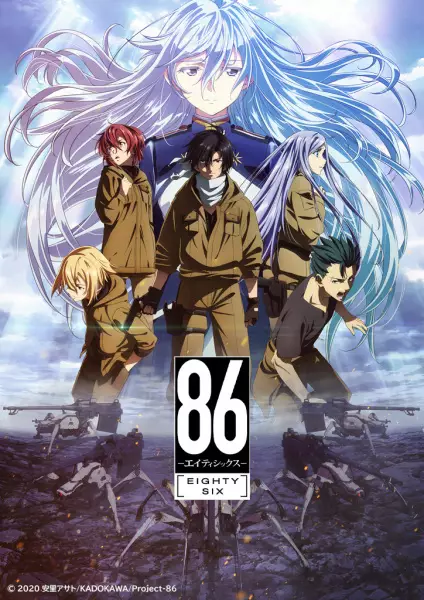
According to the Republic of San Magnolia, their ongoing war against the Giadian Empire has no casualtiesâhowever, that is mere propaganda. While the silver-haired Alba of the Republic's eighty-five sectors live safely behind protective walls, those of different appearances are interned in a secret eighty-sixth faction. Known within the military as the Eighty-Six, they are forced to fight against the Empire's autonomous Legion under the command of the Republican "Handlers." Vladilena MilizĂ© is assigned to the Spearhead squadron to replace their previous Handler. Shunned by her peers for being a fellow Eighty-Six supporter, she continues to fight against their inhumane discrimination. Shinei Nouzen is the captain of the Spearhead squadron. Infamous for being the sole survivor of every squadron he's been in, he insists on shouldering the names and wishes of his fallen comrades. When the fates of these young souls from two different worlds collide, will it ignite the spark that lights their path to salvation, or will they burn themselves in the flames of despair? [Written by MAL Rewrite]
7.2/10
Average Review Score
65%
Recommend It
20
Reviews Worldwide
The word masterpiece gets thrown around so much these days, itâs nearly lost its meaning. The literal meaning being the defining work of an individualâs career. Iâm here to tell you now, Eighty-Six:86 is a masterpiece in the truest sense of the word and is one of the best stories in the modern history of the medium. 86 depicts the brutal nature of war, racism and oppression in such a way that you canât help but to be absorbed into the story, characters and fall in love with the series. From the time it was announced that my favourite LN series would be getting an animeadaptation, I was filled with excitement at the prospect of seeing my fave scenes and characters adapted. Unfortunately, I could not help feeling a sense of dread as well given the studio that would be adapting it. A-1 have had a pretty inconsistent track record over the past decade or so. Theyâve given us some amazing works like Anohana and Bokumachi, but also someâŠ. less than stellar works like SAO season 2 or War of Underworld PT.2. A-1, and the anime industry as a wholeâs main issue is that LN adaptations are usually just cash grabs and glorified promo material to get people to go out and buy the books. Usually large swathes of stories are left out or butchered. As a result, I was worried that A-1 may rush through the story and omit key aspects of 86. Thankfully, I could not have been more wrong. Not only did A-1 remain faithful to the source material, they even enhanced it in many instances. With arguably their best LN adaptation ever, A-1 gave us the anime of the season. 86 is a very character driven story. Volume 1, which the first cour of the anime covers, is quite slow at time just because of all the detail that goes into the world-building. Asato sensei does a great job of humanising characters and creating a connection between you and them. There may be times during the anime where you feel it drags on or itâs going a bit slow, but I can guarantee you thereâs a pay-off coming around the corner. Every second you spend in this world and with these characters matters. The cruel nature of war and child soldiers is on full display, and unfortunately death is always only a moment away. At the core of 86 is the theme of racism. The light novel and anime by extension, do an amazing job of showing how easy it is to fall into the cycle of hatred. On one hand, you have the Alba living peaceful lives within their cities, on the other you have the 86 being forced into a war they didnât start and left to die. The psychological trauma that both the kids and their commanding officer, Lena go through is conveyed masterfully and really drives home the toll these things can take on humans. If it sounds like this is a dense story, itâs because it is. There is a LOT to unpack in 86, which is why I am so happy A-1 took their time and only adapted one volume for the first cour. This is something thatâs nearly unprecedented in todayâs era of profit over fidelity. From a cinematic perspective, A-1 eloquently employ the use of split perspectives in 86. The story is told through the eyes of Lena and Shin and is usually split halfway each episode. Itâs a great way to flesh out the world and the characters and Iâm glad they went this route. I also loved the use of camera angles, particularly as it relates to facial expressions in the show. During tense moments and conversations, I found that the cuts and angles used added to the moment and helped drive home the significance of the scene. I mentioned it briefly earlier, but I canât help but reiterate how much I LOVED the pacing of the show. Usually with these types of adaptations we would get 1-3 volumes for 12 episodes. For a series like 86 which is quite frankly extremely dense, this would have been a disaster. Doing the first volume, at a rate of one chapter per episode and with the quality we got artistically with amazing character designs, the best CGI Iâve ever seen, etc etc., perfection. Anyone who knows me knows Iâve been pushing the 86 agenda on Twitter and facebook for years. Part of that agenda was an OST by Sawano Hiroyuki. I could not imagine the world of 86 being animated without an OST from the GOAT himself. Sawano has done the OST for several aniplex mech series so itâs not really a shock that he hopped on 86, but bringing his kouhai Yamamoto Kohta onboard was a pleasant surprise. As youâd expect, the two of them SNAPPED on every track featured in the anime. Both EDs are amazing and several inserts like âThe Answerâ are on repeat on my phone daily. Could not ask for more. In closing, 86 has been my favourite Light Novel series for years, and at this point itâs probably safe to say the anime is now my favourite anime series. A-1 put together an all star team of talent to work on this show, took their time and gave us something really special. Even if you donât normally like mech or science-fiction anime, 86 is well worth a viewing due to the amazing handling of real life themes. In todayâs hyper-political and tense times, a story on the dangers of racism and hate couldnât be more relevant. Eighty-six gets 10 Para-Raids out of 10.
Click an episode to read its synopsis.
The number 86 doesn't sound very special at first glance, until you realize the dark story behind it. Plagued by an ongoing war for 9 years, you can imagine how both Republic of San Magnolia and Empire of Giad's lives have been shattered. War itself lays the foundation of this show and with it, characters comes to understand what it means to live, survive, and fight. Yet, the story of 86 runs far deeper than just a frontline war. Behind the closed doors of their society has unimaginable secrets. Advertised as a military science fiction, I first want to mention that above all else, the animemanages to maintain a stellar force of animated quality. A-1 Pictures can sometimes be a missed bag but make no mistake, this show doesn't step over its toes and overestimate itself. It manages to capture the essence of a military sci-fi by the high quality animation. From the machines, battle sequences, to the character design themselves, every bit of production makes a strong impression. Producer Nobuhiro Nakayama has previously worked on other sci-fi projects such as Heavy Object, A Certain Magical Index, and Accel World, among others. Let's of course not forget about the director, Toshimasa Ishii. He managed to put together a storyboard to compensate with the artistic talents of the staff and make this show into a reality. However, I do want to distress not to think too hard into this show. While 86 may be somewhat more complicated than the average sci-fi anime you see these days, it's also fairly watchable for new viewers. You don't need a rocket science degree to understand the technological advancements of their world. However, it make take a bit of time to understand what our characters are capable of and why they exist. Off the bat, we have Major Vladilena 'Lena' Milize, who serves as a Handler in the Republic forces. Coming off as one of the most human characters in the show, she treats others like humans than tools. It seperates herself from her superiors and above all, she fights for equality rather than winning the war. Lena's character is portrayed as human by her actions. She often speaks out and challenges morality issues with her superiors. Within her squadron, she tries to forge a bond together even during their toughest times. As such, Lena represents much more than just the average Handler. She's a beacon of hope for the 86 Squadron. Speaking of which, what exactly is the 86? In general definition, they are pilots representing the Republic of San Magnolia. However, these members are not treated equally as other sectors as result of many complicated events. The show follows a group of elite 86ers (as part of the Spearhard Squad) with Shinei Nouzen as their leader. Taken for granted, Shinei carries a burden of responsibilty for his squad members. This is seen through his actions, when he disregard his own life to fight in what he believes in. Throughout the show, Shinei faces death straight on without fear even when taking inconceivable risks. His actions are not gone without notice as characters have come to respect him as a capable leader such as Kurena. I'm not here to convince you whether Shinei is a likable character or not. His actions can sometimes be questionable but the sheer bravery he shows on the battlefield is undeniably respectable. With that in mind, 86 deals with war drama elements by showing and telling, a combination that is achieved with its historical background storytelling. From the very start, we learn about the state of their world and how characters are shaped by what they are. Most prominently, Lena and Shinei explifies their leadership role, and they must make important decisions even if they have to do it themselves. It's also important to realize that Shinei's squadron has character bonds within the group. When we see its members outside the battlefield, most of them behave like normal people despite knowing what future may lie ahead of them. It's because of their bond, there seems to also be a glimmer of hope for the 86ers. It's a 1-cour show, at least for the first half and not only that, this falls short on one episode compared to the standard 12-episode formula. By no doubt, there's content omitted in this adaptation such as the death of a certain important character on-screen. And also, if you came expecting this show to tell some romance, then look elsewhere. Sure, there are some hints dropped from Lena's point of view and her growing affection towards Shinei. However, this doesn't bloom into a relationship. After all, Shinei is the last type of guy who wants a girlfriend in this series. He's a fighter, not a lover. Looking back though and among the Spearhead squadron, their relationship is perhaps one of the most important in the series. I've already mentioned about the high quality production of 86. But who can forget the music? Hiroyuki Sawano is well known for his previous involvement in sci-i projects such as Aldnoah Zero and Guilty Crown. Here is no different as we see the sheer amount of talent poured into the soundtrack. Every episode is able to synchronize the soundtrack to make scenes impactful. It accomplishes this to make viewers feel what the characters feel, especially during the more emotional scenes. That's important too, because war itself can have emotional impactful on anyone. It feels like the author and producers wanted us to experience what war is like hence the soundtrack enhances that experience. Science fiction military anime isn't an uncommon trend in today's industry. Darling in the Frankxx, Aldnoah Zero, and the infamous Code Geass are just a few examples. What 86 manages to do is capture the feeling and reality of war, in a way that makes us realize what lives really is like for the characters. From day one, you can see grim reality of how war can change a world and people. Let's just hope the second half of 86 will be as memorable as the first, because this anime is just getting started.
Life, land, legacy: all reduced to a number. Discrimination, privilege, pride and unlikely bonds form the basis of Eighty-Six. The story revolves around the French-coded nation of San Magnolia, a state which, cornered in its war effort, turns on its own minority citizens in a dehumanizing way similar to WWII era Germany. In the first three episodes especially, no punches are pulled to show the extent of the dehumanization of those minorities now branded as â86â, and the depravity of those stationed above letting it happen. Itâs a deeply unsettling premise showcasing how easy it is for humans to justify cruelty once backed in acorner, and avert their eyes from it. Slapping a label or number on the oppressed makes it all the more simple to distance oneself from atrocities committed onto fellow human beings. Writing a story about discrimination is easy: sympathy is easily gained when you depict one side as the oppressor, mercilessly beating down on the poor oppressed. Itâs a formula that worked for most of Code Geass. However, Eighty-Six takes it a step further, delving into the dynamics of oppression and privilege, in a nuanced manner rarely seen in these types of anime. Eighty-Six mainly follows the story of Vladilena MilizĂ©, an idealistic officer within a rotten system that forces the â86â into internment camps and out on the battlefield to fight for their sake. She constantly apologizes to the â86â that she commands from behind the safety of her countryâs walls, talks nicely to them, and overall seems like an angel among the Alba (San Magnoliaâs majority race) oppressors. My first pleasant surprise was Eighty-Sixâs treatment of this kind of character. The narrative acknowledges that no amount of niceties on her part make up for the fact that she is partaking in the system that actively oppresses people. It doesnât validate her or put her on a pedestal for merely being nice. Lenaâs attitude, similar to the âwhite saviorâ phenomenon, is called out â the story aims to deliver the message that acting nice and setting oneself apart from the oppressors, like âone of the good onesâ, isnât enough: if one is in a position of privilege, they must rather take action using said privilege. Anything less would be fulfilling oneâs own ego, and not much else. This more nuanced treatment is also seen in other Alba characters like commander Karlstahl or Annette Penrose, representing the privileged people who acknowledge the injustices in a system but simply deem themselves too powerless to do something against it, or fear the repercussions on their own privilege should they try speaking up or taking action. Sadly enough, Karlstahls and Annettes in fact form the majority of the public in such cases of blatant societal injustice within the real world. On their end, a fair amount of characterization is devoted to the â86â, with a particular focus on Shin. They live in a completely different world compared to the Alba cast (one much less artificial), and the story doesnât fail to make that clear with its visuals or directing. Eighty-Six takes care not to represent the oppressed minority as âvictimsâ ; the focus is rather on the pride that keeps them going, their individual bonds, and their conflicts not wholly related to the situation of oppression at hand (Shinâs goal comes to mind). Similarly to how the narrative doesnât treat every Alba as racist devils, the Eighty-Six arenât angels â though rare, implications of conflicts and evil within the Eighty-Six are present, though difficultly spotted. I recommend paying close attention to Anjuâs character in that regard. That being said, if the average named Alba character is grey, the average â86â character is presented a lot more positively, save for one or two instances. Part of me wishes that conflicts and evils within the â86â werenât only left in implication (and just one direct scene), as humans are complex creatures â but I also perfectly understand that showing too many negatives in regards to the oppressed would be counterintuitive. What opposes these human characters is the mechanized Legion. Tying into the Bible in ways I canât explain without delving into spoilers, these foes are terrifying, and I must applaud A-1 Picturesâ competent CGI for bringing these mechanized monsters to life seamlessly. They exist to set up the overarching conflict of the story, but also tie into the more personal arcs of some characters. The directing is often spot-on when it comes to Legion scenes. Iâve been very pleased with the sound design of the show, although sometimes an ED playing in the back may not fit with the scene at hand, and the J-Rock OP song hardly matches the visuals (nor, in my opinion, the quality of the story). Storyboards and directing are consistently good, with some kinks here and there. I have no reservations regarding the animation or voice acting. There are a couple of scenes that I will criticize (both of which are anime changes or anime original moments): the very first minute of the anime, and a later lecture hall scene, do more harm than good to the messages the story tries to convey by being rather caricaturized. I should also say that at times, also owing to the source being a novel, where information is delivered through prose rather than dialogue, the dialogue in the anime feels inorganic and expositional. These arenât deal breakers, but I felt them worth pointing out. All in all, though, my experience with Eighty-Six was a very positive one â and emotional, too, at certain points. Characters like Lena, Annette, and Shin, aside from the themes I mentioned above, all possessed endearing traits that made me invested in them. In such a seemingly depressing premise, Eighty-Six doesnât fail to provide moments of levity at the right instances, and I even found myself stupidly attached to a robot dog thanks to such moments. I will also praise A-1 for setting a great example in regards to novel adaptations; adapting only one volume within 11 episodes allowed not only some much needed breathing room for the story, but also space for extended or additional scenes. In an industry where publishers would rather squeeze 3 or 4 volumes into one cour, at the cost of major cuts, this sets a very good example. I am grateful for the extra foreshadowing and characterization these extensions provided.
Oh, 86. What can I tell about it? An anime that, judging by its first two episodes, was sure to be a solid 4 out of 10, and that now makes part of my top 20 anime and a good candidate for anime of the year (at least until the release of WEP finale). How did an anime that started with such a negative impression become my undisputed best of the season? First of all, I want to talk about two names: Jin Akategawa and Ishii Toshimasa. Jin Akategawa, as you may know, is one of the greatest sound directors of the industry; on the otherhand, Toshimasa is a rookie director that was making its debut with 86. So when I was almost deafened by the first minute of the anime, I was sure to blame Toshimasa. Moreover, after 3 transitions between scenes that were made with food falling in the floor and making the sound of a f*cking atomic bomb while falling, my only thought was âthere we go again, another project from studio A-1 Pictures that is left in the hands of an incompetent director. What isnât my surprise then, when, by the end of the season, Iâm considering Toshimasa for one of the best directors of the year (together with another rookie, Shin Wakabayashi)? That symbolisms hurtâŠgod if they hurt. And yeah, on the bad side of things, I might say that 86 sound effects, despite being good, are quite too loud, and they even ruin some OSTs from Hiroyuki Sawano. And thatâs the next thing I have to talk about: the OST compositor by excellence, the one that dismisses any presentation. As I said, 86 has some problems with its OST; the sound effects are too loud and the inserts often arenât fitted in the ideal moments, starting and ending in the wrong parts. But Sawano doesnât need to be at his best to be unquestionably excellent, and 86 is the living proof of that sentence. Not to mention that the ending song, written by Sawano itself, is straight up beautiful. Now concerning the narrative⊠I might confess that 86 isnât compelling at all in itâs first episodes. It sounded like the story of the princess of justice that lived among a country of maniqueistic pigs and was the only one with a good enough soul to care for the poor edgy teenagers called 86 that were fated to die. The only good point at the beginning was the interactions between the 86; even though the context was cruel, all of them (or at least, all of them that were not Shin) were acting like normal adolescents, having fun, teasing one another and jovially hating the alba processors that were in charge of them. This atmosphere was immensely aided by the good character animation involving them, making each one quite unique, even if there were too many characters to give focus to each of them. Nevertheless, this convoluted start showed itself to be really necessary soon after, in order to break all expectations. I wonât go in further details on 86 plot, in order to not spoil anything, but the anime manages to overcome and positively utilize its bad introduction to make a great discussion about discrimination and acceptance of difference (which for me, a white privileged guy that lives in the notably unequal society of Brazil, hits astonishingly close and sincerely puts me in a bad position), and a hell of a great worldbuilding, which, far from being unpredictable, manages to be still hugely impacting and rock-solid. My 9 out of ten for the anime might sound too much, and Iâm still not sure that I will be able to keep it, but judging by the way the context is escalating, I trust that the second season, that is announced for this year, will validate my score. Now about the characters: some may say they are the weakest point of the anime, and, though itâs difficult to state otherwise, I will try to do so. For me, Lena is one of the best characters of the year due to its evolution, which is special by the fact that there are almost no introspective dialogues to show her emotions; just the visual narrative and the context sheâs in are enough factors to build her progression. About the others, the only one that really shows any development is Shin; I donât really like his character arc, but I really appreciate to see such and edgy stereotype being deconstructed in order to make the character relatable and likeable. Finally, I want to highlight the great work of CGI on the fighting scenes. Since many people dislike the use of CGI- and have theyâre solid reasons to do so-, itâs good to see such a solid work being done. In conclusion, 86 in one of the animes with greater potential Iâve recently watched. I suggest that, instead of the 3 episodes rule, you give it some more time, maybe 5 episodes, to really engage in itâs world, and from there on it will be a great experience, with plenty of good messages and impacting scenes potentialized by a hands down great direction and astounding OST. Maybe not a 9 out of 10, or at least not until Season 2 airs, but still a worthwhile experience that stands above the other seasonal animes.
The first season of 86 is a scathing critique of ethnic nationalism and its connotations, those being that it lends itself to the mistreatment and othering of groups of people that do not fall under the main (or dominant) ethnicity of the state. It shows the incredible ease at which people not only accept racism against another group, but also are willing to neglect doing the right thing (even when such a thing is readily obvious for huge segments of society) for the sake of wider conformity. This multilayered approach to how racism, discrimination and war is portrayed - complimented by excellent writing, phenomenal directionand fantastic sound design - makes 86 especially compelling. Perhaps more than anything, 86 keeps war drama tropes on the characters it focuses on to a minimum, with characters that possess a more black-and-white perspective on the world portrayed negatively and nuance being something the narrative promotes above all else...but I'm getting ahead of myself. 86 is many things, its nuanced discussions on racism notwithstanding. It's a story that discusses what exactly makes up a nation, whether it's its populace or the values it adheres to, and discusses how the very soul of what a state may stand for may be stripped bare even with the aesthetics of that remaining. The Republic of San Magnolia is the example provided by the narrative in the first season, with everything from its foundation to its flag celebrating its diverse heritage, yet throughout the fridge horror experience that is episode 1, it becomes readily apparent that this is a façade kept alive by a government that was willing to collectively punish a group of its citizens for belonging to the wrong ethnic background, with this disgustingly racialized notion of what it means to belong to the Republic having been normalized and accepted throughout the state - with the persecuted non-Alba citizens, the 86, being regularly dehumanized in all of the Republic's institutions. This extends so far as to have said 86 have their citizenships stripped from them and serving forced conscription in the military with the promise of gaining citizenship back for themselves and their families should they serve their full terms. Like many an oppressive dictatorship, this is a lie propagated with the intent on sending the 86 near the end of their service - all while intentionally undermining their military capacity and underfunding them - on a death march that bears more than a passing resemblance to infamous instances of genocide, ranging from the Trail of Tears to the Armenian Genocide to the Nakba. And yet, 86's nuanced enough to neither portray Alba citizens of the Republic as full monsters nor innocent bystanders, instead showing the painful complicity through which ordinary people might be in the persecution of their fellow man. More than anything, 86 possesses the nuance to show just how easily can the tables turn on the opposite direction - what with 86 themselves often treating the Alba or half-Alba within their ranks (who were often themselves political dissidents of the new order in the Republic) with the same contempt that was showered on them. This understanding of racism as being conditioned rather than simply something people do because they're evil helps paint the series in a more mature light, whereas the author has a clear understanding of the subject matter that she is tackling. There's more to 86 than merely what it has to say about racism. Perhaps just as important is on the sentimentality the series portrays about life in the midst of chaos, and how being conditioned that you might drop dead on any day so radically alters one's life to the point of being unable to imagine much in the way of well, living, beyond what is temporary. Many conversations are had - usually between both main characters Shin and Lena, but also among other members of the cast - on what exactly purpose even means in such a radical situation, and what comes after the fighting ends, if it even ends. That last point is key, because the cast are so used to fighting tooth and nail to survive that they can't visibly imagine a world where the end to their journeys don't come with their brutal deaths on the battlefield. Shin himself is an exemplary example of this, being someone whose purpose in life had become his role as a death reaper carrying his comrades' reminders to whatever final destination he finds as well as his own grudge against his brother, trapped in a Legion who he seeks to both liberate from his suffering as well as take revenge on for his own scars. Perhaps a more symbolic analysis of the Legion in this context - and one complimented by later events in the light novels - is that they are walking, symbolic reminders of trauma and how they can haunt the suffering of those alive now, that the past isn't simply something you can tow away to be forgotten once you're no longer part of it. Much of Shin's purpose in such a context - one that's also complimented by Raiden, Theo, Anju and naturally Lena - is how exactly to take meaning out of people who simply are no longer around, what with someone existing here and now. It's difficult to describe where this goes without spoiling events in future seasons and volumes, but needless to say that many of 86's finest moments are when it rubs home that it's perfectly fine to pursue happiness for its own sake, without perceiving the past as a burden but rather something that can compliment and empower a person, even through all the pain someone had previously undergone. Both the underlying themes exploring racism and sentimentality tie insanely well into what it has to say about memory and what that means to its cast of characters but also its setting at large. Historic revisionism is at the core of why the Republic does what it does, and yet characters struggle with how their own perception of history clashes heavily with that of the state, where instead of the 86 being monsters whose country of origin brought forth the Legion to ransack and torment the world, they're...otherwise ordinary humans who are not responsible for what the Glad government that existed at the time had done. The 86 remember having fellow Alba serve alongside them who similarly are not the xenophobic ghouls that they consider them as, serving heroically in battle alongside their fellow 86 kin against the Legion and in spite of their atrocious government. And more than anything, memories of people who had died, irrespective of who they were in life, are frequently shown via photos contrasting them with the people they are now (or were when they died), in one amazing instance with video footage summarizing the entire journey these characters took together until the end. Shin's own self-perception is also explored, what with him perceiving himself as a dead man walking yet having that thrown into question, and the same applies to Lena's own memories of being saved by an 86 when younger. Memory - both memory politics and insofar as deeply subjective perception of events present and past goes - is at the core of everything in 86's story, and it's this hauntingly fascinating yet human understanding of how perception is flexible to change that makes 86 such an amazing story. The cast of characters are wildly varied in both the screentime they receive and their characterization, but the characters that the narrative focuses on the most are incredibly multilayered and complex. The Spearhead Squadron as a whole are a fun cast whose chemistry is just always a joy whenever they're on screen, Shin being the character who receives the most focus over the course of the series. Raiden, Anju, Kurena and Theo all also receive a lot of characterization, with Lena also receiving a lot of characterization (her internalized racism and self-righteous attitude being viciously criticized by the narrative, with her growing increasingly attached to the Spearhead Squadron heralding in her being outright antagonistic towards the Republic by the end of S1). Annette and Jerome are both cases of characters who act as contradictors both to information Lena believes about the Republic as well as her own memories involving people she holds dear, all while putting her convictions to the test considering their opposition to her ideals. Even minor characters like Daiya, Lev or Kaie get decent amounts of characterization despite their comparatively minor roles in the story, and characters who are merely mentioned in passing or hardly feature at all still have their deaths affect the overall story with lasting impact being felt. The character designs and artwork are a noteworthy but understandable step down from Shirabii's gorgeous illustrations in the light novel volumes. Much of the detail had been sacrificed in favor of simpler character designs, but this actually stood to benefit the series rather than detract from it; the animation is fantastic from start to finish, with facial animation and expressiveness being absolutely amazing and always reflective of the tone of a scene or more importantly, how a character feels in a given moment. They're dynamic and fluid, and it helps set the stage for just about anything the series is trying to do; these are complimented by gorgeous backgrounds, excellent use of CGI for the mechs, phenomenal voiceacting (with relative newcomer Ikumi Hasegawa being worthy of particular praise for her excellent role as Lena, a worthy followup to her also amazing role as Minami in Bottom Tier Tomozaki-kun) and a great soundtrack courtesy of Hiroyuki Sawano, even if not a soundtrack I'd consider among his best (that would go to Gundam Unicorn). The direction - both visual and sound - is fantastic from start to finish, and there's very little to say on this front that wouldn't be self-described by the series itself - episode 1 is a fantastic example of how to perfectly set up a story while keeping exposition to a minimum by contrasting both the 86 and the Alba in the Republic's day to day lives as well as their reaction to something as mundane as dropping food on the floor, with excellent transitions and shots layered throughout. The only reason there somehow isn't more to discuss involving 86 is because, well, volume 1 (which season 1 covers) acts as a sort of prologue to the entire story, with more to discuss in subsequent arcs. I cannot await how future arcs will be explored in future seasons hard enough. 86 is a marvelous story that tackles just about everything exceptionally well, and perhaps more than anything is a reminder after the relative drought the mecha genre suffered during the 2010s that the genre has not run out of fantastic new stories to tell. I cannot recommend this highly enough. Thank you for reading, any and all feedback would be appreciated.