Links go to search results. Availability varies by region.
ăă°ă»ăă©ă€ășăł ćć掩ćŁ
12
TV
Finished Airing
Jan 13, 2021 to Mar 31, 2021
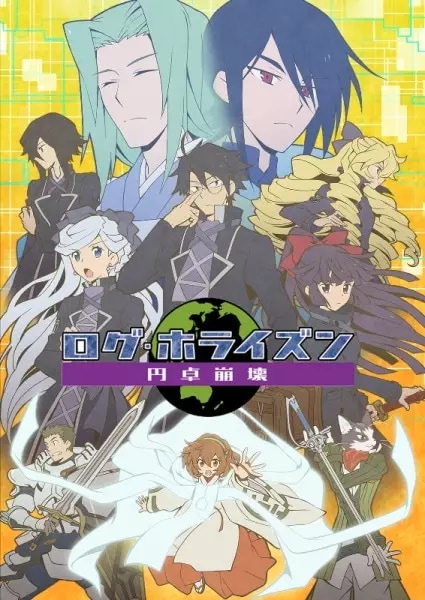
Third season of Log Horizon. It's been a year since Shiroe and his friends were trapped in Akiba due to the Catastrophe. Their forging of the Round Table has brought order and prosperity to its people. But fracturing political alliances and the constant menace of the Genius monsters threaten to destabilize all they've fought for and built. Can faith be restored and they persevere, or is its destruction truly inevitable? (Source: Funimation)
6.4/10
Average Review Score
45%
Recommend It
20
Reviews Worldwide
For years, the concept of a 3rd season of Log Horizon seemed like a pipe-dream. After the author went through a tumultuous tax-evasion case the series went on a hiatus and most of the momentum seemed to have been killed. Seasons 1 and 2 were extremely well received and offered a unique political and economic style approach to the isekai genre. When we got news that season 3 had been green-lit, I couldnât believe my eyes, but it immediately became my most anticipated sequel. Unfortunately, this third season of the beloved LN series failed to capture the glory of its first two seasons. All thesame themes that we know and love about Log Horizon are there, but they just donât feel the same. The first arc is a political power struggle thatâs pretty good, but nothing amazing. The second mini-arc focusing on Krusty was really what most fans of the series were looking forward to seeing adapted, and I do think that was a very enjoyable set of episodes, the peak of the season for sure. The finale arc was also pretty fun and gave some really nice shine to Minori, who has always been my favourite Log Horizon has always been a slow, dialogue driven show. But this season just felt 100x slower. I also felt that the quality of episodes was inconsistent. Episode 11 for example is amazing, definitely the best episode weâve had since season 2, but then the episode before that was pretty âmehâ. If I had to identify a reason as to why the season was so inconsistent, it would probably be because of the small amount of content that was available to adapt. As I mentioned earlier, the authorâs tax-evasion situation really put the series on hold and itâs only recently got back to being updated. Therefore, parts of this season were always going to be stretched and paced weirdly, which showed. Overall, the pacing issues are definitely noticeable in this season of Log Horizon. At times things seem to be dragging on forever. But, the highs of the season, such as Krusty and Minoriâs mini-arcs really were enjoyable to me and made me nostalgic of the first two seasons. The finale single handedly raised my score for the show. Hopefully, the series begins to get more consistent updates and we donât have to be left in limbo about a potential season 4 as long as we were for 3. If youâve seen the first two seasons and liked them, it goes without saying that you should watch the latest season, just be prepared for a drop in quality. Log Horizon season 3 gets 8 round tables out of 10.
A couple of years ago, I watched a YouTube video about Isaac Asimov and sociological storytelling. That video links a blog from Scientific American, âThe Real Reason Fans Hate The Last Season of Game of Thronesâ by Zeynep Tufekci, which posits that itâs not just bad storytelling âits because the storytelling style shifted away from sociological storytelling to focus solely on psychological storytelling. I have never actually read the blog until I watched the first episode of Log Horizon Season 3 And that is when it struck me: I may have found one thing that helped in giving people the feeling that Season 1 andSeason 2 hit differently. Season 1âs two starting arc focused heavily on the sociological side â or rather, the main cast, the adult cast as they say, are better suited to a more sociological framing. The youngling cast arc are more psychological in nature. Season 2 even at its best arcs was framed around the psychological storytelling side â yes, even the âadult castâ. Maybe it was not made to be told that way, but it was framed that way. Before we dive into it, we should start with definitions first because this might be confusing since these are not exactly literary classifications, just some shorthand that has been used by some people. Tufekci wrote: âIn sociological storytelling, the characters have personal stories and agency, of course, but those are also greatly shaped by institutions and events around them. The incentives for charactersâ behavior come noticeably from these external forces, too, and even strongly influence their inner life.â In what he calls psychological storytelling, the story is primarily about the characters as individuals and their internal struggles, change, and development. In sociological stories, the incentives of a political or social system helps determine the choices a character make. We can see an extremely basic example of âsociological storytellingâ in the Player Killer group who ambushed Shiroe, Naotsugu, and Akatsuki in the forest way back in the first couple of episodes of the first season. That PK group settled down and even created their own merchant stall. Was there some character defining revelation on that night they got beaten that taught them PK is bad? Maybe. Maybe not. What did happen though is that after Shiroeâs food revolution and creation of the Round Table, there was little incentive to be rogue player killers and a lot of incentives to be peaceful and engage in trade to make oneself rich and also not bored out of their minds. That is âsociological storytellingâ. Now I donât subscribe to such clear-cut divisions between two storytelling methods because stories arenât just one or the other in my personal experience; itâs a little bit of both, with one side being the more dominant over the other, a fluctuation that varies from story to story. Often, even in the same story, there are characters whose stories are sociological storytelling dominant and characters whose stories are psychological storytelling dominant. What I just want to do is establish the shorthands I will be using: âsociologicalâ and âpsychologicalâ. Now on to the review. There are three major arcs to this season, one too much for a 12 episode season. The first arc of the third season was poised to be a sociological dominant storytelling. It promises the fracture of the current status quo and the collapse of the Round Table. This is not a spoiler; this is a tagline the whole third season runs with. It both achieve and did not achieve its goals. The first arc was so confusingly and infuriatingly half foot in, half foot out of the status quo fracture. Season 2 set up future plot threads to shake the status quo and one of them, this one, resulted in much ado over nothing. For an arc with a sociological setup, there was only one sociological status quo change involving the People of the Land. It is not so much under-delivering on the premise of the collapse of the Round Table, although it was under-delivering, as it was postponing a reckoning and just leaving a thread for a future plot thread to be revisited. This arc does leave some truly potentially big plot threads open for future use and two big game mechanics related shenanigans. Enjoyment of this arc may hinge crucially on whether you enjoy speculations and theories. If you just want a solid enjoyable arc, this arc is not it chief. The worst part of the first arc was that it was rushed. It is okay to be just a setup arc. It is not okay to be a setup arc that was also rushed and not fully fleshed out. For a political game with potentially huge plot relevant stakes about the future of Akiba, there was so little intrigue and games. The âwinning tacticâ was a basic twist anybody could see coming with the wording of the rules of the major arc event. The real status quo change that affected this arc involves the Fairy Rings but the season does not explore it further. It is for the future seasons. And the collapse of the Round Table that could have been rooted in the sociological issues it failed to address was answered instead using a psychological factor: one character really taking on a firm stance on where she wants to be. If your enjoyment of Log Horizon resonated with my intro, this may not be an enjoyable season for you. The second and third arc of the season are psychological dominant storytelling. However, if your enjoyment of Log Horizon predicates on the gaming aspect or the character development aspect, then the third arc may be the arc for you. The second arc is nothing grand initially but it does introduce both the Moon in slightly more detail (well, glimpses more like) and a potentially game-changing mechanic with regards to the People of the Land. Knowing the author, it will be something that will come again in the future and it may not always be a helpful mechanic. For now, this mechanic and the Fairy Rings of the first arc serve only to positively help the characters we are rooting for. Hopefully, these setups pay off and the third arc gives me hope that it will. In the third arc, Log Horizon seemingly returns to a semblance of form by introducing an arc that can stand on its own and exploits a game mechanic to turn the tables on the players/adventurers. Log Horizon revels in using a new interpretation of previously introduced game mechanics to expand the details of its world. This is worldbuilding by extrapolating the many ways how a mechanic affects the world and it is peak Log Horizon in many ways. Log Horizon is back! And I cannot wait where the setups in this season take us next.
season one was great season 2 was great except for the entire part about the young kids absolute trash so boring. season 3 slow but enjoyable i love the complexity that the story telling and politics bring. the fighting when it happens is a bonus. I have absolutely no interest at all in the "kids part" of the storyline just delete it so the fact that barely anything happened and half the season was the kids in a raid was suuuuuuuuuper disappointing. I expect at some point the anime will pick up but yikes that could take a while. TLDR if you dont like thestory about the younger group of kids this season is gona suck for u.
A wonderful continuation of one of the best anime yet on the subject of lost other worlds and games, it ha style, great characters, fine and well done art and design and overall a joy to watch. There is no better show this season tho there are two other equally fine ones making this winter a good one for new anime. Some may find things missing that they wish for well there are plenty of other shows to enjoy. this one has its own path and follows it truly. enjoy and savor and i look forward to Season 4 which will surely come from thesuccess i see here in Japan for this fine work.Well done director-san and all staff. Yoshi
I don't write much reviews so this could just be considered a rant after finishing this. First off, I'll start with why I liked this series. Season 1 and 2 of Log Horizon was exceptionally interesting, how the characters found loopholes and created new concepts was based on their understanding of the game. It showed that players with experience and knowledge had an upper hand of this generic genre and it was really fun to watch. Even the parts where they try to connect it to a bigger plot related to the real world. This season I could not enjoy at all, I was excitedto see a season 3 but somewhere in the middle I lost interest so fast. Politics plot and the clashing of opinions in the round table were bearable, but everything after that felt like it was made just to make it reach 12 episodes. Don't get me wrong, adding politics into an anime does make it interesting but I feel like the execution was utter garbage. Based on the title, "destruction of the round table" you would think that the clans would be separated and gain individual influence for themselves. Yet, they tried to force the antagonist role onto one individual and ultimately destroyed the whole concept itself. It felt very forced and all the exciting elements of S1 and S2 did not show up at all. The foundation they laid out was never executed, where was the plot going? Nowhere. The whole story crashed, little to none character development (except for the children, which weren't the main characters of the show?), and don't get me started on the "last boss". The raid arc was painful to watch. The last 2 eps, I couldn't concentrate for more than 5 minutes without being bored to death. The last boss was really a disappointment, "Lose hope, the one you hold in veneration will not show up", I swear I have heard it say this line for more than 50 times and it gets old real quick. Before they started the fight, they decided to fight for themselves and not rely on their so called 'heroes'. Yet, they wanna weep about it when they get reminded of the heroes not coming. The last fight was such a letdown. This line. "we can't evade the purple attack, but we won't get caught if we are far enough?" How does that even work? First you show the villain damaging everyone in the room then you say "oh just take 2 steps back". The mechanics of it was so poorly executed I wanted to play it at 2x speed just to get it over with. TL:DR, mad cuz S3 was garbage, it had so much potential to grow. :'(