Links go to search results. Availability varies by region.
ăčăŒăăŒă«ă
12
TV
Finished Airing
Apr 7, 2021 to Jun 23, 2021
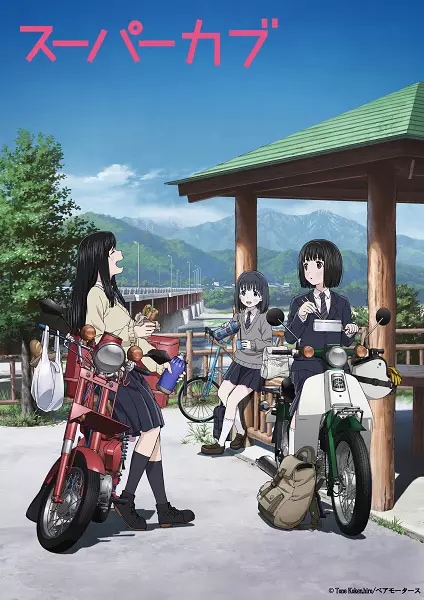
Koguma, a reserved second-year high school student, has nothingâno parents, hobbies, friends, or goals. On her way home one afternoon, she visits a vehicle shop in hopes of acquiring a motor scooter. With only enough money to make ends meet, she is disheartened by the price tags and prepares to turn back. However, as she is about to leave, the shop's owner offers her a pre-owned Honda Super Cub for ten thousand yen. Believing that the motorcycle will help brighten her monotonous world, she accepts the deal. As Koguma journeys through her town on small adventures with her Super Cub, she begins to build irreplaceable friendships and eagerly advances toward her new life. [Written by MAL Rewrite]
6.9/10
Average Review Score
60%
Recommend It
20
Reviews Worldwide
Watching Super Cub kind of feels like taking a bath. It's a bit plain and simple, yet never fails to soothe you even when you are having a bad time. Super Cub revolves around high school student Koguma, a timid and lonely girl who has never had anything that she could cherish. As Koguma herself describes, she has nothingâno parents, no hobbies, no friends, and no goals. However, after buying a pre-used Super Cub, she finally finds something that even she could enjoy. The anime chronicles the now adventurous days of Koguma's life, showcasing how vastly she has changed and continues to change. Super Cub seems likea simple CGDCT anime at first glance, and if you take the series at face value, it's likely that you won't change your opinion even after watching it. Most of the times, the characters of the anime simply travel around various places while riding their beloved scooter. Due to this and the seemingly unimaginative subject matter, it's easy to mistake Super Cub for another typical CGDCT, but in reality, there's far more to the show than just that. The narrative of Super Cub is fairly simple, but the themes that surround it are surprisingly thorough. Unlike most of its predecessors, Super Cub consistently maintains a solemn tone throughout its 12 episodes, which complements the themes that it tackles. That doesn't mean this is a sad show, though. Despite the serious undercurrent, Super Cub is actually very relaxing to watch; partly because the atmosphere is charmingly calm and quiet, and partly because most of the events that occur in the anime are intrinsically light-hearted and easy to follow. This casual approach to storytelling can be a double-edged sword, though. Super Cub follows a rather basic storyline and mostly relies on the characters to move the plot forward, which places some obvious limitations on the potential scenarios. Due to the apparent lack of "innovation", some parts of the show can feel a bit monotonous. There are other areas where the writing is very lackingâthe prime example of this being the first half of episode 11 which suffers because of the characters' unusually irrational actions, and the fact that Koguma's unusual background is never explored despite it being the introductory point of her character. Luckily, Super Cub balances this simplicity and makes up for its shortcomings with substantial characterization. The most compelling character of the anime is by far Koguma, the protagonist of the story who is a bit of an oddball. If you overlook the fact that her past is shrouded in mystery for no reason, she is surprisingly a very relatable character. Koguma's initial inability to find motivation in her life is something that resonates with me a lot, so seeing her gain confidence and create genuine friendships is uplifting to say the least. In a way, Super Cub is also a very encouraging show. The entire anime delivers a generally wholesome and optimistic message, and all of the main characters beautifully reflect that statement. Koguma, Reiko and Shiiâthey all have something they love from the bottom of their heart, and they will do pretty much anything to protect that. At first, that something was simply Super Cub (Alex Moulton bike for Shii), but as the three grow closer through interactions, they gradually forge a precious and long-lasting bond that they don't want to lose either. This is essentially what makes Super Cub such an encouraging experience. Seeing Koguma and the others wholeheartedly pursue their dreams honestly made me very motivated and electrified, something which very few shows can manage to do. Additionally, all of our main characters display a remarkable degree of realism and relatability, because of which I quickly found myself rooting for them. For the most part, the script of Super Cub is fittingly simple and straightforward, but the lines are crafted in a way such that they are subtle and meaningful. While there aren't a whole lot of dialogues or monologues in the show which is understandable), ones that are there mostly exist for a significant purpose; they are relevant to the contemporary events and provide insight into the characters' emotions. That said, some of the conversations about motorbikes can be a bit difficult to follow, especially if you are someone like me who has little to no knowledge of vehicles. But hey, this may be something bike enthusiasts can rave about. Suitably, Super Cub takes a bit minimalistic approach in terms of its soundtrack. There are quite a few scenes that are intentionally barren of music, which is a clever choice given how neatly it fits in with the calm ambience of the show. Most of the other scenes are fittingly accompanied with tranquil piano music. The sound effects are pretty good; they add more realism to the environment of the anime. The opening song titled "Mahou no Kaze" is alright, and the same could be said about the ending "Haru e no Dengon" which is sung by the voice actors of the main cast. Super Cub's animation is generally very beautiful, albeit the artstyle is a bit cutesy. Since the characters travel a lot in the anime, the scenic designs are rather diverse, memorable, and beautifully animated. Simple backgrounds such as school, shops, houses, etc. are nicely drawn as well, which has become an uncommon trait in anime nowadays. Occasionally, there are some odd uses of CGI, though (usually while the characters are riding or paddling), that don't really blend in with the background and are a little jarring to look at. Besides that, I honestly don't have much to complain about. It's a bit sad that Super Cub hasn't gained much popularityâit's arguably one of the better anime of this season in my opinion. Honestly, I didn't expect much going into the series, but it didn't take much time to win me over with its refreshingly calm nature. If you are a fan of the iyashikei subgenre, you will probably enjoy Super Cub as much as I did. And who knows, you might even become inclined to buy an actual Super Cub.
Click an episode to read its synopsis.
There are many anime these days telling stories about self-discoveries. I'm talking about a type of show where a protagonist would undergo a dramatic change after meeting new people, experiencing new events, and changes themselves. Super Cub's main protagonist Koguma is one such character, a lonely girl who takes up a Honda Super Cub and begins her own journey. Watching Super Cub is much more than just following a girl's life and her bike. Let's remember that Koguma is very lonely and starts out the show friendless with no income, friends, or even a future. A person like this would need to set a serious pathto build their own future if they even want to live in real life. Her physical appearance is also lacking and can be labeled as an 'invisible kid' in class. So in essence, Koguma is often in the background and it's up to herself to stand out. It's a lot harder than it sounds as she has a repressed personality, one who even has difficulty speaking openly to others. The first few episodes shows that Koguma's social skills needs improvement but deep at heart, she is a friendly person. She just lacks friends. Luckily, fate allow her to meet new people such as Reiko. In sharp contrast to Koguma, Reiko stands out in class as a beautiful girl and easily opens up to others. With a decent knowledge about Cubs, she forges a bond with Koguma through their similar interests. At first, Koguma also has trouble opening up to her but as the series verges on, they build a strong friendship. It's important to note that Koguma's own confidence begins to bloom after meeting Reiko. It's the type of relatable interaction you can discover in anime and in real life. Through their relationship, Koguma is able to interact with others and discover herself in ways she didn't even realize. With that in mind, you should know that Koguma and Reiko's character bond is among the most important in the show. Joining them is Shii Eniwa, a shy girl who meets both Koguma and Reiko with their shared interest in Cubs. Unlike Koguma however, she has a future planned out with a dream to open a bakery shop. Together, these three are the heart and soul of this slice of life anime. With every episode, we follow their everyday life adventures and discover what they learn. It's interesting to note that even as as slice of life, the anime contains a somber and lonely tone in the beginning of the anime. The first episode is especially noticable for the silence and slow pacing. It's almost an iconic representation of Koguma's personality, being alone in the world and without friends. After forging friendships with Reiko and Shii, the anime begins to brighten more and develops a more charming mood of elegance. As it should, Super Cub knows what it's doing when telling its stories. Even as as slice of life, the show has a deeper and real meaning when showing how lonely life can be when you have no friends or connections. Koguma's life is an example of what a person would be like in real life if they remained friendless. It's thanks to discovering herself and friends that she becomes much more confident. But I won't lie. Anime like this doesn't have much of a linear storytelling or deep plot. Even as a complex as seems at times, Super Cub remains fundamentally a simple slice of life show. Every episode shows what these characters goes through in the way we live our own lives. It's very straightforward and remains realistic throughout every episode. A prominent element included into this show is the Cubs, where we get to see how the show's bikes functions. Every episode features these bikes and in the beginning, we also get to see how they are maintained on and off the road. Unlike some anime about bikes, this show doesn't include sports competitions or rivalries. It's quite the opposite as the characters all share a common interest and it's what bought them together in the first place. Sometimes, the show may feel like an advertisment for selling a brand but deep down, Super Cub is relatively a simple show that anyone can enjoy If you got the impression of a somber show in the beginning, then I don't blame you. The first few episodes has a gloomy feel that represents Koguma's loneliness. In fact, I think the director and producers managed to capture the essence of her character through the show's unique artwork. It has a gray-like style of imagery and backgrounds stands out as static as her character moves with her bike. Koguma's character expressions is also noticable that undergoes changes with each episode. As I mentioned before, this anime adapts a character's self discovery and the artwork brings its themes to life. Almost every season, there's that one show where we tend to overlook and forget easily. Super Cub may not be a mainstream anime but I dare say this is a dark horse of 2021. By that definition, the series knew exactly what it had in mind and followed a roadmap to show what a character journey and self discovery is about. Add in the bikes and we have this unique slice of life, one that may be somber at first, but is a reality check of how people can adapt and change.
I don't have fancy words for anime reviews that make me sound smart and sophisticated so most of the time i don't leave any. I figure "I'm no expert" and move along. That is not the case with this one. You see... I am an expert. Due to health issues i spent over a decade housebound with no independence. I had no parents, no money, no friends or hobbies nor any ability to have goals for the future. My own "Days of nothingness." I couldn't afford the mobility scooters that cost thousands of dollars and aren't covered by insurance, so i was dependent on the occasionalouting where someone would push me in a wheelchair. Then... my life changed. I got a seated e-scooter. This anime captures so perfectly what it's like to experience that moment the sun peers over the horizon after a long seemingly endless night. The moment where something shifts just enough to allow your world to start expanding. Each thing learned or problem solved is a step further in that expansion. In the beginning, you're still a shut-in learning to become part of the world again, but there comes a moment where you cross over and you're part of the world but your experience of that is always sweetened by the fact that you were once a shut-in and you never forget the bravery and courage and luck, not to mention the growing pains it took for your life to make that little change that doens't just take you where you want to go but most importantly makes it possible for you to be someone who has places you want to go. This anime is rated: precious.
Looking for something to fill that Yuru Camp/Non-non Biyori sized hole in your heart? Look no further, Super Cub is your answer. Super Cub is not only arguably the best motor scooter ad ever made, itâs a damn good anime and is one of the hidden gems of a loaded season. I watch everything every season, so despite having no expectations for Super Cub, I went in with an open mind. From episode one, I was blown away by just how mesmerising this series is. Itâs such a simple concept. Girl with no friends or family going through depression decides to try out a Super Cubscooter. Falls in love with riding a scooter and uses it to explore her prefecture. Yet, Super Cubâs quality lies within its simplicity. Reikoâs inner development is paralleled by the literal development of her scooter. As it grows, so does she. Itâs a really beautiful metaphor that keeps the show grounded, yet impactful. Just like Yuru Camp and other CGDCT shows, thereâs not a whole lot of plot going on. While there are some recurring plot-lines, overall the series aims to showcase the charactersâ development through their daily activities. This should not come as a surprise, as this is the CGDCT norm. I really was shocked by how much I came to like this show. While Yuru Camp interested me with camping and outdoors-y activities, Iâm not a scooter or motorcycle person to really care about that. Yet, I found myself drawn to Super Cub due to its loveable characters and their growth. By 4-5 episodes in, I was really concerned for the MC and just wanted the best for her. One of the more interesting aspects of the show for me was the use of CGI. For a slice of life show, I thought the series relied a little heavily on it at times. For really simple shots like characters riding their scooters or even just walking around, the studio used CGI. Personally, I donât think CGI ever looks good, so thatâs one downside artistically. Other than that, I loved the art style and the more muted colour palette used by the studio. They make use of this as part of the narrative, by having the first episode start off really gray and then gradually adding more colours into subsequent episodes. A perfect example of colour as a storytelling technique as it reflects the MCs interior struggles. The character designs themselves are actually quite unique and I must say I like them quite a bit. Make no mistake, while I used Yuru Camp as an introductory comparison, Super Cub is very much its own show, and one very much worth watching. If you enjoy slice of life or CGDCT shows, this is a must watch. It brings all the traditional aspects together in a rather unique way. Certainly one of the most memorable shows of Spring 2021. Super Cub gets 9 oil changes out of 10.
It goes without saying that not everyone will be able to like, let alone understand the appeal of Super Cub. This is due in large part because of how it deviates from the Slice of Life/CGDCT formula, which more times than not tends to have a happy-go-lucky protagonist or cast of characters with a positive, optimistic outlook on life. Koguma, the protagonist of Super Cub, is anything but âhappy-go-luckyâ, stating rather bleakly that "I have no parents. No money either. Nor do I have any hobbies, friends, or goals for the future.â While some may proclaim that this is a betrayal of what is tobe expected from the genre, Super Cub explores a side of SOL that is rarely ever explored: nihilism. Koguma, for the lack of a better description, is as relatable as anime protagonists come for a major demographic that is underrepresented in the SOL genre. If anything, people are more likely to share the same sympathies as Koguma than they would with Yui Hirasawa from K-ON! or Nadeshiko from Yuru Camp. Koguma, much like the rest of us, isnât granted a harem of friends to drink tea or go camping with, but instead seeks a temporary but just as fulfilling comfort with the namesake of the show: a Honda Super Cub. Without going into detail about the themes of materialism or Kogumaâs interactions with the other characters as the show progresses, Super Cub explores the more existential feelings of life that are rarely seen in the SOL medium. If youâre expecting a protagonist or cast of characters whoâll provide a form of escapism with blinding optimism, Iâm sorry to say that youâll be disappointed. To put it bluntly, Super Cub is as realistic as fiction gets, and not just when it comes to SOL. Many viewers of the SOL genre will be disappointed that this show doesnât reinforce the same overused tropes of cheerfulness, friendship, and a positive view on life that can be found in 95% of anime within the genre. So just in case I havenât made my point clear enough, if youâre expecting this show to be like Yuru Camp, K-ON!, or other shows within the SOL genre, turn away while you still can. Super Cub is a show that anyone can enjoy, but to understand the themes and meaning of this animated Honda commercial, you really have to relate to its protagonist, Koguma. If youâre someone who can sympathize with her quote that was brought up earlier, which speaks in part for many members of the Millennial or Zoomer generation, I would strongly recommend giving this anime a watch. Itâs not going to provide a positive outlook on life, at least explicitly, nor is it likely to grant you a window of escapism from the day-to-day troubles of reality. What Super Cub will do once you watch all 12 episodes though, as you follow Koguma throughout her journey, is provide the much-needed representation and social commentary that is lacking in the genre. Above all else, Super Cub explores one out of many perspectives of the meaning of oneâs self and life, which I feel is as âslice of lifeâ as the SOL genre gets.