Links go to search results. Availability varies by region.
ćĽćŹć˛ć˛Ą2020
10
ONA
Finished Airing
Jul 9, 2020
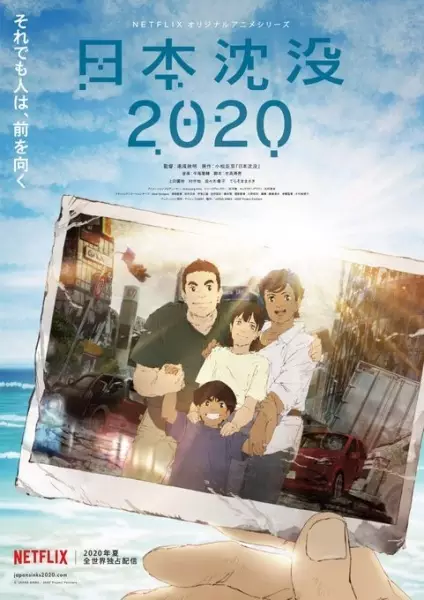
The Mutou family leads a peaceful life: Kouichirou works at a construction site and his wife Mari is returning from an overseas trip. Their daughter Ayumu has just finished her track practice while their son Gou is playing video games at home. However, life as they know it is flipped upside down when a calamitous earthquake strikes the entire Japanese archipelagoâobliterating the face of the country in an instant. With society crumbling around them and their nation gradually sinking into the ocean, the Mutou family must band together to survive the catastrophe. Treading the near-apocalyptic setting, they struggle not only to stay alive, but also to learn the difficulty of coping with loss. [Written by MAL Rewrite]
4.7/10
Average Review Score
35%
Recommend It
20
Reviews Worldwide
Itâs fitting how this show is called âJapan Sinksâ, as my expectations for Japanâs animation industry seemed to sink lower and lower with each passing minute that I viewed this train-wreck. Japan Sinks is undeniably a poor work, but what truly prompted me to fully mull over this cesspool of incompetence and juvenility was how fascinatingly abysmal it truly was. This isnât your run-of-the-mill Netflix-commissioned anime schlock, this is a show created under the eyes of the renowned Masaaki Yuasa. Science SARU (Masaakiâs own studio), was at the helm here, and while theyâve been fairly hit-or-miss over the past year or so, they also created Devilman:Crybaby back in 2018, a show that shook the earth (pun intended) with its experimental flare and masterful use of controlled chaos. Many -- including myself -- had high hopes for a similar situation in which culture would be completely shocked, hopefully creating a work as impactful and year-defining as that was. Everything has been lining up to its release, I mean, 2020 is the year of endless possibilities for controlled chaos -- just look out your window. A show as dark in tone as Devilman coupled with a more realistic edge released in a year of actual disasters was clearly a recipe for true success. It would be foolish to wonder âwhat could go wrong?â in a year that continually proves to be the antithesis of that philosophy, but the answer to that sadly lined up with the established pattern of our beloved 2020. In Japan Sinks, we follow a family throughout a period of seemingly-endless suffering, all triggered by a few gargantuan earthquakes. Thereâs not much to say about this family, because theyâre more so based off of the archetypal roles of a modern family, rather than being real people with genuine motivations and personality traits. This issue is also extended to the numerous friends they meet along the way. Because of this, none of the characters in this character-based show feel real. In a story in which Japan literally sinks, itâs unsurprising that thereâs going to be loads of death and destruction, but the way the characters handle all of these incidents proves to be frustratingly alien. Nobody seems to care all that much when a man is blown to bits by a bomb or when a child is brutally crushed by a falling building: they instead tend to grieve for a few minutes, then move on with their comedic-hijinks directly after to lighten the mood. The pace isnât so rapid and dizzying to send a suffocatingly-bleak message along the lines of: âthis is your new reality, people perish like that!, and after that itâs time to move on.â No, far from it. It feels more like the creators were too apprehensive around the idea of fully committing to a despairing atmosphere, so they instead opted for the most extreme version of tonal-whiplash possible. After the first few episodes, weâre clearly shown that these non-characters will be killed off out of nowhere for the sake of creating a dramatic cliffhanger at the end of each episode, so why should the viewer care? They have no unique identities to assume outside of their most basic character descriptors, (Mom. Daughter. E-boy.) and their passings arenât convincingly grieved over by the rest of the cast, so why should we care? The characters are already bad enough, but even worse are the situations that theyâre thrust into. Japan Sinks has to be one of the only one-cour (actually, even less!) shows Iâve seen in which multiple episodes felt like complete filler. Itâs hard to understand what the show was going for in the middle portion in which the cast find themselves entangled in a cult, but these episodes completely eradicated any suspension-of-disbelief I attempted to latch onto at first. The show transforms from what seems to be an intimate family drama to a total cluster of tonally-conflicting concepts, truly making you wonder what the show wanted to say. The fact that the most famous YouTuber in all of Japan decides to ride around with this random family after a chance encounter is inadvertently hilarious in and of itself, but are we truly supposed to take that seriously? How much in this show is supposed to be taken seriously at all? The realistic edge I presumed it would have seemed to be absent following the first few episodes, as fantastical elements such as spiritual mediums who can speak to the dead as well as a travel YouTuber a la Logan Paul having a kind heart began to ruin any sense of thematic consistency it started with. Visually, itâs a nightmare. It hurts to say that seeing as Yuasa is one of the most visually-inventive directors in the medium, but itâs the sad truth here. The character designs are fairly basic, yet they rarely seemed to stay on-model, and this was increasingly apparent within the middle segment of the show. Itâs clear that a large part of it was outsourced to places it shouldnât have been, but keyframes are constantly missing nonetheless, which leads to scenes that should be able to deliver some kind of impact falling flat and often airing on the side of hilarity. Thereâs moments where Yuasa clearly did have his influence with his strange use of color and anatomical fluidity, but theyâre few and far between. The messy transitions from these visual peaks back down to the horrific rest of the show harshly broke immersion, and had me promptly recall, âoh, Iâm watching Pyeon-Gang again,â every single time. The bitter feeling of squandered potential truly stung in those moments. Thereâs an awful, awful choice made regarding the voice-acting throughout the entirety of this catastrophe that made this one of the most unintentionally hilarious shows Iâve seen in a long time. In a moment of pure genius during production, someone realized in order to truly immerse the viewer in the cultural-diversity of the cast, (seeing as it follows the aftermath of the 2020 Olympics), characters should shout out miscellaneous phrases in English...usually at the worst possible times. At least this aspect made this train-wreck somewhat entertaining. The son whoâs not a fan of Japan and its culture compensates for his disdain by often randomly blurting out Engrish jumbles of words in the middle of horrific moments, like âWhat the! That is cwazy! No!â anytime anything that could be considered âshockingâ occurred. The absolute peak of the show was when he unironically said âlive, love, laugh!â like a 50 year old white woman in the midst of what shouldâve been a scene of pure emotional catharsis. After that, I was simply waiting for him to screech âbazinga!â after stumbling upon a mutilated corpse. Thereâs also a stereotypical caricature of an American man who claims to be British despite there being no indication of such being the case, (Well, I mean, I wouldnât be opposed to distancing myself from America in 2020 either, so I donât necessarily donât blame him), and he also speaks in this way, but at least it fits his identity? Ok, well thatâs actually no excuse, because he cried out âhasta la vista baby!â during what the show wanted to be a dramatic climax, and I think I lost a solid number of brain cells upon hearing that. Really, what am I supposed to feel throughout all of this? All of these choices are constantly at odds with a story that shouldâve fully embraced its tragic circumstances. These are all separate pieces of a puzzle that simply donât fit together. The vision of the creators is present, but what message does this show actually want to deliver to its audience? During its conclusion, it takes a pseudo-nationalist stance, campaigning for the idea of loving your country no matter what and endlessly supporting them in times of need. Ok. Interesting message (if not somewhat tone-deaf to reality), but where was it for the first eight episodes? Not to mention this message feels shoehorned-in in the most banal, trite way imaginable. The characters are too one-note to get attached to, the timing of both the comedic and disastrous moments are both so poor that they blend in together eventually, and the âinspirational storyâ backing it all up that should have mitigated a number of these glaring flaws is too flawed in and of itself to take seriously. The fascination that captivated me around this show wasnât from a source of awe like when pondering Devilman, but instead came from seeing something that had so many things going for it disregard all of that and fail in such a calamitous way. If I, a highly-sensitive crybaby found myself laughing at what shouldâve been devilishly disturbing, then you know they messed up on this one. Honestly, the real 2020 disaster was this show's existence itself.
Click an episode to read its synopsis.
Japan Sinks 2020 - An anime about "earthquakes" that start to happen in an uncontrolled way, and can sink Japan, in this dangerous scenario, we accompany a family that so much finds a way to survive in the face of all this chaos. The first thing worth mentioning about "Japan Sinks 2020" is how earthquakes are not the main focus of the anime. The notable presence is in the huge variety of subjects discussed all the time about JAPAN. If you came expecting an anime "about natural disasters" you were probably disappointed, but this is not the anime's fault, it's about the expectation created about thegenre. Yes, it is an anime about natural disasters, and the events have consequences, but they serve more as an ornament for the central events of the anime, so much so that the first earthquake happens very quickly (of course, with your degree of concern, put itâs still an earthquake), but throughout the series, whatâs really worth noting is how the main characters fit into the allegory that the anime builds. It already begins VERY characteristic when we see both a different hue coming from the central characters, the design as a whole that tends to stand out from the vast majority, nothing has been chosen here. This is all going to be related to the 2020 Olympics that would happen this year, but later on I will get to that. The form and decisions made by the characters are somewhat doubtful, the anime almost always manages to surprise by anticipating the thoughts of the viewer. For example, (Spoiler) the character Kouichirou (Father of the family) who gives the impression that he can be killed by a wild boar, and it does not happen, only to then die by a mine / bomb buried in the ground. This anime at all times shows tiny choices, which can always have big consequences, and this is the anime's way of holding us until the end of the series. Already a feature that differentiates it from other animes in this regard, but that does not mean that because it is different, it is good, it could go very wrong, if the anime did not also focus on the visual factor of the world that it created, that if it does in real life, but with its own established rules. The destruction events are very random and with huge consequences, just like the decisions made by the characters, so everything is very connected, and yes, everything works right from what was established. Masaaki Yuasa's direction, as always incredible, decides to give a greater brightness to the space where his events occur, and not so much in his characters. Here, different from other of his animations, he focuses more on the amplitude of his scenarios, which besides being very beautiful and detailed, are also frightening and distressing due to the representation of disaster so well achieved. The way the anime is framed reminds me a little "Tokyo Magnitude 8.0", that we also have its simplest characters and maybe less animated than it should, but it also focuses on the immensity of the destruction, it creates this real feeling very well that we are in that medium, and tries as hard as possible to represent the situation passed by the characters. But like everything else I said, about anime creating its own reality to talk about its main subject, which is not natural disasters, this is also reflected in scenarios and animation. The scenarios are real, but it is a reality within Japan Sinks 2020, it is not meant to be a situation of almost 100% real destruction as in Tokyo Magnitude 8.0, the goal is to help further illustrate events and decisions made by the characters, and the consequences of their acts that are often extreme. This would be the year of the Olympics if it weren't for the pandemic problem, and the anime was originally scheduled to be released in October, even closer to the event. We know that an Olympics brings together different people from all over the world, people of different skin, religions, beliefs and everything that our world can provide with differences. Usually, people who do not live in their country of origin tend to create very vague judgments about that place that does not live together, and a lot of anime may reinforce this stereotype, but "Japan Sinks 2020" does it differently. Firstly, showing problems that are not widely discussed in other countries, but that actually exist anywhere in the world, as generous actions that are also not very expected, sometimes even cause distrust, showing foreigners in a strange and sometimes strange way. different, but reliable, friendly and heroic too. At all times we can see the anime breaking some stereotypes and using them in its allegory. The goal is to try to generate a concept very close to: "we are not just what the media shows, or how our image is sold, we have the same problems and quality as you and yet we have our culture". The anime shows a little resistance all the time of the older and more conservative there are people from other countries. The whole world would meet in the country this year, so this is perhaps an anime more aimed at the "Japanese" audience, both foreign characters and other naturalized Japanese but of mixed races tend to be generous with others, and sometimes the opposite too. (Spoiler) The old man at the convenience store who hates foreigners, spectacular scene from Episode 9 where they rhyme and the last minutes of the Final Episode are almost like a "summary" that kind of helps to understand a little of this problematic created by anime in a genius way. That's why I said at the beginning of the review that the earthquake is not the main focus of the series, but what it does between the lines that is so great. "Japan Sinks 2020" is an anime with such important moral importance, and above all, making total sense within the world established by itself where it manages to reach its social criticism very well.
I know all the young little nihilists populating the internet are good about recognizing and rejecting fundamentally anachronistic media, but I think we should just trade in those red pills for some black pills, and instead of merely scoffing at religion, patriotism, and chivalry, we should proceed to disregard all traditional values altogether, because from where a suicidal sociopath like me is sitting, such values do nothing but dilute the theming of creative works with trite morals and utterly squander a storyâs ability to build interesting characters divorced from insipid archetypes or deliver unique messages free from the influence of unwritten orthodoxy. Nuances aside, JapanSinks 2020 is not only written for amateur viewers, but is directed by an amateur creator, Pyeonggang Heo, who decided to cope with his obvious lack of experience with some truly artless cinema. While the phrase âamateurâ can hold many connotations depending on who youâre asking, I personally try my best to use it as modest critique toward aspiring artists with clear potential as opposed to a condescending insult toward the incompetent. From Akira Amemiya to Rie Matsumoto, thereâs so many young directors I can name who have more passion and creativity than even they know what to do with, and while anyone could watch something like Kyousou Giga or SSSS.Gridman and jadedly dismiss either one as an unorganized mess, I canât help but see them as the creative output of geniuses who are simply unpolished in their craft. Unfortunately, I see none of this in Japan Sinks 2020. Heoâs direction feels as book-learned as that of an undergraduate film student, and just in case you had any hopeful reservations regarding Yuasaâs possible involvement, the self-seriousness of the show is absolutely suffocating in a way he would never let fly in a work he had any intimate involvement with whatsoever. A story about barely surviving a cataclysmic natural disaster isnât the kind of story youâd want or expect to be particularly comedic or upbeat, donât get me wrong, but thereâs still something to be said about letting your audience have a chance to breath with anything other than aimless, themeless, tensionless meandering which populates the entirety of this show not drowned in drama or spent in an obviously destructive cult which the characters shouldâve left immediately. This isnât a high-minded masterpiece like Texhnolyze which actively seeks to smother its viewers in a dreadful tone, itâs simply an obtuse melodrama like Anohana which ascribes to the filmmaking philosophy of Michael Bay, figuring if one explosion gets the theatre roaring, then surely two and a half hours of nonstop explosions canât possibly get boring! Our melodramatic cast of teenagers, whilst more than justified in their stress, are the same pouting anime characters youâd see in any PG rated drama, and while their struggles are certainly relatable, the manner in which they are relatable is so vast, they come across as being completely manufactured. Desperately worrying for the well being of your family, of your fellow man, of your country, of the direction of your life and aspirations following this catastrophe, or the post traumatic stress any human would undergo. Every problem which any cast member struggles with over the course of the show is so sympathetic as to be utterly impersonal. Youâd have to be as much of a fundamental outlier as me to not find such basic humanistic concerns upsetting, and should you actually be as numb to humanity as I am? Then nothing which this story and its characters present to you with teary eyes and ruffled clothes will mean anything to you, and the entire experience will come across as banal normie cry porn at best, and disingenuous mass-market emotional manipulation at worst. My abrasive wordage aside, this show obviously had nothing but good intentions, just little creative means to make me care. If generic melodrama can put you in tears so long as those on screen have the same waterworks streaming down their faces as you do, then you may find this to be surprisingly engaging, but alas, I could not. The problem with seating your narrativeâs emotional ties to its audience in genre staples like family and love is when you garner the attention of a misfit whoâs estranged from even these basic moral and spiritual values, theyâre left with nothing to latch onto. But, hey, thatâs a me problem. If I wanted to more fairly criticize Japan Sinks 2020 in a fashion which wasnât so intensely personal, I could look any direction and be faced with a frankly atrocious animation production. Despite how much I prayed for this nightmare to never find its way into reality, this show ended up being comparable to Hands off the Motion Pictures Club, a show filled to the brim with flat gradients, shadeless coloration, misshapen modeling, progressively barren background art, and clunky animation all-around, all of which was obviously the result of the crunched scheduling they likely put upon themselves by over-producing an unequivocally beautiful first episode, only Japan Sinks 2020 doesnât even have that gorgeous debut as an excuse and somehow gets even worse, not even touching the visual fidelity of Science SARUâs previous Netflix commission, Devilman: Crybaby, which itself was blemished with a fair amount of inconsistency and cost-cutting as well. And speaking of which, Kensuke Ushio returned to compose the score, and while his sound will always be beautiful, it is becoming very repetitive, and Iâd challenge anyone to try and differentiate any ambient track herein from those of Koe no Katachi or Liz and the Blue Bird, standouts notwithstanding. I expected inconsistency to be the name of the game, but what I didnât expect was having to witness these enthusiasts of personalized artistic stylization resort to some truly garish CGI in absence of the time or manpower to consistently hand-draw vehicles, nor did I expect this show to be worth calling ugly as early as episode three. While I appreciate the fact this show continues Masaaki Yuasa and Eunyoung Choiâs commitment to experimental animation direction, even if I think the messy line-work is a bit much, I think the design team on this project ultimately took it one step too far with the character designs, and more specifically, the facial designs. Variation in facial animation has always been a thing in the industry, and whether someone like Hiroyuki Okiura is using the unshakable attention to detail and unmatched production values of Production IG to do it with photorealistic blinking and lip definition, or whether Yuasa himself is unapologetically taking advantage of the awesomely exaggerated Taiyo Matsumoto art style over the course of his entire career, variation in facial structures is nothing new. However, no matter how famous the creative lead, sometimes a misguided, poorly practiced, or downright bad production will leave such experimentation without unanimous praise. Thatâs right, if you thought Isao Takahataâs dimples in Only Yesterday were jarring, then nothing in this world will prepare you for the hideous yet hilarious neck rolls in Japan Sinks 2020. Needless to say, it is quite difficult to take the sorrows of these characters seriously when you can barely even look them in the eyes without their neck lines distracting you from the matters at hand, and even if you find this critique to be as dumb as it sounds, the atrocious animation will still do your immersion no favors. I mean, clunky key animation, missing in-betweens, and off-model artwork made even an attempted rape scene laughable. Thrashing the production values is righteous enough when theyâre this pitiful, but I fully recognize my thematic complaints are as personal as my cinematic complaints are unfair. Japan Sinks 2020 will leave you with the same uninspired emotions any other half-baked disaster movie ever has, but the fact it can leave you with any feelings at all speaks to its passable writing at the very least, and while the essence of the story will tread no new water, conclude in an astronomically corny and outlandish fashion I didnât even afford myself time to discuss, and even alienate you should you be as desensitized to human nature as I am, it will still pander to the average viewerâs average emotions and make them feel something as opposed to nothing. While Yuasaâs position as Chief Director gets more and more set in stone in the face of his recently announced departure from Science SARU, director Heo isnât inept, and while youâll certainly be missing the cinematography of the master, his understudy here wonât disappoint anyone with adjusted expectations. And while the neck rolls, by far the stupidest of my critique, will remain as disgusting and discomforting to look at as the rest of the show already is, they will also remain completely in the eye of the beholder. This story of a family fighting against an unfair fate is your typical headline of tragedy not complicated by a villain or thematic challenge which is only newsworthy thanks to its ability to reassure the bleeding-heart normies they can continue to live on without feeling the guilt of the unfortunate, so if the fact the cast is, indeed, a picturesque and politically correct family of four is enough to invest you in their artless narrative despite the fact theyâre cardboard cutouts who are scribbled onto the screen uglier than roadkill, then just know you have my jealousy. "Normieness is next to godliness," as a wise man once said, and Iâm going straight to hell. Thank you for reading.
(Might contain minor spoilers) From the other reviews, it seems as if everyone either loves this and considers this a masterpiece or hates it and considers a piece of trash. Therefore I'm gonna try judging this series as fair as I can. Earthquakes are scary. The Japanese society, culture, and many other aspects of the nation has been affected by Japan throughout the history and creation of Japan. This anime is another disaster earthquake anime in which Japan gets hit by a giant earthquake and many, many people die. At least that's what it seems like it was like until it turned into some crackheads appearing everyepisode. Story - 3/10 Nothing worse than a badly done, over the top unrealistic story which they tried making realistic. All of Japan sinking? At least try keeping it realistic to a certain point! On the other hand, this anime does a mediocre/good job of portraying survivor's guilt and other psychological problems. I am going to pretend I never saw it become a fiery bullsh** because it seems as if I can't put negatives down. Art - 6/10 Drawing and animating is really hard work. The art in this anime would have been really good if done correctly. You could see parts from time to time in the art and animation that was off. Animating building collapsing and humans getting crushed and twisted realistically is also very hard, making the animation more clunky and off. Sound - 5/10 I'm not an expert in this stuff but I'm gonna try. The intro was average... just average. The sound effects were good. Everything was fine except one thing. English. I don't know about you but personally I hate it when the English is pronounced really badly over and over and over. Character - 4/10 They honestly did a pretty good job with the characters. Or maybe since everything else was so bad, it looked better. Either way, they did a great job portraying the psychological effects on the characters. Enjoyment - 5/10 Did I enjoy it? The answer is Yesen't. Overall - 4/10 Honestly, the story might have been good and they could have done better. Do I recommend this anime? I honestly recommend the first 3 or 4 episodes. Then the series just burned, got mauled, feel off a cliff, hit a landmine, blown to shreds, and then yea you get the point.
I cannot believe what I witnessed. I stumbled upon the trailer of this anime on YouTube and thought it looked fantastic. I was really looking forward to it but now I can honestly say this was my biggest disappointment after watching any piece of media in my life. Yes, it was that horrid. The funny thing is the first two episodes were quite good with great animation and art. Then, it just went south after that to a point where I was just lost for words. The tonal shift was so abrupt and jarring. The quality of animation dipped so badly some scenes looked like itwas animated at 5 fps. Characters never had any real development and deaths were completely pointless and for shock value. The worst part of all of this is that many scenes were unintentionally funny. The broken engrish between characters on top of an abrupt tonal shift made this a funny watch indeed. I wouldâve given this a higher score had it keep that kind unintentional satirical humor but no the show switched gears dragged itself towards the finish line. It was like a train wreck, a bad car crash that you canât help but look despite being absolutely repulsed by it. It was a miserable experience.