Links go to search results. Availability varies by region.
Cop Craft
COP CRAFT [コップクラフト]
6.73(55K votes)
Ranked #6785Popularity #2011
episodes
12
Type
TV
Status
Finished Airing
Aired
Jul 9, 2019 to Oct 1, 2019
Studios:Millepensee
ActionFantasyMystery
Synopsis
Fifteen years ago, a hyperspace gate appeared in the middle of the Pacific Ocean, connecting Earth to a strange world filled with fairies and monsters. The city of San-Teresa became a home for over two million of these otherworldly visitors. Unfortunately, the population boom also brought its fair share of problems—drugs, prostitution, and trafficking. To combat the rampant crime lurking in the city's shadows, a new department was established in the San-Teresa Metropolitan Police.
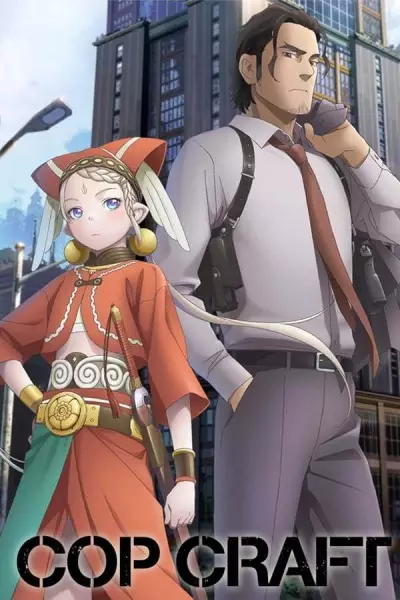
Former JSDF soldier Kei Matoba is one of the best cops that the department has to offer, despite his inclination to occasionally bend the rules. After a fairy trafficking case goes wrong, Kei loses Rick Fury, his friend and partner of four years, setting him on a quest for vengeance. To help him with the case, the department pairs him with Tilarna Exedilika, a noble of the Farbani Kingdom. As one of the Knights of Mirvor, her duty is to rescue the noble fairy that Kei encountered during his last case. Despite his distaste for non-humans, he accepts the arrangement at the request of his superiors. Now, the unlikely duo must come together and overcome their differences in order to return the missing fairy to her country and avenge the death of Kei's partner.
[Written by MAL Rewrite]
128,353 Members
Worth Watching? — Global Verdict
6.5/10
Average Review Score
45%
Recommend It
20
Reviews Worldwide
International Reviews
ExemplarCayman
Recommended
10
“The password is seven letters, listen carefully. It starts with F, then U, then C, K…” Ever seen a buddy cop film? This is a love letter to the subgenre, and it turns out, buddy cop plus moe is a match made in heaven. The key premise of a buddy cop film is forcing two very different people to work together - anime allows these people to be as different as a gruff veteran detective and a space elf loli jedi. They’re supposed to bicker - so we get angry loli pouts and a despairing guy too old for this shit. “Fish out of water” -we get treated to a curious inquisitive daughteru interacting with the modern world. None of that, of course, gets in the way of the pure cop drama goodness - you still get all the “getting shot two days before retirement”, “investigation leading to a strip club” and “the FBI rolling in and taking over” that your heart desires.
Juxtaposition is also a hell of a drug. Sword and sorcery stuff happening against the backdrop of the criminal underbelly of Not Los Angeles makes up for a unique, eye-catching setting. The world-building, the characters, the comedy and dialogue writing are quality stuff you can expect from Gatoh Shoji (Full Metal Panic and Amagi Brilliant Park creator). Special mention for a western setting that actually feels western.
On the story front - despite being an adaptation of a novel series, it isn’t just “stuff happens until it doesn’t.'' It feels like an actual story that begins with the first episode and ends with the last. The last two episodes work as the culmination of every major arc that happened up until that point.
There is an unavoidable fact that the animation is very lacking due to a blatantly tight budget (which in practical terms means the deficit of manpower), but the show does an amazing job of working around its limitations with clever editing/shot composition. In fact, this series is a great illustration of the fact that animation/sakuga (the amount of movement, the number of frames per second, etc) has very little to do with how good a show actually looks. For example, there is one scene of a car crossing over the hill, and it’s literally a cutout of the car moving against a static background, with the front wheels just going up into the skies. It looks bizarre… until the scene changes and you see the car’s suspension violently smashing down from a jump. The front wheels did, in fact, go into the skies, what you saw is what happened in-universe. A tiny studio pulling every trick in the book to make up for the lack of resources is to be commended, especially when the very same season we can see an inverse of that with Fire Force - the cream-of-the-crop animator talent being wasted on terrible visual direction.
Even bigger flaw is a bizarre episode structure of the first arc which makes it look like a movie that just got cut into 25 minute chunks - a culmination of an entire arc happens basically in a pre-credits scene, while the rest of the episode starts a new arc. Again, it appears to be a consequence of simply not having enough animators and being forced to do 2.25 episodes out of what was supposed to be 3.
Anyway, what I am getting at, why is a show with such flaws is rated 10? It isn’t, I’d take out 0,1 points for bad animation and 0,3 points for the episode structure, so the final score of the show would be 9.6/10. There is no way in hell I’d feel justified subtracting more because neither random junky frames, nor the other thing detract in a meaningful way from story, dialogues, humor and ideas that together make up 96% of my enjoyment of this show. If other people are incapable of appreciating those things and resort to focusing on other aspects, such as production values - it’s their loss.
9.6/10 for “unique, thought-provoking and entertaining piece of fiction.”
Episodes (12)
Filler Recap
Click an episode to read its synopsis.
Community Discussion
173 found helpfulSep 30, 2019
AltoRoark
Recommended
9
I don’t consider myself easy to impress, and harbor a considerable amount of skepticism when it comes to anime in particular. The state of the industry and Japan’s own questionable ethics more often than not lead to incomplete adaptations, overreliance on tropes, tendency to pander, and plenty other undesirable practices in the medium. Suffice to say, anime as a medium has yet to evolve to the level of films or literature, and as such I choose to keep my expectations rather low with every coming season. Sure, you have your hard-hitters like Vinland Saga and Demon Slayer, but then there’s the expected boatload of isekai, orseries with potential but fall into mediocrity--for me and plenty of others, To the Abandoned Sacred Beasts was one such show. And even then, the hard-hitters often are not something I personally find enthralling, since they tend to fall under specific tropes palatable to very young teenagers; or as we call them, shounen. Don’t get me wrong, I’m onboard with that every once in a while, but there’s only so much of it I can take before a medium of seemingly endless potential and imagination begins to feel surprisingly safe and sterile.
To be clear, I’m not trying to diss anime as a whole. Plenty other mediums have their own problems, especially in their infancy period. Anime is a medium I love and support, and as such I’m all too aware of the drawbacks I’ve come to expect while digging my way through the depths in search of anime that are true standouts. And it’s because of this that the level of enjoyment I had watching Cop Craft is truly precious. If you’re like me, you’ve certainly had reservations or mixed feelings about Cop Craft’s reveal, particularly in the context of Japan’s ever-so-uncomfortable liking for small girls. Some of those same people went on to be pleasantly surprised, just like I was, at its first episode. As for me alone, I kept watching to where it would become one of my most cherished anime in recent memory.
My love for crime-focused shows and films akin to Lethal Weapon, The Sopranos, and the like had sold me on the show within minutes. After some more time of watching, I was then engrossed by the character chemistry and splendid dialogue. And with wild supernatural elements, fantastical concepts, and bizarre sci-fi all welded cohesively into a thrilling buddy-cop drama, Cop Craft stands as another showcase of what anime as a medium, compared to live-action, is truly capable of pulling off.
Before I go any further, however, I must address the elephant in the room. Yes, this show has serious problems with its production, which many people are aware of due to the damaging effect it's had on animation and pacing. Cop Craft's overall quality undeniably suffers as a result, but I feel like people should know the whole context of why this show is the way it is. I’ll go much deeper into this later on, but the basic story is this: this show was made with the passion of a driven and talented team in a very small studio with budget constraints and scheduling issues; a project far too ambitious for what the team is capable of doing. As a result, the animation quality is a horribly mixed bag, but this should not be attributed to laziness of the staff, as tempting as that is. As pressing of a topic as this is, I want to save it for later in this review. As of now I want to make the point that poor production is a tragic reality of what is otherwise a fantastic experience.
The dynamic between Kei Matoba and Tilarna Exedilika is the essence of what makes Cop Craft such a worthwhile experience. The incessant passive-aggressive remarks between the grouchy nihilistic cop and the spoiled, ill-tempered young rookie is one of few aspects of their interplay that makes their first several hours together so immediately riveting. Not only is their interplay superbly written, varied, and sometimes comedic, they’re highly fleshed out characters whose relationship evolves from a bitter incompatibility to a dubious comradery. In general, Kei is someone who doesn’t get along with people, which is understandable since he’s one of the last people you’d ever want to hang out with. He’s a callous and largely inconsiderate man, making rude or judgemental comments towards people regularly with no signs of remorse. But he is not without a heart, as much as he tries to hide that fact from Tilarna. A man of few words, his sparse acts of kindness and courtesy are often dubious, with his true intentions left concealed in his own frigid mist of a personality. Even his most notable good deed, rescuing and adopting a stray cat after pursuing a perp, is reasoned with the idea of it being selfish instead of altruistic, saying he wouldn’t be able to sleep at night if he left the cat there.
While ostensibly uncaring, Kei clearly has humanity as shown in his outrage over the death of his partner, Rick (which, by the way, happens within the first few minutes of the first episode, so no spoilers there), and the fact that he views his chief, Jack Roth, as a father figure. Likewise, it’s made obvious that in spite of his bitterness towards Tilarna, he does grow to care for her. His dialogue with her later on walks a fine line, making it uncertain which of his lines are playful, complementary, sarcastic, or tough love. In general, Kei appeals to the part of us that wants to be spared of the nonsense and get the task out of the way. His cold attitude is admittedly hard to tolerate at points, especially when he shows no gratitude whatsoever for when Tilarna saves his life, but that’s just part of what makes him so endearing. Kei and Tilarna’s rough interactions are what makes their sparse cases of growing closer all the more meaningful.
Tilarna is always aiming to uphold her dignity and her moral code, making sure to never stray from either goal, excluding particular circumstances. Yet she’s also prudish and naive compared to Kei, often used to great comedic effect and is crucial to her development in much later arcs. Similar to Kei, her abrasiveness towards him isn’t exactly reflective of her actual feelings. More than anything, she just wants to feel respected by Kei and not be treated like a burden, which is an understandable frustration for anyone having to work with the man for so long. With such an entertaining banter between well-realized characters whose bond develops with every few episodes, topped with brilliant dialogue, Kei and Tilarna end up being one of the most compelling duos in anime I’ve ever had the pleasure of following.
On another note, it’s strange and disappointing to see the stereotypical depiction of gay characters that plagues Japanese media appear in Cop Craft--by which I’m referring to Tony. Funnily enough, I initially approved of his character as I assumed *he* was a transgender woman. Because transphobia is just as much of a problem in Japan, my first impression of Tony was a pleasant surprise. And I was let down upon finding out that Tony isn’t a transgender, but a very effeminite and flamboyant gay man. Generally, his appearance and character alone isn’t all that big of a deal. But it does get a lot more off-putting with that one scene of Tony subconsciously feeling up a teenager only to be stopped by Aleks; and wiping drool off of his face as an added bonus. Although Tony is portrayed more tastefully than the likes of Puri Puri Prisoner from One Punch Man, they're both still sad reminders of how long of a way Japan as yet to go in terms of proper LGBT representation in media.
This is a real shame since Tony is generally a good character apart from this, alongside his detective buddy Aleksandr, both of which are a treat to watch thanks to Cop Craft’s sheer aptitude with dialogue and comedy. And then there’s police chief Bill Zimmer, who is just about the closest to an anime Samuel L. Jackson since Afro Samurai. Although his spitting rage and humorous lines are a joy to witness, and with how respectable he was in speaking favorably of Tilarna towards a racist subordinate, Zimmer isn’t one of the more fleshed out characters of the show, unlike the doctor and ex-girlfriend of Kei, Cecil Epps. While it’s shocking to see someone actually put up with Kei’s rudeness, and even remain friends with the man, the main draw of Cecil’s character is how easily she befriends Tilarna. The friendship between the two feels genuine, with Cecil consoling Tilarna about difficult tasks and personal woes. Their playful dialogue about Kei also leads to one of the funniest moments I’ve ever seen in an anime. A lesser writer would simply use Cecil as a plot device or to flesh out Kei’s history, but she’s given the humanity needed to make her truly feel like a person with a physical presence in the overall narrative. With such an engaging main duo alongside almost equally great side characters, Cop Craft boasts one of the strongest casts of characters of any anime I’ve seen in recent memory.
This setup for a buddy cop show is hardly a unique one, especially to those well-acquainted with Western TV and films, but it does stand out in the anime medium among its contemporaries at the very least. And besides, execution is everything. And Cop Craft’s execution in its story is as great as one could ever hope.
As we’re welcomed to the fictional city of San Teresa, we venture into the unknown as well as the familiar. Conflict is abundant here as any Earth-dweller would expect a city to be, but the presence of the Semaani race brings forth a plethora of surprises among the crime scenes and detective cases, imparting a fantastical and arcane flavor to the adventure rarely seen in a police drama. With roughly 15 years of interaction with humans, the Semanians and their world is still largely alien to its human neighbors, with many discoveries to be made about them and what bizarre occurrences and fields of magic, or ‘Latena’ as it’s called, could be at play. To be a policeman in San Teresa means to expect the unexpected, a mantra that would benefit the viewer just as well.
Of course, constantly throwing surprises at the viewer runs the risk of making the world feel incohesive and random, but these ideas are well-developed and properly built up to thanks to some impeccable world-building and (for the most part) remarkable pacing. The true depths of Semaani reveals itself little by little in the human world, pacing out these discoveries in such a way that provides intrigue and tension in a near-perfect manner. It also helps that Semanian arts have a logical presence as opposed to simple magic. Aside from the admittedly far-fetched “strong feelings create Latena” thing, practices and contraptions of Semanians operate on rules of their own, much like our technology. Perhaps the author, Shoji Gatou, was given a freebie by age-old concepts in Western fantasy when creating the Semanian race, but this world is so fleshed out to where it’s given an identity of its own. Semanians even have their own language, which when spoken sounds remarkably elegant and refined, unlike numerous other fictional languages such as Parseltongue of Harry Potter which sounds vague and almost like gibberish. To show just how refined this language is, aside from apparently being learnable, it’s worth considering Tilarna’s uttering of “Boliceman.” This is made to be an endearing quirk, but it also gives the implication that the Semaani language likely lacks a ‘p’ sound, with ‘b’ as a common substitute.
After some time, the role of exploring a foreign world is passed over to Tilarna. Here we have the pleasure of watching Tilarna trying to cope with and adapt to facets of our planet Earth--specifically, pornography and vehicles of transportation--all bundled into an episode’s worth of hilarity, enticing chaos, and a grace of character bonding at the very end. It’s easily one of the most enjoyable episodes of anything in recent memory, as well as the few cases of anime humor making me laugh out loud. This is an episode that lingers in my memory continually, which is a very high honor to hold.
A prominent facet of the setting is how the world of Semaani interacts with that of Earth. The many fields of Latena originating from Semaani unsurprisingly can accomplish certain tasks in a way that human technology cannot. And surprisingly, the opposite is also true. Coding, hacking, firearms, automobiles, photography, and night vision goggles are what the world of Semaani lacks, and play an equally vital role in snuffing out the perpetrator.
Obviously the aptitude of your arsenal means little if the one using it lacks competence, as evident in many shounen and seinen that get away with artificially stretching out their arcs by having characters fumble around or arbitrarily bringing forth a greater power to stall the action. Cop Craft is the exact opposite case. The policemen of San Teresa are intelligent and capable as policemen are expected to be, using any strategy or asset at their disposal to gain the upper hand. I think anyone could remember a time they watched or read a piece of media, getting aggravated at characters for not seeing the obvious solution or making moronic decisions leading to their downfall, taking you out of the experience. Cop Craft almost never stumbles upon this, and crimes are dealt with efficiently through the use of Latena magic, Earth technology, and competent storytelling.
That said, as praiseworthy as this is, it comes with a cost: conflicts in Cop Craft are dealt with relatively fast, and arcs can feel frustratingly brief and even anticlimactic as a result. Some could frame all this as a negative, but it ultimately depends on what you look for in an action show. I for one couldn’t be happier with how Cop Craft chose to execute this. The overall narrative of Cop Craft is akin to that of Cowboy Bebop and Samurai Champloo, and not just with its Western influences. It spends a brief enough time on an idea so as to throw a new one on the table. Cop Craft never gives anything a chance to get boring (excluding the fan-hated episode 8). Each arc is expounded upon enough to be satisfying in its own right, with the resolution feeling authentic and plausible rather than climactic.
Apart from human tech and Latena, the interaction between Semanians and humans leaves sociological effects that are intriguing and applicable to reality. Heavy politics are in full force as would be expected in a city of mixed races, and Cop Craft is incredibly bold and proficient with this direction, especially for an anime--granted, it involves a fictional race, but the point stands. Multiple points of view regarding the presence of Semanians are touched upon and come into play during a much later arc, lending more weight and authenticity to an already fascinating world. A simple biased aversion towards Semanians or humans for what they are is obviously just racism, but one character in particular has a far more elaborate and justified viewpoint that comes from a similar place, whose quote is written below:
“Coexistence, peace...just lies idealists tell. Earthlings and aliens can’t ever get along. We must keep apart.”
“Some of them are getting by just fine!”
“And their ability to adapt is what scares me. Look at their strength, their vitality; in three generations they’ll usurp us and rule the Earth! The invasion will be over before anyone notices. Yes, not even the invaders are aware of what they’re doing. The world needs to wake up and see just how dangerous these Semanians are.”
If you’ve watched Cop Craft up to a certain point, you definitely know who these quotes are from, and where this exchange transpires. For spoiler reasons, I won’t say, but the crux of the matter is the ideology of what is said here. This is clearly in line with most conservative views regarding immigration; a fear that there is more to lose than to gain, and results can be disastrous. Obviously there are different viewpoints on immigration and I don’t wish to have this sort of discussion at the moment when it comes to real life issues, but Cop Craft is commendable in bringing this predicament to light in a setting where it fits like a glove.
For a 12-episode season, it would be wrong of me to say that these issues are explored to their fullest, but that’s all the more reason to consider the ongoing status of the source material, and to acknowledge that the anime only covers a portion of what is, or will be, in the full story. If anything, this is a positive way of looking at the studio’s size. Since their budget is so small, there’s a relatively greater chance of Cop Craft making a good profit, thus hopefully leading to a second season being made.
What’s really admirable in regards to the studio’s size is just how well the team could do in spite of such meager production. While Cop Craft’s animation is limited, the overall aesthetic is a feast for the eyes. While the show lacks in frames, it excels through well-directed framing and glorious attention to detail. The open nocturnal suburbs are coated in a softly-lit patch of neon colors, contrasting with the grim and subdued tones of the alleyways where conflict is sure to erupt. Bloom lighting is applied constantly in places to accentuate the bright urban life. Most indoor areas are rendered in modest colors where bloom lighting is sparingly used, creating a calm environment where the brutality of police work is given a rest. With such limited resources, the team has made a show that is not only pretty to look at, but with effective theming for different environments. All of this is to say, Cop Craft is one of those cases where the art is superb, but the animation is lacking--hopefully the anime community will finally know the difference between the two.
When it comes to Cop Craft’s visuals, there’s no getting by without mentioning the action scenes, which are of particularly low quality past the second episode. This is where the studio’s size is made all too clear. However, lack of animation isn’t exactly the only thing holding back the action scenes, and this is an area where people are most inclined to blame the director. So here’s the way I see it: is the director, Shin Itagaki, at fault for Cop Craft’s shoddy action scenes?
My answer is: yes and no.
Shin Itagaki is an enigma of the anime industry. You might construe that as a word of praise but that’s literally what he is. Shin Itagaki is the director of shows like Basquash!, Ben-To, Teekyuu, and of course the infamous Berserk 2016/17. On top of being a director, Itagaki is also a freelance animator, sometimes doing his own work during production, and an extreme perfectionist. When discussing the animation quality of Cop Craft, an important thing to consider is that Shin Itagaki has a rather unusual way of directing fight scenes, putting more emphasis on impact than spatial awareness. This sort of style favors very dynamic camera angles and frames of impact, constantly breaking the 180-degree rule of cinema which all results in an action scene that feels visceral yet lacks sense of place. Cop Craft is consistently animated in 3s, and most of its action scenes are animated similarly to the likes of Studio Trigger, with limited frames, heavy smearing, and very dynamic pose-to-pose action facilitating impact in a way that fluidity cannot. However, with such wild storyboarding and constant breaking of the 180-degree rule, higher frames are a must for the scene to flow properly, and Cop Craft is proof enough of how much this can backfire.
To see just how well Itagaki’s action can turn out, look no further than Ben-To. Fight scenes in Ben-To, as well as certain ones in Cop Craft, are evident of just how much increased frames make the difference with this style, creating enough flow between scenes that would otherwise end up disorienting and drain the scene of its tension. With the current state Millepensee is in, it seems most wise to ditch such strenuous methods and stick to basic, conventional fight choreography to make do with what little frames there are to work with. In the case of Cop Craft, this would have been the better approach in plenty of cases. Many scenes would have worked much better with the same amount of frames but different storyboards, but it seems that Itagaki is hellbent on sticking with his vision no matter what, making demands that the studio just isn’t able to meet.
This really hurts the anime in the long run, and it’s incredibly tragic. But there’s a reason I’m not putting so much scrutiny on this front. And it’s that I fully expect the DVD releases to amend this. Itagaki is clearly a very ambitious, passionate individual, and along with his team would love to take any opportunity to make this project exactly how they wanted to. For some episodes it’s not a huge deal if not many changes are made, but as for episodes 3, 5, and 10, Millepensee would be insane to not give them a makeover when the chance comes. Those episodes are infamous for containing some of the worst action in the series, with episode 3 commonly remembered as one of the most shocking dips in quality an anime has ever suffered. But I have faith in Itagaki and all of Millepensee, and wish them nothing but the best.
Cop Craft, you deserve better. You deserved a bigger budget, you deserved better management, you deserve more attention, you deserve more support, and above all things else, you deserve a second season. This fascinating world, these splendid characters, the intriguing storytelling; Cop Craft is a project that is clearly too ambitious for what the studio is actually capable of, and it’s my earnest wish that the BDs improve upon this significantly, as it’s their one chance at polishing this product into what they truly wanted it to be. The heart is there, the team is competent, and the tremendous quality of the source material is for us to experience on a small screen. While I hardly ever excuse poor production, this is a team that deserves our sympathy and support. The story of Cop Craft feels like it’s only just begun, and I’m fully on board with what more adventures await our duo, as well as how much higher the studio will go from what is their biggest project yet.
85 found helpfulSep 30, 2019
Stark700
Not Recommended
3
Cop Craft made me question what happens if Blood Blockade Battlefront had a brother or sister. While they share some of resemblance of its other from their base premise, Cop Craft certainly stands out to be its own series. Taking place in a gritty underworld setting, this is the type of show I didn’t know if I wanted to see again. Are you a fan of storytelling with a buddy cop style formula? If so, Cop Craft will probably be a treat with the amount of character dynamics. There’s certain level of character interactions that will get you comfortable with its first opening episodes. Make nomistake though, Cop Craft itself is meant to be taken seriously although its execution of humor can be questionable. I’ll get to that later but the first two episodes hit the right marks to make a favorable impression. We meet main protagonists Kei and Tilarnia after a strange encounter and it sets the tone of the main story. This pair stands out as the most important character duo as they tackle on the challenges in this dark metropolis.
One of the more fascinating element of the show revolves around the strange premise itself. The story blends fiction and reality together in what should be described as a police procedural drama. In the present timeline, Teresa City is filled with crime. It’s like the type of city where you’ll see chaos erupting from weapon trafficking, drugs, prostitution, and even murder. Based on the light novel of the same name, some of these concepts doesn’t entirely surprise me. Shoji Gatoh (author of Full Metal Panic!) has been known to craft work with police drama. Cop Craft relies heavily on its insider ideas and main character duo. Unfortunately, the main storytelling itself is very loose and sometimes, I find that it lacks a general purpose. By the time this show almost concluded, I pretty much accepted the fact that the plot wasn’t going to improve. At least we have the main characters carrying this anime, right?
Kei is a human cop. He fights the good fight in this dark city while Tilarnia is the sidekick and partner. Imagine a strange alternate world where Full Metal Panic’s Sousuke and Chidori became detectives. Somehow, I picture Kei and Tilarnia in similar roles. There’s no doubt the pair has character chemistry despite their vastly contrasting differences. Humorous gags also occur between the two although over time, it feels more and more redundant than being actual funny. Coming from different backgrounds, there’s a mediocre appeal about both characters individually. It seems the pair’s character dynamics work best when they are together. When apart, I quickly find myself losing interest in what they’re doing. In some episodes, the anime also likes to poke fun of Tilarnia’s weak common sense and alludes to adult humor. The lack of character development doesn’t help either to get invested into either character. It’s a shame really since both Kei and Tilarnia could have been what holds this anime together. When you begin to lose hope for its main cast, there’s not much room for improvement. Unfortunately, most of the side characters hold little relevance. I honestly can’t even remember most of their names out of the top of my head.
Putting the drawbacks aside, I do think Cop Craft had a wealth of ideas to be something special. The main problem is the execution. It’s difficult to get invested into the plot when the mood changes from frame to frame nearly every episode. The plot structure also has a ‘monster of the week’ like format where some sort of crime needs to be solved. It does reinforce the dark side of the city with its underworld activities. But when the show lacks a general purpose, it quickly wears itself out and loses significance. The character development is almost non-existent with every episode spitting out random events rather than a concentrated focus. With each progressing episode, I felt like the show loses more of its relevance. The anime is only 12 episodes and according to some content I’ve heard, there’s pacing issues too. Coming in as an anime only viewer, it’s a major disappointment from what Cop Craft could have been.
However, that’s not the end of its problems. Even on a technical level, Cop Craft suffers production issues in later episodes. From an early example (episode 3), you can tell that the animation quality drops with lackluster battle sequences. It doesn’t help the anime also has to rely on some rather strange fan service at times to do the talking. Somehow, Tilurna’s character ends up becoming a source of animal jokes in one particular episode. Desperate as it seems, it’s the type of fan service that basically shows it has nothing else to say. Luckily, the world setting itself has a decent amount of creativity. The dark metropolis contains a degree of realism despite the fantasy content. It reminds me of Los Angeles with a wealth of cultural ideas and social problems.
Ah Cop Craft. I wish I read the light novels beforehand so I limited my expectations. The first two episodes made a strong impression but quickly begins to wear itself out with its charm. The main character duo delivers popcorn entertainment but it doesn’t manage to fully make the show itself entertaining. If you don’t mind the cheeky humor or bland storytelling, then this may turn out to be a treat for you. For me personally, this is one of those anime that lost steam and never looked back.
77 found helpfulSep 30, 2019
TheDeedsOfMen
Mixed FeelingsWell-written
6
"It's the American dream, you know!" If a gate opened to a magical fantasy land, which would be the likely outcome? A) You are summoned as a hero and must defeat Generic Evil Overlord #21,576 with the help of your newly found godlike powers and a harem of people desperate for your love and affection. B) The people from both sides engage in awkward coexistence and cultural exchange, featuring racism, guns, pornography, drugs, theft, prostitution, humanoid trafficking, terrorism, rampant consumerism, and cats. By the very nature of their premises, cultural commentary and social issues should be natural topics for isekai series. After all, isekai is supposed to be abouttravelling to other worlds, and the obvious thing to do would be gawking at the different cultures like a confused tourist. However, very often these issues are neglected almost entirely, with series instead choosing to focus on arbitrary godlike superpowers and harems the size of a phone book. This begs the question: why bother with the whole "transported to another world" setup in the first place if all you are doing is the same old story of harem antics and generic villains? Even though it has its faults as well and is far from perfect, Cop Craft at least manages to avoid that fate.
In this case, I suppose "reverse isekai" is more accurate because the story takes place on good old Earth. Kei and Tilarna, who are from different worlds, team up to form a cop duo who fight crime in a city populated by both Semanians and humans (or the Doreany, as called by the Semanians). The city is on an island in the Pacific that was originally Semanian soil and was transported to Earth by a gate that happened to open between the planets.
I wouldn't mind seeing reverse isekai more often because it is refreshing to have Earth as the setting once in a while. This show seems to agree because it goes ham on Earth culture. The dialogue showcases cultural references from Earth and can often be witty. It is worth noting that both species consist of individuals with clearly different personalities and interests. The Semanians are definitely not a Planet of the Hats, a species with a single defining feature shared by almost all members. They are simply individual people, just like humans. Many of the Semanians have adapted to life on Earth remarkably well. If it wasn't for their slightly different appearance, I would often have a hard time telling them apart from humans. Tilarna, who is a noble and only recently arrived, initially seems out of touch with not only humans but many other Semanians as well.
Another pop quiz. If visitors from another planet arrived on Earth, what would they be after:
A) natural resources,
B) humans as manual slave labor, or
C) porn magazines.
If your answer was C), congrats. Apparently, even the boring, low-quality ones are worth a fortune in a fantasy world that has almost no photos. Incidentally, the shops on Earth are allegedly too well stocked in general, making it difficult to choose items.
"Do you know the name of Earth's God? 'Money.' Simplest thing in the world, right? I've converted to its religion, too."
A Semanian big-time criminal says so.
Given that the protagonists are in the police, particular attention is given to due process. There are rights and obligations that protect citizens from arbitrary police action but also make it more difficult to convict criminals, even when it is obvious that they are guilty. Tilarna, the alleged knight of justice, criticizes this pretty frequently. "Is this the justice of your world?" and so on. Search warrants? What are those? Beating up suspects? Just another day at the office.
Racial tensions are fairly often portrayed in isekai series, but this time they are more eerily similar to our current political discourse. A hard-right politician, Tourte, has a central message of "live by human rules or go home" and he wants to deport Semanian criminals (after revoking their citizenship, I suppose) in large numbers because many of them are involved in crime. One of his ads is saying "San Teresa first," and his supporters are holding signs of "ET, go home." Another character argues that the Semanians are "invading" Earth without even knowing it themselves simply by staying here. Meanwhile, calling the Semanians "aliens" is considered racist in some circles. We also get the "all the options on the ballot are terrible" view on democracy because the other candidates have other problems.
However, some of the attempts at ethical and political arguments are left unfinished. For instance, at one point Tilarna is arguing with Tourte and saying that the island was originally Semanian soil, while Tourte argues that it is now on Earth, so it belongs to humans. A more effective argument against Tourte would be that it is up to chance who is born where and thus which people are deported. It would force Tourte to argue harder, but Tilarna does not present it. There is also a lot of untapped potential when it comes to the social issues here, and I feel like the screentime could have been used a bit more effectively to highlight them in a more varied way. The ending also tries to downplay how volatile the political situation is, which seems like an unjustified 180-degree turn from some of the previous episodes.
The show also has other problems. One thing I'd prefer is a more cohesive plot. Some of the cases are not directly linked to the main plot. There is still some thematic cohesion and connected details, but tying the different cases together more strongly would definitely be a good idea. I can barely remember some of the one-episode antagonists. The worst offender by far is a sequence of 1.5 episodes (episode 8 and a part of 9) that focuses on generic slapstick comedy and some particularly off-putting fanservice scenes related to a particular scifi plot device and a cat. It is based on a freak accident and is dragged on for far too long. It contributes basically nothing to the main plot or the themes either. This part felt so out of place that I feel like I have to specifically mention it. Fanservice is far from rare in anime, but this was far more awkward than usually.
Kei and Tilarna often have good banter going on about Earth culture and related topics. Their chemistry is pretty solid and also varied enough, though Tilarna's excessive Tsundere side can be hit-or-miss in some scenes. Some of the side characters such as the other cops and the informant guy also get some witty lines, but many of them are still starved for screentime. Meanwhile, the main villain gets barely any screentime or development and is left at a somewhat generic level. If you forgot that he existed and got an "oh right, that guy" moment near the end, I won't blame you. The side villains somehow get even less, and I can't even remember their names.
Additional world-building wouldn't hurt, for Earth but especially for the Semanian planet. Could we at least step on Semanian soil (not including the island) a few times and see first-hand how they live? It is not as though isekai must take place in only one world. We learn some aspects of Semanian society by second-hand testimony, but that is no substitute for witnessing the place for ourselves. Apparently, there was initially a war between the two sides before they could reach an agreement on the land, but the war is only mentioned in passing.
The opening song is called "Paradise City" with pretty catchy music. The video features a superficially cheerful city full of neon lights, but it quickly becomes obvious that it is full of gunfights, people armed with guns in general, and also car chases, explosions, etc. A true paradise, alright. This is the kind of naming I would use too: sarcasm.
The ending song, "Connected," has Tilarna singing while the video highlights the mixed, blurred culture that has been born out of the coexistence of the two species. In this instance, some of the artwork is pretty great, such as some backgrounds of the city and the rain effects.
The stylistic choices are a mixed bag. I like some of them. San Teresa looks like a fairly typical large city on Earth: not very posh but not a total slum either, sometimes with additional neon lights. It showcases both the prettier and uglier parts of life on Earth. Notably, the cars look old-school and a bit of thought must have gone into their designs. On the other hand, there is occasionally awkward-looking fanservice that does not quite fit in the situation. Usually it is within tolerable bounds, but the filler episode I mentioned is a serious offender, and I am not saying so lightly.
What stands out is that the quality of animation for the series overall is clearly lacking. Aside from lazy-looking motion sometimes, it sometimes get so bad that the characters are speaking with a still frame on-screen. No mouths moving or anything. Some action scenes also end up looking like a series of still slides, kind of a PowerPoint presentation. I can only guess that the studio must have been running on a shoestring budget, forced to cut corners whenever even remotely possible.
The setting has great potential. They should simply focus even more on its strengths. Do more world-building, visit the other planet as well, showcase the different cultural aspects more. Don't try to brush aside a tense political situation that you hyped up just before. Have the main villain actually appear onscreen now and then. Avoid PowerPoint slideshows. And drop the worst of the filler and the most off-putting fanservice, of course. I really wanted to like this show more because the setting is great and the dialogue is witty sometimes, but then I remember some of the questionable parts, and my heart sinks.
I wish they were allowed to build a McDonald's on the Semanian planet. I think it would do well.
16 found helpfulSep 30, 2019
maxiburger
Not Recommended
3
Don't bother if you're a fan of the Buddy Cop genre, police procedurals, good world building, or even above-mediocre animation or directing. The only positive quality Cop Craft has to offer is its unoriginal premise. But if that's what got you interested in checking it out, you'll be just as satisfied from reading the plot synopsis above as you would be from watching 12 episodes of this garbage. Let's go through this one complaint at a time: The show is trying to talk about racism and xenophobia by introducing a fantasy race of immigrants from a fantasy world, which is a cheap but efficient trick. The maintarget audience of Japan doesn't have to feel alienated by having to consider the issues of groups they might not feel too inclined towards, any minority group can't feel personally offended if their issues aren't portrayed accurately, nobody can allege malice if the show references real life events incorrectly, and most importantly: anime fans by default are more interested in the fantasy aspect. However, if you're introducing a whole parallel universe of elves and fairies, you need to establish what exists in that universe and what doesn't. And over the course of 12 episodes, there hasn't been a single scene that shows us even the glimpse of a fantasy landscape. We just have to accept that magic is real now, and that it pops up as a macguffin or deus ex machina whenever it's convenient. The only other information we can infer from the plot is that the fantasy world is very traditional and antiquated and that there's no modern science or technology. That's pretty much it. There's no political dealings with the fantasy world, there's hardly any fantasy world characters besides Tilarna with more than two lines of dialogue to tell us more about their home, I personally don't even find the aliens to look all that different from Earthlings (although maybe that's due to the wonky artstyle). Neither does the show put any particular effort into portraying the influence of the fantasy immigrants on Earth's society. All that's really changed after the dimensional portal opened is that this one fictional Pacific island became a bigger metropolitan hub due to the population increase. Sure, most episodic crimes make use of some magic gimmick (a fairy bomb, vampires, a mind-switching artifact, magic memory alloy...), but those gimmicks are usually a big surprise for Tilarna as well, so they're not representative of the fantasy world's culture. Besides the main antagonist's necromancy ability, no other gimmick had any lasting effect on the plot or the setting, even though you could build an entire show around just one of them.
In summary, the introduction of the fantasy aspect is ultimately just laziness as it never exceeds its function of a shorthand for racism.
The biggest reason why all the potential was wasted is because they decided to make the show too episodic instead of focusing on the one big case. I'm not sure how faithfully the anime adaptation follows the novel, but episodes 4-10 feel like bad fillers. Hell, even the recurring side characters do nothing but waste precious time that could've been used for more meaningful interactions between Tilarna and Kei, or at least to build up the villain to have more of an impact.
On that note, it was a stupid decision to off Elbaji as early as the 3rd episode for the surprise reveal that Zelada was behind everything all along, but then postpone the confrontation with him until the final episode. Both Zelada and Elbaji had potentially interesting (conflicting even!) motivations that could've been explored in a better way than just dumping everything into a stereotypical villain speech right before their respective defeats. Their involvement in the mayoral election and their conspirators in the police should've offered plenty more opportunities to fill the time, without having to add 1½ episodes about Tilarna turning into a cat and having to chase after a garbage truck. At least, if you MUST include inconsequential episodes, give us more insight into the main characters. For instance showing us for a whole episode how Tilarna struggles with everyday life on Earth, like not understanding mobile phones, cars, food, the value of money - that kinda thing (the first episode did this to a somewhat satisfying degree with Kei). Because for a Fish Out of the Water character, she's way too capable and savvy.
This also ruins the buddy cop dynamic she should've had with Kei. In order to make a Buddy Cop duo work, both character need to have clashing personalities (eg. Young Reckless vs. Old Cautious, or Goofball vs By-the-Books Sourpuss). But aside from one being a middle aged dude and the other being a foreigner loli, Kei and Tilarna are too similar. Both are proud, grumpy workaholics who just want to get the job done, insult each other with dry quips, and get into arguments when one was being too reckless when the other one wasn't prepared for it in that particular moment (they alternate between who does it). As the daughter of a noble family who got her knight's rank by birthright, and considering that she does develop something of a crush for Kei over the course of the show anyway, it wouldn't have been too farfetched to make her more innocently naive, clumsy and inexperienced - in short a stereotypical loli character - rather than easily irritated and overall bitchy. Her cute character design certainly would've suggested that the show was gonna go for the Newbie vs. Jaded clash. In terms of character development, Tilarna could've grown more mature from overcoming shocking experiences like murder, prostitution, drugs, etc. while Kei could've softened a bit and rediscovered his compassion - as you'd expect from someone who in the 1st episode couldn't even be assed to tell his deceased partner's wife about her husband's death in person.
I'll admit that there were a few jokes here and there that summoned 5% of a chuckle out of me, but I laughed WAY more at some of the now infamous animation goofs that would look more fitting in the studio's previous show Teekyu, a no-budget 3-minute nonsense comedy. The visuals really didn't do Range Murata's original artwork justice. If the writing and directing was solid enough, this would've been excusable. But when neither the story nor the visuals are convincing, I can only strongly recommend against committing yourself to the whole series.
Spend your time with better shows!