Links go to search results. Availability varies by region.
çćœăźç§ćŠăăŻăăăăăŒă«
26
OVA
Finished Airing
Dec 10, 1986 to Jun 3, 1987
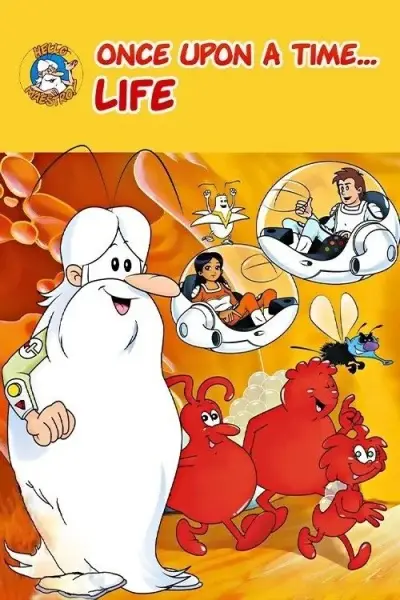
The series "Once Upon a Time... Life" teaches about the human body and about the different systems in it with the same characters from the other "Once Upon a Time" seasons. "The good Characters" represent the body's defense mechanisms, whereas "the bad Characters" represent the viruses and bacteria that threaten to attack the human body. (Source: Wikipedia)
7.0/10
Average Review Score
67%
Recommend It
3
Reviews Worldwide
Seimei no Kagaku: Micro Patrol or Il était une fois la vie (once upon a time... life) Is a French Japanese Animation financed by several EU countries (Belgium, Switzerland, Spain, Holland) and Canada. It belongs to the label "Il était une fois" ("once upon a time") created by Albert Barillé. Under his works, all the series are dedicated to entertain and educate the children in a very well balanced way, with good story line and funny or interesting characters. It was made a at a time producers wished the children to have a good time but also to make them think and learn in theframework of an anime with good artistic value. Very nice combination...this was a success : Millions of children have seen it in the 1980s and 1990s. This one which is the third installment is about the human biology. Main human body functions are addressed all in good mix of science, suspense, comical situations, and original design. All biological entities are anthropomorphized and all the characters of the previous series (about history and space) reprised their role but as neurons, lymphocytes, virus and so on...! Even the wise Maestro is here (guess where?)! The heroes are often the protectors of the body, they even kept their science fiction clothes from the previous series. Story of each episode is really enjoyable and can raise interest among children and adult viewers alike with a good amount of suspense. Regarding the biological aspect, as a medical doctor myself, I confirm that they explain in a very clear and entertaining way all the essential mechanisms from immunity, to organs functions, brain role, reproduction and even genetics. Everything is scientifically sounds and relevant. Drawing involved artists from Japan and France. Animation done by the Eiken studios (Testujin 28) is definitely dated but still satisfactory and fluid enough for viewing in the 21th century. Character are simply designed but are easily recognizable and relatable. In 2016, all the series benefit from a complete remastered version (color palette improvement, drawing error correction, sounds remaster) to fit the 1080p enhanced edition. Music is classical and its very agreeable and rich melodies fits perfectly the action and are very well composed by Michel Legrand, a famous multi Oscars winner composer. YES, you read well, Albert Barillé chose an MULTI-OSCAR winning composer for the music. It shows the extent to which he thought children should be exposed to quality content just like adults. French Dubbing have involved Dramatic Art Theater actors and is very enjoyable. Roger Carel is perfect as the voice of the wise Maestro. Dutch dubbing is very good, the Italian version is excellent, German version is really professional and Spanish dubbing is a success. I do not know about the other languages, maybe some of you can tell us... EDIT : RobdeFR told me that the Portuguese version was popular, efficient and "Iconic". Thanks Rob for the info! Overall, this anime is a perfect way for children and adults alike to learn about the human body all the while being captivated by the story taking place inside our very organism. The travel to the microscopic world begins!
âSeimei no Kagaku: Micro Patrolâ is a Japanese and French co-produced educational 26-episode OVA that covers different aspects of bodily processes, from how various organs function to what happens if you donât brush your teeth, using kid-friendly characters in easy-to-understand situations. Apparently, this series was quite popular in various parts of the world when it came out, and it seems that there is a lot of nostalgia for it. Watching it as an adult and for the first time, however, I have to say that at least the English dubbed version was a real slog to get through. Each episode is self-contained and focuses on adifferent body part or function, but the episodes are arranged in a logical order corresponding to the subject matter, so itâs best to watch them in that order. The characters are confusing. You have a central cast of âkidâ characters, âbullyâ characters and âadultâ characters, and some of these have their own forms as white blood cells, viruses, etc. in the body. The âkidâ characters will look like theyâre around 8 years old in some episodes, and in others theyâre closer to 15. The in-body characters appear to be the same for everyone â basically, everyoneâs bodies are run by old white guys who sleep on the job half the time, and they have 2 kids that patrol the body in little hover ships, making sure there isnât any trouble from bacteria or viruses lurking about. And the three main red blood cells, Hemo, Globin and the Professor, seem to be ubiquitous as well. Regarding the Professor, he dies 3 times during the course of the series, only to be shown alive and well like nothing happened in the following episode. So donât expect any consistency from this anime. The depictions of various bodily processes are interesting, informative and memorable, particularly due to the unique character designs each part of the body has. I especially liked the frog-like macrophages. This anime also does a good job from a public health standpoint, showing what could happen to you if you donât wash your hands, brush your teeth, get vaccinated, etc. Some of the facts they espouse on the show are outdated, however. For instance, they say that the appendix isnât important, and they make it seem like itâs easy to fully recover from leukemia. What really makes this show difficult to watch is the dialogue, but this may only be an issue with the English dub. Interactions between characters are stiff and awkward, and often donât sound like natural conversations. Some of the voices donât fit the characters well, and voices often donât match lip movements. Hereâs an example quote from the series that shows how bad the writing can be at times: âI love to eat when Iâm hungry; donât you?â Characters also react unrealistically to events they experience. For instance, when a couple of characters break their legs in a fall, they just sit there and laugh, like itâs no big deal. Animation-wise, thereâs a lot of recycled animation and a few animation errors, but at least the art is unique. It definitely doesnât look like a typical anime. There are a few odd sequences, particularly the opening sequence, which shows a naked man and woman hugging each other, and then combining to form a blob as they rise into the sky. A baby then comes down, grows and repeats the process with another naked person. The horn-heavy background music gets grating after a while. It sounds like something that would be more at home in a â70s variety show than an â80s anime. The ending takes a sharp turn away from all of the educational content delivered up to that point and delves into strictly sci-fi material. Some of the âfuture historyâ covered is controversial, such as human experimentation and genetic engineering; they even say that animal-human hybrids were created to âperform menial tasks.â There is, surprisingly, a fair amount of potentially objectionable content in this, although itâs supposed to be a show for kids. Besides the male and female nudity which appears in the opening sequence and in one other episode, we get to see two different kids urinating on a tree, a rather gross depiction of a mosquito bite, and some more injuries and even deaths (both the injuries and deaths are oddly uneventful and anticlimactic, though). Overall, while I wouldnât say watching "Seimei no Kagaku: Micro Patrolâ was a waste of time, and I feel like I learned something, I canât say that I enjoyed it. The inconsistencies, awkward dialogue and reactions from the characters, as well as the background music made it difficult to sit through all 26 episodes. And the ending was just odd. Perhaps other versions are better, but I donât recommend watching the English dub of this.
Here we have the father of Anime Hataraku Saibou and the American series Osmosis Jones, a very educational series that will explain the functions of the human body from a scientific and historical point of view. Each chapter will see not only the main functions of the body and how it defends itself from the different diseases that we will see in the series, but they will also show how each microorganism that functions inside the human body works, with very well-crafted representations of a factory or city, school, and police officers to better explain and entertain the little ones in the house without neglectingthe true functions of the organs. If you are worried that the program is old and has outdated information, that will not be a problem. All the information shown is general information from today. The creators of this series thought well so that the series could be used for future generations like the other series that make up Once Upon a Time, so do not be afraid to show this series to the little ones in the house. All the chapters can easily be found on their YouTube channel.