Links go to search results. Availability varies by region.
ăȘășăšéăéł„
1
Movie
Finished Airing
Apr 21, 2018
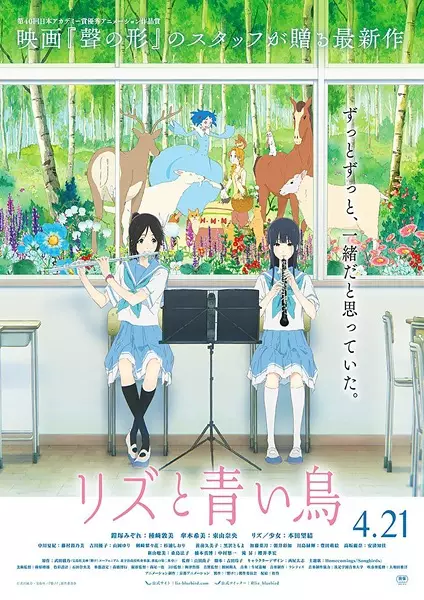
Liz's days of solitude come to an end when she meets a blue bird in the form of a young girl. Although their relationship blossoms, Liz must make a heart-wrenching decision in order to truly realize her love for Blue Bird. High school seniors and close friends Mizore Yoroizuka and Nozomi Kasaki are tasked to play the lead instruments in the third movement of Liz and the Blue Bird, a concert band piece inspired by this fairy tale. The introverted and reserved Mizore plays the oboe, representing the kind and gentle Liz. Meanwhile, the radiant and popular Nozomi plays the flute, portraying the cheerful and energetic Blue Bird. However, as they rehearse, the distance between Mizore and Nozomi seems to grow. Their disjointed duet disappoints the band, and with graduation on the horizon, uncertainty about the future spurs complicated emotions. With little time to improve as their performance draws near, they desperately attempt to connect with their respective characters. But when Mizore and Nozomi consider the story from a brand-new perspective, will the girls find the strength to face harsh realities? A spin-off film adaptation of the Hibike Euphonium! series, Liz to Aoi Tori dances between the parallels of a charming fairy tale, a moving musical piece, and a delicate high school friendship. [Written by MAL Rewrite]
9.2/10
Average Review Score
90%
Recommend It
20
Reviews Worldwide
"Liz to Aoi Tori" is essentially a side story to the "Hibike Euphonium" series, and from the very start, it fully embraces that role. Fans of the TV anime will likely find themselves despairing over the limited screen-time of their favorite cast members, inching forward in their seats as Kumiko, Reina, and the rest of the now-second-year ensemble teasingly jump in and out of picture for only moments at a time. This minor frustration will only be temporary, however, as we're forced out of that frame of mind, into the soft, melancholic lens of our focal point in this movie: Mizore. Although this story existsin the same music room we've all come to know, it takes on a different hue. Owing in large part to the incredible soundtrack and fresh character designs and art direction, the tone of the movie shifts entirely, transitioning from an inspirational story of motivation and hard work into a deeply somber and introspective world. The story itself is very simple, examining the relationship of Nozomi and Mizore in their final year in high school. It openly compares the feelings of the two characters with the piece they play, the namesake of the film, and the folktale it was based on. I was originally concerned that the comparison would end up overplayed and come off as forced, but I left pleasantly surprised. The film acknowledges the simplicity and straight-forwardness of the story, but instead of allowing itself to be confined to that, it achieves a level of technical mastery that managed to blow me away, even though I was already plenty used to the historically superb Kyoto Animation and the other wonderful works by director Naoko Yamada before watching it. The film succeeds on such a level because it allows itself to be a single vignette in the "Hibike" storyline. It's not a story of hard work, a story of competition, or even a story of music. It's a simple story of two characters, and it's precisely because this aspect of it was so intimately understood by the production crew at KyoAni that such a story was allowed to flourish. There is no excess. The film brazenly jumps through time, refusing to linger on anything unnecessary while still allowing the events that clearly happen off-screen to create meaningful depth in the story. We don't focus on what practicing is like. We don't see what the characters do on their weekends. We don't listen to the girls ruminating on their feelings in the comfort of their beds. From the moment we as an audience walk with Mizore onto campus at the beginning to when we exit it at the end, all we see is what's limited to the confines of the school, to the band room and to our two leads, and everything else is left to become a sort of wistful ether that exists on the fringes of our minds. Because what was shown was clearly so carefully chosen, we come to viscerally understand the weight behind every lingering shot. It's an incredibly delicate experience, and one that could've only been realized with production quality of this caliber. Yamada's quirks as a director have often been the subject of conversation in the anime community, but I believe that this film has been one of the best applications of those idiosyncrasies to date. Her approach to the art of unspoken communication paralleled the film's focus on Mizore, a girl unable to truly express, and at moments even understand, her own feelings. Subtle gestures such as Mizore stroking her hair not only serve to silently convey the cast's thoughts, but end up feeling as if they were sewn into the very plot itself due to how integral of a role they play. The consistent focus on the characters' legsâa mainstay in Yamada's worksâmirrors Mizore's own downcast eyes, and the other camera shots always seem to look off to the side, as if shyly avoiding the characters around her. Add to this the introduction of a softer pastel art style, and we see the world brilliantly through the lens of our main characters, creating something amazingly intimate. The soundtrack and sound direction are, hands down, the shining star of the film. It combines composer Kensuke Ushio's fragmented, minimal approach also found on his work in Yamada's previous film, "Koe no Katachi," with the expertly realized orchestral arrangements that the series is known for. However, gone are the sweeping brass-heavy pieces that complimented Kumiko's role as a main character in the original series. The introduction of the new piece instead turns the focus to the woodwinds. Brass now supports from the background, and the airy voices of woodwind instruments paint the entirety of the film with a wonderful warmth that sets it apart from the main franchise. The parallel stories of Mizore and Nozomi and the girls from the folktale blend masterfully into each other because of thisâfrom the gorgeous bass clarinet adding a sense of comforting security to the cold isolation of a "Koe no Katachi"-styled piano piece casting an ominous tone over the charactersâyet the well-timed use of other instruments such as the bassoon add the perfect amount of levity when necessary (the bassoon in particular being used wonderfully to comedic effect when the bassoonists themselves are relevant to the scene), while still staying in line with the overarching thematic style. That's why this film works. Every aspect of it is fine-tuned to near-uncanny perfection. The psyches of each character are silently brought to the surface through each deliberate animation choice, from Nozomi's eyes darting around the room to Mizore's subconscious trembling. The soundtrack compliments each and every emotional swellâsynchronized musical flourishes match footsteps and impeccably timed silences pull us devastatingly close to the most minute of actions. Each background track cuts to the core, yet never accidentally overpowers the gentle art and soft color scheme. Because of this masterful balance, all of the reactions are almost unnaturally natural, seemingly larger than life because of how lifelike they are. This kind of exaggerated humanity is an achievement only possible through the medium of animation, and even then, I have never seen it done quite like this. Although giving a full score seems like it could be a provocative statement for a film focused simply on the minutia of a measly two characters, if this movie isn't considered among the best for the sheer level of craftsmanship that it exhibits, then I really don't know what other film deserves to be.
It's nearly impossible for someone interested in the anime industry not to have heard of Yamada Naoko. Her personality-focused direction on K-On! is arguably what turned it into a hit and raised it above its contemporaries. More recently, she directed Koe no Katachi, a film that seemed to signal a move into a more art-house style with unusual shot compositions, a minimal soundtrack and a meandering pace. While the film had many flaws, its personal message resonated with a lot of people, further shining a light on Yamada's talent. With this in mind, it was clear that Liz to Aoi Tori would be well received, evenfrom the conceptual level - a down-to-earth, character-driven drama tied to an existing franchise, directed by the person who does that best, with a heaping helping of symbolism. However, in my opinion, the final product can be described as nothing other than a waste of talent. First of all, the visuals. If KyoAni is known for anything, it's their high quality artwork and animation. However, in this case they're oddly mediocre while acting more flashy than ever. Characters have their hair flap around wildly to show off fluid key animation that everyone knew they were capable of anyway and doesn't add anything to the scene other than a distraction, while the background art consists of uncharacteristically low detail surfaces which seem to have been made completely separate from the foreground objects (and not in a superflat way, there was clearly an effort to portray depth within the frame). The transitions don't guide the viewer's eyes so much as throw them all over the screen, and there's a lot of random cutaways to objects lying around the room or to the side of a character's limb without any real purpose or meaning, not to mention it rarely goes more than two cuts without an obnoxious depth-of-field effect that puts winter's Violet Evergarden to shame. The plot moves at the slowest of paces, and while that isn't a problem in and of itself, it makes the narrative progress (which is almost exclusively located in the last 20-30 minutes) feel jarring and unearned when it comes. There's a heavy focus on a story which our two main characters are obsessed with and constantly relate themselves to, even though thematically it turns out that the story doesn't fit either of their situations very well, making it feel like wasted time which is especially egregious when coupled with the aforementioned pacing. On the other hand, the sound design is pretty exceptional (it was directed by Youta Tsuruoka and Kensuke Ushio after all), and I have no complaints regarding it. It really helped sell the reaction to Mizore's performance around the climax and the evocative dreamlike melodies may have been what kept me from completely disliking the film. All in all, I don't regret watching it but I can't see myself rewatching it or recommending it to anyone. 5/10
From the world's most famous female anime director, Yamada Naoko, comes Liz and the Blue Bird. A spinoff movie of Hibike Euphonium, produced under KyoAni. The movie focuses on two Hibike side characters, Mizore and Nozomi. The story is about their relationship and personal drama, mainly focusing around the ever present music and how it plays a part in their coming-of-age and self-discovery, giving a meaning to their life and the base to their relationship. The movie especially focuses on how hard letting go off something is, and raises the question "are all good things really bound to end?" This is presented in 3 differentways. Directly in daily life, inderectly and silently through audiovisual story-telling which is mainly seen via character behavior and expressions, and the third way being the symbolism of Liz/aoi tori. The music presented is way more impactful -for myself at least- than in the actual Tv series. The art an animation is typical KyoAni for the expectation of the actual monogatari side of the story which is so fluid and gentle it looks almost fragile. Surprisingly beautiful for KyoAni who practically never tries anything new to secure mainstream appeal. Kudos for that. Basically, this is highly similar to other KyoAni movies. In a way, it's like Tamako Love Story with different approach, but also like Koe no Katachi except this time the other lead characters is not a mary sue. For those who enjoyed these movies for their drama, and found beauty within them, Liz and the Blue Bird is more than recommendable.
A Genuine Masterpiece of Yuri; Or How Shoujo Become Adult ---------- After international success of "Koe no Katachi" (or, "A Silent Voice,") Naoko Yamada has been regarded as one of leading anime directors. In "Koe no Katachi," Yamada tried to adopt the adolescent's sense of guilt as a main subject and depict how the young overcomes their difficult time of teenage, which was highly reputed both by the folk and by the critics. As the former work shows, Naoko Yamada tends to depict teenagers' mental conflict, sour-sweet love, and attitudes towards coming future, especially girls. This is true also in the latest featured anime, "Liz to Aoi Tori." "Lizto Aoi Tori" is a kind of spin-off of Kyoto Animation's "Hibike! Euphonium" series. However, though all of characters on the screen are from the TV series, there is no need of watching it before you go to cinemas. Yamada created this movie as a completely independent work. The protagonist is Mizore, a high-school student and good at playing the oboe. Though she is spending her last year of the school, she have not decided what she will do after graduation. What she always thinks of is Nozomi, her cheerful friend, and, a member of the school band like Mizore is. For Mizore and Nozomi's final chance of winning the national competition, a coach selects an instrumental composition, 'Liz to Aoi Tori,' which is based on a (fictitious) fairy tale. As the best players of oboe and flute in the club, they starts to practice hard, but it seems that something between them becomes an obstacle to brush up the music, and after realizing that fact the two meet each other in a biology room. In this work, both Mizore and Nozomi's emotions and standpoints are likened to the characters of the fairy tale, Liz, a lonely girl, and the blue bird, which transforms itself to a girl and starts to live with Liz to heal Liz's sadness. In the end of the tale, the blue bird leaves Liz's house, following Liz's advice. The director, Naoko Yamada, carefully treated this tale and accomplished to make it the framework of the entire anime. At first, we might consider that Mizore is compared to Liz, for she does not have many friends and tend to bare loneliness. In contrast, Nozomi's gregarious trait easily connects to the cheerful blue bird, which is believed to bring happiness, in our brains. This assumption leads us to one certain understanding: this movie may be about Yuri or even girls' love between Mizore and Nozomi. True, for Mizore Nozomi is her only friend. Mizore always stands just behind Nozomi and follows her. Such acts reminds us of many Yuri anime/manga. However, "Liz to Aoi Tori" is not merely a Yuri anime; it depicts how shoujo leave their teenage-like traits, as the blue birds leaves the cage. We cannot deny that "Liz to Aoi Tori" is a masterpiece of the Yuri culture, but this work goes beyond this reputation. Throughout the story, Yamada rarely depicts landscapes or incidents outside the school. For teenagers, it is school that isolates them from the society; school is the cage. As long as they remain in school, they can be shoujo and avoid from being adult. However, shoujo cannot be shoujo forever, because of request from the world, and of their growing. Someday shoujo will have to fly from the nest. Yamada has already realized it and includes this school - cage metaphor in "Liz to Aoi Tori" to express growing of Mizore and Nozomi after going through their conflicts. As above, Yamada's ambition easily goes beyond our expectation. What is impressive here is that Kyoto Animation and staffs of "Liz to Aoi Tori" met Yamada's, and our anticipation with highly-refined techniques and unusual talents. Animators succeeded to live up to Yamada's fine direction plans, from where eyes focus to tiny actions of Mizore, which reflects transition of her emotions. Drawings of the fairy tale is also worth mentioning; you might feel as if you were reading an animated picture book. Music and sound effects are memorable, too. Kensuke Ushio, a composer, again made an unique soundtrack mainly based on notes of piano. Like "Koe no Katachi," Yamada and Ushio used classical piano tunes effectively, which tells us the changes of characters' mind, their maturity and immaturity, and their growing. Sound effects helps such direction using music, so I strongly recommend you to see this work in theater. With these sophisticated elements, Yamada tried to tell us something important. Back to the theme of this work, the director concisely showed how shoujo open a door to the world, that is, how shoujo leave their young days. As is often the case with Yamada's featured anime, words appeared in her movie are keys. At the beginning of the movie, we see an impressive word: 'disjoint.' Then, Yamada gives us another clue at the end of this work; again she indicates the word 'disjoint' and then she erases a prefix 'dis-.' Paradoxically, by disjointing we can joint; or, by jointing we can disjoint. It will not mean that in order to disjoint we have to joint something in advance; it just implies that jointing and disjointing are supporting each other. Shoujo can be mature women by jointing ties to someone and by disjointing it. After all, Mizore and Nozomi decided to help each other, though a tragedy has set on. It is that way that they will take to grow up, which indicates us what 'joint' and 'disjoint' mean. Both Mizore and Nozomi are Liz, though the two are also the blue bird. Supporting each other, shoujo will fly to another sky. Naoko Yamada achieved to express it finely. Definitely one of the best anime in 2018.
One week before this film would hit US theaters, I was just learning about it. I saw some artwork from the film and thought, âHuh a music anime film. Oh it is a Hibike side-story. Sounds interesting.â Three days before Iâm set to get see the film, videos on YouTube start popping up for the film. One by Lock-kun and the other by Motherâs Basement. Both videos praise the film on all accounts with Lock-kun going as far to say itâs the greatest thing theyâve ever seen. Ok well now the bar is set wayyyyyyyyyyyyy high for this film. I arrive at the theater, sitdown, and prepare myself to (hopefully) enjoy one and a half hours of this Hibike side story. I was going to include this one pre-written section to talk about my feelings about the Hibike TV show. However, it isn't needed because it doesn't matter due to what the film ends up showing. You can go into this film 100% ready without seeing the show. Yes it helps connect some dots but honestly the film does such an amazing job relaying the character troubles and interactions. You just understand each character's standing within the cast. The film is, quite simply, the best animated drama film I've seen thus far. Going into the film I wanted to find every little issue with it due to the hype that Lock-kun and Mother's Basement started perpetuating leading up to its US release. They were though...completely correct. This film is marvelous. The music and visuals have to be talked about together because, like with the TV show, they are married together. In the film, every scene is perfectly intertwined with visual and acoustic representation. The music dances with the animation all the way through the film; one does not lead the other. The drama (to be more precise melodrama) works because of this marriage. If one of them were over-the-top, I wouldn't be able to take the film seriously. Luckily the film pulls off this balancing act throughout the entire film. The film tells a dual but interlinked story; one being a following of two members of the high school's concert band and the other being a glance of a townsperson meeting a new friend. The stuff that revolves around the school looks great. It is staple Hibike detail. The stuff that revolves around this picturebook-like story though is amazing. It almost comes off as a Miyazaki-esque looking film which is a huge compliment. The fact that the studio was able to juggle between these two drastically different art styles within the same film is praise worthy. The music performance scenes are also quite the treat for the eyes. One of the scenes in particular takes over 5 minutes to complete and there are no sort of cuts that force you away from the performance. So you are seeing 5 minutes of straight up musical playing animation. It's amazing, all of it. The music made me cry alright. I haven't cried in a film since I don't know when. The music, working in tandem with the visuals, will pull on your heart strings if you are invested in the characters. From an atheistic standpoint, I loved the music. It fit the setting of the concert band really well and the music was super pleasing to listen to. The two main characters in the film worked really well for me. They are great friends but they fundamentally misunderstand each other. The idea of having them work together on a duet solo for a song fits perfectly into their final characterization. I was sort of invested in them in the beginning but by the end I was 100% on-board. As a side note, I thought I would be disappointed with the main cast of the TV show being sidelined but honestly it was for the best. I applaud the studio for sticking to making this film its own thing rather than fanservice in the other characters. The film also completely skipped a pool event. The film is 100% ready to show you a serious film. My one gripe with the film is that it made the decision to skip over early characterization of the two main characters. You are dropped into the story pretty much at the tail end of their high school life. Since we don't see their freshmen and other earlier years together, I had issues early on getting invested into the characters. However, this is honestly a pretty small gripe in the grand scheme of things. I don't know what else to really say about this film. The octopus hair wasn't octopusy enough? I left stunned with how much I enjoyed it and even now writing this review I'm still stunned. I don't know when/if I'll watch it again in my life but I'm glad that I got to see it when I did in the theater. You don't have to have seen the TV show to watch this film so you have no excuse. As soon as it comes out on DVD/BD, you must set aside some time to watch this. Enjoyment: â/10 Overall: 9.5/10 Thanks for reading my review! If you liked my writing style, would like to see some other reviews, or just want to talk, please stop by my page! Sincerely, Awesome Drummer