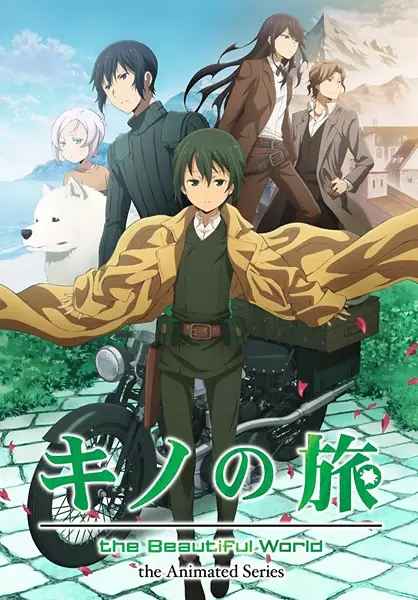
Links go to search results. Availability varies by region.
キノの旅 -the Beautiful World- the Animated Series
12
TV
Finished Airing
Oct 6, 2017 to Dec 22, 2017
When 15-year-old Kino is feeling weighed down by heavy thoughts, one thing always manages to cheer her up: traveling. Nothing fills her heart with joy like exploring the beautiful, wonderful world around her and the fascinating ways people find to live. However, Kino is not as helpless as her cute appearance and courteous demeanor suggest. Armed with "Cannon" and "Woodsman," her trusted handguns, Kino is not afraid to kill anyone who would dare to get in her way. Always by her side is her best friend and loyal companion Hermes, a sentient motorcycle, who supports Kino through the sorrows and hardships of their journey. Together, they travel the vast countryside with the shared goal of always moving forward, and a single rule: never stay in one country for more than three days. As Kino and Hermes encounter new people and learn the rules of their civilizations, they grow and find out more about their own values and virtues. But as Kino slowly discovers the world around her, she also finds herself facing dangers that linger within the vast unknown. [Written by MAL Rewrite]
5.6/10
Average Review Score
35%
Recommend It
20
Reviews Worldwide
Keichii Sigsawa's 'Kino no Tabi (Kino's Journey) The Beautiful World' is one of the longest running ongoing Light Novel series in existence, generally releasing a whole volume of material every year since 2000. In that time it has received first an Anime adaptation in 2003 directed by the late Ryutaro Nakemura, and this 2017 adaptation by Studio Lerche. For fairness, I will not try to compare this version to its source material or the previous adaptation too much and try to judge it based on its own merit. The premise of the series is that it follows the Journey of a traveller named Kino and theirtalking Motorrad Hermes through their travels across a world made up of small countries which each encompass their own unique ideologies, cultures, and traditions. From this, Sigsawa uses the perspective of Kino, a traveller with no ties to a particular culture of their own and a maintained neutral outlook on the morally grey activities which they often come across, to look at multiple facets of philosophy and the human condition. This results in a very interesting and thought provoking episodic series, whatever its incarnation. While this will be a positive review overall, as I did find more to enjoy about this adaptation than I didn't, I will start this review off discussing the negatives of the series first, as they are perhaps the more glaring issue with this adaptation, and the one which may turn potential viewers (be they familiar with the source material or not) off. The biggest issue with the adaptation is without a doubt the stories that were adapted for this versions. For those of you who didn't know, the stories from the LN selected for this adaptation were picked from a poll in which fans of the LN were asked to vote for their favourite stories from the series. While this may sound like a good idea on paper, as it means we get to see what the fans themselves picked as the highlights, sort of like making the series a Band's Greatest Hits compilation which can in turn help to entice new viewers, the issue comes about when the stories placed near each other cause the series to feel extremely uneven. What I mean by this is that in the original source material, these stories would have been written in the order they were for a reason. That becomes apparent when we see how tonally conflicting the series can be, as the episodes can often be radically different in terms of tone so that one week we witness a deep and quite dark study of the way that humans take their lives for granted but then next week get a silly, action packed episode. This often extreme tonal dissonance which occurs between the stories can often feel jarring, and lead to the feeling that the series suffers a severe identity crisis in which it doesn't quite know what it's trying to be as a series. It doesn't help also that some of the stories in the series perhaps aren't what I would have selected as being among my favourites. The worst offender perhaps being an episode which is itself a compilation of short stories which each feel insufferably self parodying and painful to watch (this is episode 9 in case I've convinced you to skip this episode when you watch). Another major problem with the series is the direction it takes. Lerche are a studio whose work I'm only familiar with from this year, and from what I can gather, the popular consensus seems to be that they're an extremely uneven studio, and that certainly reflects in this adaptation, which additionally serves as a showcase for both the studio's strengths and weaknesses. They certainly aren't a studio known for subtlety for one thing, and when the series does try to showcase its more philosophical side by showcasing the actions of people within the societies that exist in this world, their emotions and negative reactions to things which dilute their customs can sometimes feel a bit overblown, not helping is some really overacting VA work for those characters. This can unfortunately cause the side characters to feel a bit like caricatures, and the way such scenes are so sporadically directed to have some sort of dynamic breakdown suddenly occur can often lead to it looking a tad more silly than it was possibly intended. Additionally, the studio's trademark heavily saturated lighting can sometimes cause the colour pallet to feel overblown and processed, and this becomes an issue when it subtracts from any atmosphere the story in question is trying to convey, and for those with more sensitive eyes can perhaps look a bit ugly when it is done wrong. That said, this lighting effect when done right can actually help to enhance the atmosphere in some episodes, and make some genuinely lovely background art which brings the world of the series to life, looking appropriately Beautiful as the title implies. Now, with these admittedly very large issues of inconsistent story quality and sometimes harmful directorial choices, I will say that the series is actually good overall, when it manages to overcome these issues. More specifically, when the strength of the source material is able to shine through in the stronger episodes. For me, these would include episodes 1, 4, 5, 6 & 10. Each of these episodes appeal to the main strength of the series, a frank look at philosophy and the human condition, sometimes told through a surprisingly dark and chilling lens which invites the viewer to reflect and think about the morality of what just transpired. On the side of characters, Kino and Hermes are of course the main characters of the series, travelling across the world with a neutral stance towards the (often terrifying) events they encounter which in turn helps us the audience to view them with a similar lens. Unfortunately, there's pretty much nothing in terms of development for the main character as a slight result of that aforementioned episode order, with the possible exception of episode 10. Adding fuel to the fire is the addition of episodes which don't feature Kino as the main character, as we also see stories told primarily through the perspectives of other travellers who Kino met on their journey, such as their mentor, and Shizu; the former prince of a dead kingdom who travels with a talking dog, and later a unique child. These characters are likeable enough on their own, and does provide a counterbalance by looking through the different perspectives of characters who lack Kino's neutral ideology and solve situations differently from how they would, but it does become a problem in the second half of the series when their episodes dominate and cause Kino to feel almost insignificant in their own series. On the technical side of things, I already discussed the advantages and disadvantages of Lerche's heavily saturated lighting. The animation looks fine for the most part, though it does look fairly safe, there's nothing much unique about it. Some people criticised this change in artistic style from the 2003 adaptation, but this ignores the fact that Sigsawa's own illustrations for the series have changed through the years he has been working on the series. The 2003 version reflected the designs he used at that time, while this version reflects his current artstyle, so it isn't really "betraying the source material" as many said. The OST isn't particularly grabbing, while some of the side characters do overact a bit, the voice acting is generally fine for the most part, with Aoi Yuuki being typically lovely as the voice of the main character, and Inori Minase providing an appropriate mix of nervousness and calm to her one-off character. The OP and ED are both quite lovely (and evidently where most of the animation resources were allocated above all else) capturing the more calm and tranquil aspects of the series, as well as its serene sense of beauty. Perhaps the most frustrating conclusion I have come to in this review is that I still don't quite know who I'd recommend this series to. I suppose if you consider yourself a "Super fan" of the source material you should at least try it, outside of that it becomes a bit trickier, as I've seen from the community mixed responses to the series, some newcomers feeling unmotivated by it, others enjoying it, and similarly mixed opinions from fans of the 2003 adaptation. I will say that if you're a newcomer, the 2003 adaptation is probably a better bet to go on, as it has a much more consistent tone and represents the strengths of the source material in a much more solid way by ignoring some of the sillier storylines that pop up in this version. And check out this adaptation after that if you feel you can tolerate it. As I said before, despite this adaptation's glaring faults, its uneven quality, I still found it to be a fairly faithful adaptation of the source material. Especially in those stronger episodes that I highlighted. And it does reveal many of its cracks, especially in the second half of the series, but for what it was, and for those episodes I liked, I do give it credit.
Click an episode to read its synopsis.
"The world is not beautiful, therefore it is." This review will be based sorely on the 2017 remake/reimagining of Kino's Journey, while references to the original 2003 will be debatable as well. To boot, the original series was a cult classic to people who have watched it, and the reboot by studio Lerche this year made a good transition with the visuals and music, and personally and honestly this is a good watch even if it's action-packed, adventurous SoL. This is the story of Kino and her motorrad Hermes, on an episodic journey to showcase the countries they have been to: its characteristics and what makes it standout for the country, even if for the citizens of the respective countries they come from. Honestly, I wouldn't go so far as to call the 2017 version a reboot of Kino's Journey, but like as mentioned, a reimagining with sprinkles of the original anime mixed into the substance as well, and I kinda quite liked the direction it took, even if some scenes were hard to understand and swallow. Characters: The simple Kino, her adaptation of the name from a traveler of the same name who got murdered (Episode 11 spoilers) riding along with her motorrad Hermes, both characters take the cake for being the main "protagonists" of the show. I say it that kind of way because the show's narration doesn't quite explicitly focus on them all the time, but then it's still fascinating to see how Kino survives with Hermes on the journeys of good and bad and getting a fine taste of what's to come. And also, this time we have another set of people: Shizu and Riku (from Episode 6) whose intention is the same: to travel around and experience life that's a journey. Unfortunately, I feel like their on-screen time could have been given a bit more than just 2 or 3 episodes, even if their plot started out a bit later. Unlike Kino, Shizu is more regressed and too also has a heart of gold, with the dog companion Riku, they both make good progress with their lives too. Overall, this series doesn't need to overshine the main and supporting characters, but they at least get the job done for showcasing a simple, yet intriguing series that keeps you on your toes. Art/Animation: Again, Lerche has done great on the series, albeit that most people prefer the original due to nostalgia. The truth is that while this series has nothing new to offer, it at least got an upgrade to the visuals and music (which I'll discuss later). For a world that's portrayed as "not being beautiful, therefore it is", the environment looks lush and beautiful and could not go any further. But with that said, some liberties are taken directly from the original source material, but it's honestly not too bad. Surprisingly enough, I did notice a fair share of lack in quality, but it quickly overshadows that with the immersive story. Another job well done. Sound: This might be the 1st of a few times where I actually like Yanagi Nagi's music composition with the OP and ED, it sticks out in a very melodious atmosphere, and honestly it could not get any better than this. Her music makes you feel like you're experiencing something totally new and fresh, and that's how I like how she portrays the surrounding and makes the sound of music combine with the visuals to give it a good-sounding edge over the rest of the other shows out there. Overall, high praises for the music and BGM, the reason why it compels me to watch this show. Overall: As mentioned, there's some debate over this and the original to further extent, and I don't blame anyone for it, because we do share our own opinions and have a liking for the ones we love. With that said, Kino's Journey -The Beautiful World- 2017 reimagining is one show from Fall 2017 not to be overlooked, even if the aesthetics do fall apart at times and have people overwhelmed by how it sticks out like a sore thumb to the original. I personally liked the calming atmosphere, and it is truly one of the great shows of the season.
tl;dr The 2017 version takes the mantra "The world is not beautiful, therefore it is" and crushes it under the wheels of a thousand horribly-animated 3D-CG motorrads Why a 1/10? Why such a low score? It is because there is no reason to watch it. The 2003 version is better, and Lerche's remake has no good ideas and none of the things that made the original so loveable. This new Kino, cutesy and staid, has only really succeeded in becoming a clunky metaphor for the anime industry at large—gutted, and a hollow husk of her former self. Kino's Journey has been lobotomized in favour of something moreaccessible and easily digestible. All the magic is dead. Gone are the days where Kino riding Hermes around the countryside was given the dignity of normal 2D animation. That old friend you loved, the sepia tones and the somber beauty of an angular, awe-inspiring world, is no more. There's something unsettling and depressing seeing some new studio snatch up this I.P. and make it dance to the tune of modern anime trends, and thinking about this well after finishing the series has been the only time Lerche's remake made me feel something akin to what those old Kino episodes did. What is the purpose of this show? Why does it exist, and why watch it? That's why I'm here writing this, to warn adventurers that some countries aren't worth going to—that they look like the towns you know, streets you grew up on and vistas you have grown to love over the years, but are now dead countries, joyless and cheap and filled with a million identical cardboard cutouts of high-gloss Akihabara maid cafés staffed by energetic catgirls in miniskirts. Those old memories would be worser for it. There is no beauty here, only popcorn and a quick flip to the next channel. The world is not beautiful, therefore it is; some worlds are ugly, and sap the life out of those you love. Is this show any worse than others this season? Probably not, but it all depends on what you value as a viewer. If you want something easily watched and easily forgotten, Kino's Journey 2017 is definitely for you. But if you want something meaningful, something that you might love and cherish for years afterward, please just watch the original.
Life is a journey and the road ahead is filled with a lot of obstacles that we must overcome to reach our final destination...... First of all this is not a sequel for the old Kino it's a remake with some changes for the art style , plot and story which i will mention them in this review.So let's go on a journey then.... The first 2 episodes despite being bland their purpose is to get the viewer used to the plot, story and characters and captivate your attention with the improved animation and scenery(landscape). After those 2 episodes things get better and some episodes will leavea good impression after finishing this series.The story is simple and relaxing following Kino on his motorrad through his journey from a country to another meeting different people and learning about each country's customs and culture during his 3 days stay. A variety of themes are explored and morals to learn from them at the end of each episode. The characters are better explored in this series especially the side characters who get a spotlight in some episodes (the focus is not only on Kino like in the old series) which is a strong point and brings a lot of diversity to the story and plot. The visuals are gorgeous and the scenery is very captivating and this is an essential factor for the main concept of this show.An interesting fact from this show is how they portrayed the bond between motorrads&travelers and presented both of their perspectives about the meaning of a journey. One big problem this show has are some episodes who lack substance and don't manage to get the viewer attached to the characters and story.For example they should explored more about the characters backgrounds and how they end up in that situation instead the presentation is rushed and it leaves a dry taste in your mouth after finishing an episode. Although the old Kino did a better job at that the remake has some remarkable episodes that will surely become your favorites. The scenery, ost and animation are superior and for those who enjoy those stuff from an anime if the old Kino didn't seem appealing to you this remake will surely captivate you , especially the opening song animation having a rich visual vocabulary and innovative concepts. So my advice is to give it a try and don't binge it you need to take your time with this show and enjoy each minute from it.
To say this remake of Kino's Journey is a disappointment would be an understatement. The original 2003 series was a hidden gem of the decade that depicted a series of short stories that were parables focused on elements of the human condition observed through the traveler, Kino. The stories tended to vary in their mood and intensity, being either bizarre, insightful, or having a dark and twisted element to them. In spite of the changing moods, the 2003 Kino's Journey adaptation did a great job with balancing them out with exploring both the joys and pains of being human. This remake sadly lacks the subtlety andnuances that made its 2003 counterpart a pleasure to watch. The stories for this remake are more blatant in exploring the moral they are focused on and many of them seemed to lack the time to allow the viewer to be immersed into exploring the various lands visited by Kino, thus reducing the impact of when the true side of the visited country gets revealed. The story order also felt more disjointed as several episodes of this series shifted over to exploring other characters like the swordsman, Shizu, and the slave girl, Photo. While interesting characters in their own right, there's little further elaborated on with Shizu following his introduction and Photo only has a single episode devoted to her. But perhaps the worst element to this adaptation of Kino's Journey is the series often getting too immersed into showing off action when Kino and Shizu get into any sort of major conflict. Said action scenes mostly have nothing to do with exploring the moral of each of its episodic stories beyond showing off the anime's animation and goes against the whole point of Kino's Journey about the series as a whole being moral-focused parables with an occasional cruel twist. Anyone who has seen the 2003 adaptation of Kino will notice the rather jarring difference in story mood, focus, and presentation choices as some episodes for this remake adapt stories also featured in the 2003 anime like the Coliseum arc and the Land of Adults story. The only real praise that I can give this remake of Kino's Journey is the improved artwork over the original series. There is greater detail put into character designs and scenic shots are more pleasing on the eyes. Animation is also more fluid for the most part with more natural movement depicted with characters, especially noticeable during the anime's action scenes. In spite of the improved animation though, the use of CG animation still sticks out badly compared to the regular animation and is quite noticeable at points where complicated animated sequences are depicted, particularly whenever Kino is riding on Hermes. Also in terms of a presentation choice for a series like Kino, the more detailed and brightly-colored visuals don't mesh well with a series like Kino that is more focused on exploring the morals each story has to offer up on an element of the human condition. Overall, I would say Kino's Journey 2017 easily makes for the biggest disappointment I have for an anime series this year. In spite of its improved visuals, it felt like Lerche did not have a clue on what made Kino's Journey an enjoyable series during its 2003 run as there were points where it felt like the series was unsure over what it wanted to focus on and then when making the effort to explore a moral, the focus of it felt forced and lacked the subtlety and impact offered from its original series. If you want a better option at seeing how Kino's Journey could be adapted in animated form, I strongly suggest checking out the 2003 series over this subpar adaptation for it.