Links go to search results. Availability varies by region.
ナンバカ
13
TV
Finished Airing
Oct 5, 2016 to Dec 28, 2016
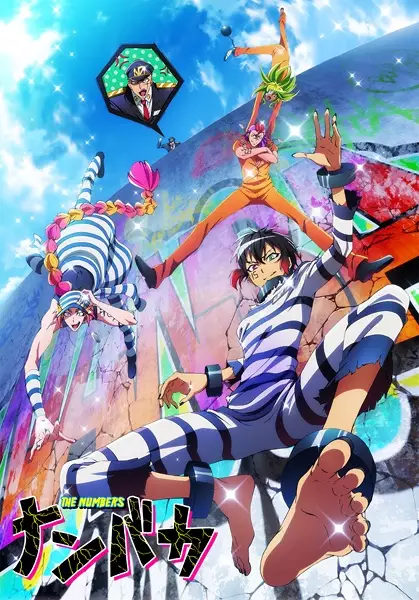
Nanba is the world's most formidable prison, built to incarcerate criminals who are too slippery to stay in ordinary confinement. The four inmates who occupy Cell 13 are particularly cunning on that behalf, having escaped every other prison with a perfect success rate. There is Juugo, a specialist in locks who has spent the majority of his life in prison; Uno, a gambler with great intuition; Nico, an otaku whose body reacts strangely to drugs; and Rock, a bruiser with a love for food. The daily shenanigans of the four prisoners always cause trouble for the building supervisor, Hajime Sugoroku, who desperately tries to prevent them from breaking out of Nanba. Nanbaka follows the comedic, sparkle-filled exploits of these prisoners and their guards. From three square meals a day to sports festivals, prison life in Nanba isn't actually that bad—and it is the closest these four have to a home. [Written by MAL Rewrite]
6.2/10
Average Review Score
50%
Recommend It
20
Reviews Worldwide
A description of Nanbaka is probably going to make it sound real dumb. This is likey because it really, really is. But the fact it is dumb does not preclude it from being entertaining, and I assure you that it is nothing if not that. I 100% recommend watching it if you are: A.) In the mood for something funny. B.) Unbothered by something being really stupid. C.) Equally unbothered by anime being weird for weird's sake. Story: I can best sum up Nanbaka thusly: it is pretty much what would happen if you transformed the Looney Tunes into bishy anime twinks with FABULOUS hair and threw them into afacility that is simultaneously the worlds most secure prison and the worlds most liberal Montessori preschool. So like Tiny Toon Adventures meets Orange is the New Black. Specifically those two shows, because like Tiny Toon Adventures the characters seem to have the impulse control of infants and can pull seemingly whatever they want out of Hammerspace and like OITNB everybody is kinda compelling and pretty fabulous and kinda gay and in prison. If that doesn't sound fun to you, you probably won't like it. We would probably also not be friends, because it sounds like a whole bunch of fun to me. Art: OH MY GOD REALLY GOOD! It is a joy to look at. The color is hyper-saturated, lime green and hot pink and crazy in the best way possible. It is exciting and surreal, which helps you suspend your disbelief over the antics of the ridiculous plot and characters. The art puts me in the mood to have fun, which the show then offers. 10/10, this is what art should do for an animated show: inform you by design alone what kind of show you are watching. Sound: Also awesome. The opening song is pretty cool: rocky J-Pop paired with some fun imagery indicative of the mood of the show. The ending, however, is the shit. It's more or less chibi versions of the characters running around escaping from prison while they all sing a song together. I love it and watch it every time. It is charming and funny, and always made me want to watch the next episode. Character: Over the top and too much, but so is the show and consequentially it more or less works. The main 4 are all pretty funny and engaging, although main guy (#15/Jyuugo) is kind of a sad sack these days. Everybody has more or less exactly one joke that they are used to tell over and over, but the joke seems to always land despite being repeated ad nauseam. They are either manic and adorably annoying, or unvarying serious to the point that they cannot themselves be taken seriously. Sometimes both at once (The Warden). Special shout out goes to Nico, the hyper kid who takes a bunch of drugs and is really into stupid anime, because he is basically me. I just wanted to hang out with him and smoke a blunt and watch G-Gundam (secretly the best Gundam despite what everybody else who has ever watched it beside me and Nico might say). Enjoyment: Loads. This show isn't going to teach you anything. It's not going to tell you anything profound, it will just make you laugh a bunch. If that is enough for you, give it a watch. I did and do not regret it in the slightest.
Click an episode to read its synopsis.
NEVER TAKE THIS SHOW SERIOUSLY Now that that's out of the way, I found enjoyment in this show though the hilarious imagery and funny jokes. THE STORY is mediocre at best, but it's a comedy, so there's not much you can expect. THE ART is great. It's the main focus of the comedy element and sometimes is a bit too lenient on it. The art by itself though colorful and wild is sometimes a bit eye bleeding. THE CHARACTERS aren't varied. They are all just comic relief, which makes them seem bland overall. OVERALL I liked this show, not to where I'll be recommendingit, but it made me laugh and I think a comedy shows goal is to make you laugh and this show accomplishes it's goal.
Many have heard the old proverb, "If you chase two rabbits, you will not catch either one". By extension, the more rabbits one chases at once, the harder each is to catch. Nanbaka takes this a step further: it starts going after one rabbit, then gets distracted by a bird and later a fish. It unfortunately fails to catch any of them, but at least it looks cool trying. At its core, Nanbaka is a zany, colourful gag comedy in a prison setting! ...Or is it an action shonen? No? A character drama? In practice, it frequently switches targets when it may have been wiser tostick to one. From the get-go, Nanbaka presents a fast-paced series of varied jokes, ranging from visual humour to ironic subversion to borderline non-sequitur. They weren't exactly original, and didn't get to me personally, but variety and quick pacing are handy tools for holding interest whenever a punchline doesn't quite hit the mark. At this point, I respected Nanbaka for what it was. It had a clear identity, and showed commitment to it. However, the show quickly lost its focus from there. In my eyes, a lack of focus is one of the fastest ways to kill viewer interest, and often a sign of poor writing. Nanbaka soon falls into this trap; rather than continuing its gag comedy roots, it tries to take on multiple identities at once. As soon as the action and drama arrive, the pacing slows considerably and the jokes become less varied or frequent. This would be fine if the new elements meshed well, or were at least strong additions to the series, but instead, they just make things messier. The action elements suffer from weak choreography. This is expounded on by mid-action cuts to narration by onlooking characters - an issue seen in many action anime. For once, Nanbaka could have made this trope work in its favour by filling the narration with its usual zany jokes. Alas, it's just the usual filler dialogue to stretch out the no-longer-action while explaining attacks that didn't really need to be explained and/or stating things that are obvious to the viewer. Despite the action portion's weaknesses, the drama is where I find Nanbaka to be the least successful. At these points, the show suddenly takes on a more serious tone than the accompanying gag comedy and action. This results in a weird situation in which a viewer is simultaneously expected to take the show seriously while also not taking it seriously at all. It's not the tonal shifts that are the issue - rather, it's their frequency and the show's inability to sell them. Furthermore, compelling drama requires compelling characters - something Nanbaka does not have. Most of them come down to one-dimensional quirks or hobbies and maybe the occasional simple backstory. They're too simple to be interesting on their own, and it makes investment difficult. And this brings up what I believe to be Nanbaka's main weakness, and the source of nearly all its problems: it's characters. Even with its wildly differing subject matter, this show certainly wasn't doomed from the start. It simply lacked the tools needed to succeed. While there were several things that could have helped the show (improved action pacing and choreography, or a more memorable soundtrack to quickly and effectively shift tone), ultimately, I believe that characterization is the one key missing weapon it really needed to hit all its desired targets. Stronger characters can create chemistry which helps to sell the comedy and elevate it from "gag" to "riot". In turn, these jokes can be a quick and effective way to show characterization. From there, these improved characters help to invest a viewer before the show switches to action, and when drama builds, the viewer will more readily buy into it. But without this depth of character, the act falls apart, undercut from its very foundations. Despite all my criticisms of Nanbaka, one positive I can mention is the show's art. It has a unique, sparkly, insanely colourful style that immediately draws attention. I'll admit, this alone made it easier for me to sit through Nanbaka's weakest points. The style, however, is not nearly enough to carry the show on its own against its many weaknesses. In the end, Nanbaka gets a tad too ambitious for its own good, and misses the fundamentals as a result. What could have been a notable series sadly ends up as a disorganized, zig-zagging mess, with no clear identity beyond its visual style. When it does manage to catch a rabbit, it's not a particularly tasty one.
The action/comedy multi-genre is saturated with great shows and awful shows. The great shows are not only deliver brilliant action scenes through the quality of the technical aspects, they’re also hilarious and consistent with the comedy. The poor action/comedy shows either skimp on the quality of the art and sound involved or lack consistency in the comedy or both. Action/comedy shows are at their best when they’re funny or exciting but not when they drift off into needless drama. Nanbaka falls between the two; it starts out great with an interesting premise and acceptable comedy. But it loses its focus along the way near the endof the series and slowly becomes boring. [Repeated prison escapists] Nanbaka is an action/comedy anime series based off a web manga originally created by Futamata Shou and his influence glows throughout the show. It is directed by Takamatsu Shinji, who’s directed brilliant comedy series like Gintama and The Daily Lives of Highschool boys. The series is revolves around the daily antics of four inmates in the self-proclaimed, most formidable prison in the world. The inmates of the infamous ward 13, Juugo, Uno, Rock and Nico, often try to escape the prison’s walls and are always stopped in their tracks by the fearsome guard, Sugoroku Hajime. But Juugo is also on the lookout for the man who gave him his unremovable shackles and his colleagues question their motives for trying to escape the prison. [An interesting premise abandoned] Nanbaka begins as a ‘gag’ comedy with an interesting premise: the main characters frequently try to escape from the prison. In the first few episodes, we see them break through several high security gates only to be caught and beaten by the head guard, Hajime. The hilarious execution of this premise coupled with the diverse skill set of the inmates makes these episodes interesting to watch. The premise also leaves a lot of room for creativity; the prison could be viewed as a dungeon, for example. As thin as the plot was, it was replaced by a pointless intra-prison arc. The intra-prison arc was not boring by any chance; it was even more exciting than the initial episodes though less creative. The event introduced most of the cast of the show and showcased the abilities of the inmates and guards alike. It was hilarious and full of explosive battles with fluid animation and lots of special effects. It was pointless but still fun to watch. Unfortunately, the show slides into a series of dramatic sketches following the last battle in the arc. The last few episodes seemed like the opposite of the first episodes; they had direction but were boring. They just seemed to tick off all the common tropes for drama present in an action show; a self-deprecating main character who learns to lean on his friends. It wasn’t awful; it just wasn’t what was sold by the show at the start. Also, the drama would have been better had there been more characters involved. [A diverse and wild cast] Nanbaka has a large cast of characters from various nationalities. Some are declared in the show like Juugo’s British and American fellow inmates. Others are inferred from their design like the inmates of ward 5. With this comes a variety in the design; some inmates wear their prison clothes while others do not. Unfortunately, the personalities aren’t as diverse. Almost all the characters, inmates and guards alike are hyperactive and aggressive; most of the inmates have no motives at all. Only the main characters seem to want other things hang out in prison. Juugo likes to break out of his cell, 13, for the fun of it; it’s later revealed that it’s the only skill he has. He’s also in search of the man who placed shackles on him but this only becomes a focus of the show much later. Uno is the self-proclaimed pretty boy of his cell; Rock is the muscle who likes to eat and Nico is playful and immune to drugs. That’s about all there is to them although they reveal other skills that only last the duration of the intra-prison event arc. The other characters of note are ward 13’s head guard, Hajime, who’s a workaholic and the warden who has a crush on Hajime. Fortunately, what Nanbaka lacks in characterization, it makes up for in its art and character design. [Glitter, gloss and pretty boys] The art style of Nanbaka is distinct and loud. The background and character art is sharp and colourful; the colours are bold and bright; the characters are drawn with prominent outlines. It’s artstyle is similar to that of Jojo’s Bizarre Adventure but it’s recognizable for the tones of colour used. It’s uniqueness lies in its overall theme: femininity. It’s difficult to miss the glitter that pervades the environment in the show. The characters glitter, the prison walls glitter, even the ocean that surrounds the prison glitters. In addition to the glitter is the gloss that’s also on everything, from hair to their clothing. The characters also tend to wear more jewellry than the average male and often have painted fingernails. Then there are characters that are effeminate in their appearance, voice and mannerisms. This art style, coupled with the jazzy themes, gives the show a 70s feel. [Jazzy with a spice of rock] The opening (Rin! Rin! Hi! Hi!) gives away the catchy jazz style that pervades the entire show. It’s a brilliant intro to the flamboyant show and one of the most memorable for me in the Fall season of 2016. Sadly, only Uno’s melody (a score that plays when he’s about to play a trick) comes close to being as memorable as the opening music. The rest of the scores are either gentle jazz tunes or generic rock music that’s designed for fight scenes in anime. I wouldn’t say I enjoyed Nanbaka in its entirety as some of the episodes were a chore to watch, often because of the obvious drama. The comedy grows less hilarious past the halfway point; it even loses its most popular running gag. The show was mostly enjoyable for its first few episodes and its flamboyant art style. It did get its technical aspects right and would have been a much better show had it stayed on course.
This anime, for me, is the epitome of the 'well you had us in the first half' meme. The tonal shift in the 6th episode gave me whiplash and made me feel like I had all of a sudden started watching a different anime. At its best Nanbaka is a fun show about a group of lovable morons. The group dynamic was so fun to see and made me love all of the characters. At its worst it casts aside all of that for a much darker and more serious action type anime and in doing so loses all charm from the characters and anyattachment I had to them. Tl:dr, should have stayed a 'gag' anime.