Links go to search results. Availability varies by region.
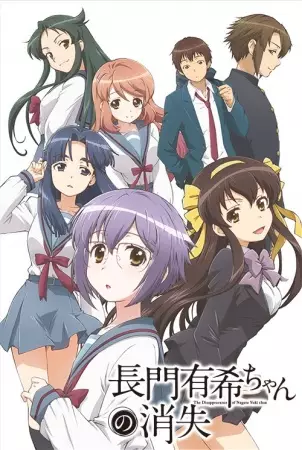
The Disappearance of Nagato Yuki-chan
長門有希ちゃんの消失
6.76(58K votes)
Ranked #6613Popularity #1802
episodes
16
Type
TV
Status
Finished Airing
Aired
Apr 4, 2015 to Jul 18, 2015
Studios:Satelight
ComedyRomance
Synopsis
In a familiar yet different universe, shy bookworm and gamer Yuki Nagato is the president of North High School's Literary Club. Her friends, the overly-cautious Ryouko Asakura and completely average Kyon, are the only other members of the club. Nevertheless, Yuki enjoys the peace and quiet she shares with them, especially when she is with Kyon, whom she has a crush on. Added to the mix are Tsuruya and Mikuru Asahina, two friends with opposite personalities who frequently stop by the Literary Club.
While walking back to her apartment on a cold December day, Yuki is coerced into drawing strange symbols on the ground by a girl supposedly attempting to capture Santa Claus. The girl introduces herself as Haruhi Suzumiya, an eccentric student from the prestigious Kouyouen Academy who is on the hunt for aliens, time travelers, and espers. When Haruhi and her friend Itsuki Koizumi make a sudden appearance in the clubroom, they declare themselves as official members of the Literary Club, with Haruhi taking up residence as the executive president.
With the tranquil days of the Literary Club now behind them, Yuki and her friends get caught up in a series of misadventures under Haruhi's leadership—with each incident bringing Yuki and Kyon closer than ever before.
[Written by MAL Rewrite]
148,230 Members
Worth Watching? — Global Verdict
6.3/10
Average Review Score
50%
Recommend It
20
Reviews Worldwide
International Reviews
HidamariSeashore
Recommended
9
As a fan of The Melancholy of Haruhi Suzumiya, I won't hesitate to watch or read (or at least plan to) anything related to that series. Of course, that includes this spin-off, The Disappearance of Nagato Yuki-chan. I read a few volumes of the manga and loved it, so when this anime was announced, my excitement was only doubled! However, I admit that I also had my concerns, as Kyoto Animation, the studio that worked on the original anime, didn't work on the spin-off. As it aired, I found that it wasn't received that well, either. However, that doesn't change the fact that I stillreally enjoyed The Disappearance of Nagato Yuki-chan.
Okay, so does anyone remember The Disappearance of Haruhi Suzumiya? This anime takes place in the alternate world from that movie, where everything is normal and there is no aliens, time travelers, or espers whatsoever. Yuki Nagato is a shy girl who is nothing like the Yuki Nagato we all know and love. This Yuki is a member of the Literature Club, along with Ryoko Asakura and Kyon. Yuki also happens to have a crush on Kyon. Basically, the anime follows Yuki as she goes through her everyday life with the Literature Club and her feelings for Kyon develops.
As you can see, a majority of the characters have changed. As I've said before, Yuki is now a really shy girl, and Kyon is kinder in comparison to the original. Ryoko Asakura is also different from the original; she acts as more of a motherly or a sisterly figure to Yuki. I wasn't really a fan of her in the original anime, and I'm guessing other Haruhi fans can understand why. However, that's not to say everyone's completely different. Mikuru still retains her character from the original series (which is a good thing, as I LOVED her in the original series), and Haruhi is still as fun of a character as ever. Even so, even the characters whose personalities have changed were still fun to watch, although I can't deny that they're still not the same as the ones we know and love.
The story is a good one, with lots of comedy and drama. The story is especially great in episodes 10-13, where the Yuki Nagato we all know and love is shown to us. The animation, I admit, is not as good as in the original series. What do you expect, though? It wasn't Kyoto Animation that did the animation this time; instead, it was Satelight. As a result, the animation is more bright and more cutesy, and it takes a while to get used to. It's not bad animation at all, though; in fact, Satelight did a good job with the animation. The voice actors also did a great job at reprising their roles, as expected. The OP and ED are great, too; I could listen to them on repeat without getting bored!
Let's face it, everyone; The Disappearance of Nagato Yuki-chan is NOT a Haruhi Season 3. However, it's still a really, really, REALLY enjoyable anime. If anyone liked Yuki Nagato from The Disappearance of Haruhi Suzumiya and want to see more of her, this anime is PERFECT for you. It's given me even the tiniest of hopes that The Melancholy of Haruhi Suzumiya will get an actual third season!
Episodes (16)
Filler Recap
Click an episode to read its synopsis.
Community Discussion
238 found helpfulJul 18, 2015
ZephSilver
Not Recommended
4
While I've never been much of a fan of the Haruhi Suzumiya franchise, I can still say, at the very least, that I admired the off-kilter charm it had and understood the appeal that others would find in its self-aware meta-humor. It was quirky, upbeat and had a trademark style of doing things that were uniquely its own. By itself, that might not seem like much of an accomplishment, but when placed through a filter with the countless other school slice-of-life titles produced after its inception, it becomes more apparent why it gained its popularity. Despite the anime industry being saturated with these dime-a-dozen titlesevery year, the Haruhi franchise still manages to stay relevant by being one of the few to tinker with the formula in inventive ways. And like most things tend to, it had its fair share of detestable moments as well (8 x ∞), but regardless of that, it still had a distinct identity that couldn't be found elsewhere. It's something you don't necessarily have to like, but you can still appreciate it for what it did.
Unfortunately, I can't offer the same accolades to its spin-off Nagato Yuki-chan no Shoushitsu ( The Disappearance of Nagato Yuki-chan). A "Spin"-off is supposed to take elements of its predecessor and add a new "spin" to it. In other words, it's supposed to do things differently from the status quo of the original series but still maintain aspects of it that connect it back to the parent story. While it was certainly "different" and a departure from the usual hijinks of the SOS Brigade, it had none of the charm or inherent value found in the parent story. In fact, The Disappearance of Nagato Yuki-chan is the exact opposite of what I saw admirable about the main story in the first place. It's a spin-off indistinguishable from the mass produced yearly offerings that I thought Haruhi never fell victim to. It's a title that got caught in the trappings of its genre's tropes, which automatically makes it a title that many would not speak of or forget altogether in the long run. The premise that it had wasn't bad, but the actual product that we were given was far from satisfactory.
Swapping the supernatural shenanigans and one-off adventures with a rom-com narrative, the story of Nagato Yuki-chan sees the titular character Nagato try to confess her love to Kyon, only for her attempts to end without fruition, and then they repeat the cycle by the next episode. There you go, that's literally it. For the 1st 10-episodes, what we're essentially given is your typical "would they or wouldn't they" scenario where every moment is ruined by the love interest in question or by a side character popping up at the most inconvenient time. In between these moments, they insert a lot of padding and fluff in the form of slice-of-life segments. This includes everything from your cliched bathhouse/hot spring episode, to your group field trips. If you've seen enough school SoL anime titles before, this is just a patch job of all the overused setups, with the only difference being that the characters are from the Haruhi universe. I feel like there isn't a need to spell out the obvious here but just in case it isn't already clear enough, this is G-E-N-E-R-I-C. But like I said, it was the 1st 10 episodes that followed this monotonous cycle, after that point, the show took an unexpected turn and introduced a plot twist that brought with it much needed character drama, but I'll save that information for the spoiler section for those who haven't seen the spin-off yet.
The story of Nagato Yuki-chan may have had good intentions, but the humdrum way it went about presenting it topped with the overused scenarios made it a tedious watch very quickly. It tossed in an unexpected twist for good measure, but by then, the damage was already done.
The art and animation of Nagato Yuki-chan were, for the lack of a better word, basic. This can also mark the 1st real point of contention for fans of the franchise as they altered all the original character designs that helped to distinguish the cast into moe ladened ones that make them appear painfully generic. Change isn't a bad thing per say, but when the change is a downgrade from unique character design to xerox copies, that change can be very jarring. Their "spunk" was gone. The quality downsizing didn't stop there, as there was also a lack of detail placed in any given background. Even the unique shot compositions were no longer present. This may have been the result of another studio handling the show, as Satelight took the reins from Kyoani in its inception; a choice that might have been the first big mistake. With no proper use of lighting, no attempts at unique camera angles, inept understanding of color theory and no real distinguishable atmosphere developed, the switch in studios was one that really put a damper on a show that was already holding on at the end of the proverbial rope. The only credit I can offer is that they were able to capture the right tone for the latter half of the show.
As if to add insult to injury, a majority of the cast felt alienated from the prior installments. Not only did they look generic but now even their personality is bleached. They were either rewritten or regressed in dimension, and some were also reduced to being used as nothing more than background decoration. Thankfully, some maintained their personality, like Haruhi and Asahina, but even then, they were all watered down versions of their former self. Nagato and Kyon took the lead roles in the story, and while Kyon still had his sharp whit about him, it was toned down quite a bit. His personality was altered to fit a more optimistic portrayal, which in turn erased the "person of reason" that he was always known for into a character that didn't quite fit the mold. It's okay if they wanted his personality to reflect better the more lighthearted tone the show was going for but his pessimistic outlook is as much of a signature of the franchise as is the yellow ribbons as much of a trademark style of Haruhi. Getting rid of it is like getting rid of a big chunk of what makes the character stand out.
Koizumi isn't even given any screen time and felt like he was only being placed the show as a carryover and nothing more. Same can be said about Asahina's involvement. They were both there to fill in their roles but was never given any time dedicated to them. A majority of the cast was underutilized or not even relevant at all. Perhaps the most significant change is that of Nagato's, and quite frank, it's the most grating. While the intention was for her to be an alternative story-line version to that of the movie, her personality makes a complete 180 if compared to the original and his grossly exaggerated if compared to the movie version. She's no longer the stoic, calculating Nagato but a shy hyperactive moe-blob with a pension for food and video games. It's a huge juxtaposition from who she was and one I couldn't buy into.
The cast as a whole was quite unappealing, and none of them was endearing or fleshed out. They were all husks of their former selves.
The soundtrack was forgettable. None of it ever grips you and remained as background noise. I can't recall anything special about it, as none of it stood out. The only time there was any visible effort came with the piano ballads towards the latter half, but even that was run-of-the-mill for what it was intended to do. The opening and ending themes were skippable, with the opening being a typical J-pop song and the ending a somber downtempo one. The voice actors were all fine, the only standout that comes to mind was that of Tomokazu Sugita's, who played Kyon. His monologs were always a nice touch and through it, provided insight into the situations the characters found themselves in.
***Spoiler Section****
(skip to the enjoyment and overall section to avoid spoilers)
So the big reveal that the show hits you with is that the old stoic Nagato from the main series randomly commandeered the body of the new Nagato of this spin-off, and while it was indeed an interesting twist..., HOW and WHY does this happen?
The plot twist had no buildup, no foreshadowing but just came out of nowhere with no explanation and then it went away just as quickly with no proper reasoning behind it. Honestly, it felt like it was a cheap ploy only there to break the monotony of the basic rom-com and in a desperate attempt to salvage viewer interest. The character drama that arose from it was nice, as it spiced things up, but with it simply popping up and then going away without consequence or reason, it just brought more questions than it helped with the overall show. Not to mention that even the stoic Nagato was reduced to acting silly and "kawaii" after the reveal, which defeated the whole purpose of her being introduced in the plot twist, to begin with. I don't know if they meant to use this as a chance to leave the story open-ended for a continuation or not, but it happened far too late into the story to matter, and everything was only brought back to the status quo by the time the series ended.
***End of Spoilers*****
Enjoyment: 2/10
I'm not going to mince my words here; I hated this spin-off. Every bit of me wanted to drop it, and the only reason I didn't is my OCD-like mentality towards finishing titles. It was bland, overly sentimental and a waste of effort.
Overall: 4/10
Nagato Yuki-chan no Shoushitsu is not only a stain on the Haruhi's name but one that manages to lose all the charm and wit the franchise is known for. It's a cash grab nobody wanted nor needed, and the only thing it honestly shares with Haruhi is the characters and familiar namesake. With that said, if you're an avid fan of the franchise, then I suggest keeping your expectations low, as it doesn't contain the same trademarks you'd expect from the series. And if you've been impartial towards the series thus far, then stay clear from this one or prepare yourself for a cringe-inducing experience.
185 found helpfulJul 20, 2015
Laupanan
Recommended
9
Its amazing how slight changes in perspective can cause something that on the surface seemed initially disjointed and disappointing, into an emotional experience that brings a surprising amount of satisfaction. Like most, I went into the series expecting the enjoyably discordant storyline, animation, and voice acting that the original series and movie had. I was consequently confused by Kyon's noticeably different appearance and a number of other slight visual changes that I shamefully explained away by learning the original studio hadn't worked on it. The first few episodes made it abundantly clear that it was not "The Melancholy of Haruhi Suzumiya", and finding that outannoyed me immensely.
However, as I continued to watch the series, I began to recollect parts of the "The Disappearance of Haruhi Suzumiya" in particular Nagato's role in it. As part of that recollection, I finally realized, "Ah... this is Yuki-chan's dream reality" and afterwards everything clicked into place. The visual aberrations weren't unintentional, there was meaning behind the almost cliche variants of this series' characters' personas, and even the series' romcom style, and use of aged animations, was used to create a traditionalized perspective reminiscent of Nagato's preferences that contrasts really well against the unreal and jolting, or Haruhi-like, characteristics of the previous series. With this new perspective, even apparently superficial references to the previous series begin to question which of the two realities (i.e. Haruhi's or Yuki's) is the "truest" one or had the most merit for existing. This issue could only have been seen from the original Yuki's perspective, and was briefly discussed in the movie; bringing it up in this manner in Yuki's reality neatly explains the logic of her actions in the movie while allowing Yuki's own personal wishes and motivations to remain at the forefront.
If you watch this series because you wanted a 3rd season of "The Melancholy of Haruhi Suzumiya", you'll be disappointed. However if you watch this series because you want to know more about why Nagato did what she did in the "The Disappearance of Haruhi Suzumiya" then I think you'll be pleasantly satisfied, and glad that this series made it to air. Personally speaking, the groundhog hell that Nagato went through in the movie still prevents me from watching it again; watching this series softens that angst and brings even more meaning to the series as whole.
126 found helpfulJul 21, 2015
Tozzy
Not Recommended
4
I don’t envy anyone who sits down and tries to come up with a spin-off story. Picture it: Here you are with a bunch of fun, memorable characters who each have a purpose but you want to change those around to create something new. If that wasn’t hard enough already, strip away one of the major genres that underpinned the original. Hand someone some paper and a pen and tell them to come up with something new with that added rule. It would certainly leave them scratching their head for a while. I’ve found the anime that shows why that’s not a simple task. NagatoYuki-chan no Shoushitsu is an attempted creation along that line, a romantic comedy created from the Suzumiya Haruhi series, with studio Satelight putting it to screen. In place of the supernatural we have a focus on romance. In place of Haruhi as the lead we have Yuki. The pieces were all rearranged on the board ready to start the game but then this anime didn’t know how to move them. It’s a show that relies too heavily on referencing the original series as opposed to crafting its own meaningful story. It’s all a big bunch of fanservice and if that’s all you’re after then there’s a few things you might enjoy spotting. But if you wanted to see some more creative spark or interesting developments in the story department you might walk away feel a bit sour.
I’ll also end up doing something in this review I normally like to avoid, and that’s compare it to another show. Given the franchise this anime is inspired from into I feel it’s only fair I draw upon Suzumiya Haruhi no Yuuutsu as a reference. Nagato Yuki-chan no Shoushitsu show fails to stand up on its own merits as a spin-off and there’s no better way to show that than by making this comparison. Note that this review contains minor spoilers for the original Suzumiya Haruhi no Yuuutsu series.
Story
Nagato Yuki-chan no Shoushitsu is a story packed with few surprises. Yuki wants to tell Kyon how she feels about him but every time she comes close to doing so she falters in some manner. Rinse, repeat. You get to watch episode after episode of it. The presentation can be fun and light hearted at least. It’s not as if the show is ever terrible, but it’s never memorable. As I watched on I couldn’t help but notice there was a serious imbalance between comedy and drama. It opts for laughs over love on too many occasions, and there’s little to no complication in the romance area. If there’s little external forces to come between our pair then what’s there to keep it interesting? There’s the odd curveball though that saves the show from being a complete flop, which I’ll come to.
More than the characters involved, nothing annoying me in Nagato Yuki-chan no Shoushitsu more than its boring episode structure. It tells you “Here’s your Valentine’s episode”, “Here’s your beach episode”, “Here’s your summer trip” and the list went on. It was sleep-inducing. While there’s a share of Easter eggs to be found in these episodes that pay homage to the original series, sometimes clever and subtle, often that’s all they are: references. They serve little purpose and it’s like the writer was saying “Hey remember this scene guys? This was in the original series!” You have a laugh, nod in agreement, and then go back to watching droll rom-com nonsense.
These generic episode set ups were still made to be exciting in the original series because romance was not at the forefront – it was a product of the mysteries and adventures the cast found themselves in. At least when Suzumiya Haruhi no Yuuutsu resorted to these stereotypical anime scenarios they came with that added spice of having to appease Haruhi. Even when the SOS Club were thrown into seemingly mundane situations you always had to expect the unexpected. It was a show that knew how to have fun because of that kicker. Here these same situations are used for nothing more than cheap laughs and with little to no romantic progression. When love is the theme, and you strip away the supernatural, things all come crumbling down.
By the time that Nagato Yuki-chan no Shoushitsu decided to start being serious and start exploring the mind of its lead character I had lost interest.
There was a serious imbalance in the way the show built up to its major complication. I was falling asleep. When the psychological drama came around it was like an alarm clock taped to my ear. I really wasn’t ready for it. Talk about a jarring tone shift. As jarring as it was though, I must say it was welcome. Here we are with not only some complication of substance, but also comes with one of the more clever throwbacks to the original series. It was the first sign of meaningful development for Yuki. It also changes up the dynamic between Yuki and Kyon a great deal. Dare I say the show even became somewhat interesting? It saves the anime in its run home but all I kept asking myself was “why didn’t this happen earlier on?” If you’re able to overcome how sudden – and maybe a bit ridiculously – things take a turn then you might get more out of this series than what I did. The ending is charming enough and I actually got a lot more out of it than I expected. While not entirely satisfying or complete, the presentation and references this time around were fun and felt useful.
Characters
Yuki obviously gets the big turnaround in behaviour when compared to the rest of the cast. Instead of the alien of few words, she is now driven a lot more by emotion. This gave her much more potential to express herself but watching her felt like a chore. How could they have made Yuki more interesting? Putting her character on a greater offensive would have been a great start. Don’t get me wrong, she really wants to make things change. She tries to express herself but you can guess how it always ends. It’s normally something along the lines of… awkward situation, exasperated overreaction then back to square one. You can find that one in the first chapter of “Writing Generic Romantic Comedies 101”. I wouldn’t be mad if Yuki followed the start of those guidelines but then actually took something away from her experiences, and learn to fend for herself. Instead it’s always mother Asakura to the rescue and Yuki herself doesn’t seem to take anything on board. It’s like every episode restores the status quo.
Speaking of the devil, that’s all Asakura’s role in this series is. She’s there to pick up the pieces Yuki leaves behind and do everything for her. She’s more of a parent than a friend. I understand that this is another interesting tie-in to the original Haruhi series (in particular the film) given the ‘protective’ nature she had there, but watching it here is tedious. She had the potential here to play a much more active role in this love story but content to hang back to provide annoying comedy (hey look she’s pulling a scary face again) and repetitive relationship advice to Yuki.
This may sound a little mean, but Kyon is just too happy and untroubled in this show. His best asset was his frustration as a result of the situations he found himself thrown into with Haruhi. He becomes just another generic anime high school male character this time around when left alone to his own devices. While we get the odd look at the old Kyon we know and love, it sadly isn’t the one taking centre stage. It’s unsurprising that some of my favourite moments in this anime came from his dialogue with Haruhi. It’s not a good sign when your main female lead can’t bring out the same level of engagement. All Nagato Yuki-chan no Shoushitsu will do is make you miss Kyon’s non-stop stream of amusing thoughts and inner monologues.
Everyone else in the show just feels like they’re there to advance the story and take the group to somewhere new. They don’t feel like active players in character relationships, again just there most of the time to remind everyone what series’ spin-off you’re watching. Haruhi manages to steal the show away from Nagato quite often. I thought she was going to add a bit of conflict this story but I was let down with that idea. Everyone else isn’t even worth touching on.
Thank goodness the original cast returned for this and helped to correct that somewhat. Tomozaku Sugita, while limited with his capabilities in this show, still gives Kyon that snarky edge through all his rom-com suffering. Minori Chihara actually gets the chance to put some sentences together as Yuki and does a fair job in a new role as the blubbering, timid female lead. You also don’t need me to tell you that Aya Hirano, as Haruhi, was excellent. I have to say that people have ragged on the character designs a bit too much. I actually like that Satelight tried to distance themselves away from KyoAni’s designs and make something unique on their end. Are they memorable? Not really, but they’re far removed from the worst I’ve seen. It’s fair that you compare the roles of characters between this and the original series, but it’s unfair to do the same for the art style.
Summary
Here’s the big problem with a spin-off that changes up the dynamics and personality of its characters: The original series is crafted around the interactions and clashes of those personalities. Changing this up is asking for trouble. Now in Nagato Yuki-chan no Shoushitsu the roles of these characters have become uninteresting and out of place. All the drama in this show is boring and everyone outside of Kyon, Yuki and Asakura don’t seem to have anything to contribute. I’d struggle to recommend Nagato Yuki-chan no Shoushitsu even to a fan of the franchise.
If you could sum up the show you could call it “References: The Anime”. All it does is serve as a reminder that you could be watching its more superior reference anime. Granted, Nagato Yuki-chan no Shoushitsu never tries to emulate Suzumiya Haruhi no Yuuutsu. It knows it’s only a spin-off. It goes for a completely different theme in its story but its execution was iffy. Pointless, meandering slice-of-life antics took up too much of the show. When it finally ditched them I’d come too far through the 16-episode count. It tries its hardest to look back of those SoL previous experiences and make them feel significant but it falls flat on its face.
Score: 4/10 (Poor)
51 found helpfulJul 17, 2015
Stark700
Mixed Feelings
6
It’s like something born out of a fairy tale story. Nagato Yuki-Chan no Shoushitsu (The Disappearance of Nagato Yuki-chan) is no Haruhi Season 3. In fact, it’s more a spinoff taking place in an alternate universe where aliens don’t exist, Kyon seems normal, and Nagato Yuki is almost nothing like what fans remember her from the original series. As far that goes, this spinoff is more or less of a slice of life story that mixes in elements of drama, romance, and some SOS shenanigans. Based on the manga of the same name, the series consists of 16 episodes that depicts the life of NagatoYuki. Unlike the stoic girl that many fans remember her as, she is rather timid and shows much more human emotions than her Haruhi counterpart. Make no mistake though, she still retains some characteristics such as her love of reading books.
As of the story itself, Nagato Yuki-Chan no Shoushitsu is very straightforward. We meet Nagato Yuki, the titular character of the show as she has an encounter with Kyon. Because Kyon isn’t like the cyclical self that we remember him as, he is able to easily make friends with her. Then enter Haruhi, the girl that made herself famous from the original series. And in this show, she is also shown to be kinder yet still full of energy. The first few episodes easily establishes the primary character cast. They compose of Nagato, Kyon, Haruhi, and joining them includes Mikuru, Itsuki, and Asakura. A good amount of investment comes from the relationship building. In particular, Kyon and Nagato shares some similarities and the two seems to be able to get along quite well. There’s also some very obvious attraction that Nagato shows towards Kyon. While the show isn’t entirely structured as a rom-com, it does highlight such moments from time to time.
Drama also does come to play at some pivotal moments in the show. This is shown early on in the series as Haruhi gets into a controversial love angle between her, Nagato, and Kyon. What started as a misunderstanding degenerated into tears and sorrow. Unfortunately, there’s really not much to expand on the story development beyond that. It’s too simple and formalistic with a predictable outcome that anyone could of seen coming. What’s more is that Nagato shows her vulnerability that fans might not be able to adapt with well. After all, she was always supposed to be a stoic girl with almost a lack of human emotions. Here, she shows more human emotions than she ever did. In retrospect, the series isn’t very good at dealing with drama. It fits more as a slice of life series and attempting to craft drama doesn’t make the series distinguishing. On the bright side, the chemistry between Kyon and Nagato can be genuinely heartwarming to watch. It not only brings out the honesty of their characters but also shows how they can co-exist to tackle almost any problem. On the other hand, the show is sometimes overshadowed by Haruhi. She is like a bright and shining energy ball that just never seems to stop glowing. While the main protagonist is Nagato in this spinoff, it’s really hard to ignore Haruhi’s presence when she makes herself stand out above others. The plus side is that she isn’t a jerk that some of us remembers.
At some point in this series, it will seem like a chore to watch. I had this sort of feeling early on when comedy on top of comedy is thrown towards the audience. While it seems fun at first, it just seems like dead humor. The jokes quickly become stale while doesn’t really add anything new for the audience to experience with. Characters also shows little change to their personalities until a certain episode. However, if you get to over half the show with patience, then you may be surprised. In one of the later episodes, the story brings out a side of Nagato Yuki that we may be familiar with. The tone of the show changes drastically for several episodes as we see this complex side of herself. Perhaps this will refresh your memory of the original Nagato as well based on her behavior. What’s more is that it also brings out the best from other characters such as Kyon and Asakura. It shows their care for a friend when they need it the most. Furthermore, I have to say that the show adds a bit of suspense that invites anticipation. While the show at that point still retains some comedy with slice of life elements, it’s almost like a 180 degree shift from the first half of the season. Sometimes, a shift like this may seem risky. But for a series that already foreshadowed some of the events, it effectively delivers. In retrospect, the short yet melancholic arc (episodes 10-13) will be an emotional ride.
Satelight is the studio in charge to deliver art visuals. And for that reason, don’t expect the artwork or visual quality to be top stellar. In fact, the show’s character designs and setting looks only moderate with generic characteristics. Nagato Yuki also looks different from her original self although still retains similar clothes and her trademark glasses. Then, there’s Kyon. Some fans may barely recognize him at first until he begins speaking on-screen. On the other hand, Haruhi still looks the same while other characters such as Mikuru gives off the Ms. Fan-service vibe. In fact, fan service is no stranger in show. From the curious camera angle shots, bouncing boobs, and classic onsen episode, it’s safe to say that the show really wants to service the fans. And in terms of comedy, the facial expressions of the characters are almost endless. The highlight part of the series is the deeper development such as the symbolism of the rain and OP/ED song adjustments. When carefully examined, it really brings out a meaning for this show’s title.
Surprisingly, the soundtrack is an important part of the show along with the voice mannerisms. In order to capture the new refreshing feeling of this spinoff, the characters needs to connect with the audience. In the beginning, it seems that they can do just that. Despite some annoying antics such as Haruhi’s overwhelming personality, the characters are able to carry the show and not bore the audience. Similarly, the soundtrack has a nice balance that changes from the casual and humorous tone in the first half, to a very melancholic and atmospheric feeling in the second. The OP and ED theme songs also reflects a good amount of this change. And in general, the music is something that can easily be enjoyed whether you’re a fan of the story or not.
A show like this seems like a blast from the past on first glance. But in the end, it’s not much like so despite some similarities with the original Haruhi series. If you’re a fan of humor, drama, and lots of slice of life, then this show will no doubt be something you can tolerate. While the series does attempt to emphasize the romance context as well, it doesn’t work out right in the end. Let’s face the facts. Nagato Yuki-chan no Shoushitsu isn’t really a rom-com. While the relationship connections are evident and the chemistry is charming, the drama itself is polarizing. On the other hand, the series does craft melancholy quite well. The shift from a certain mood from one to another of the complete opposite will seem like a surprise and keep you at the edge of your seat. And for a show like this, it’s what’s needed to keep it somewhat interesting.