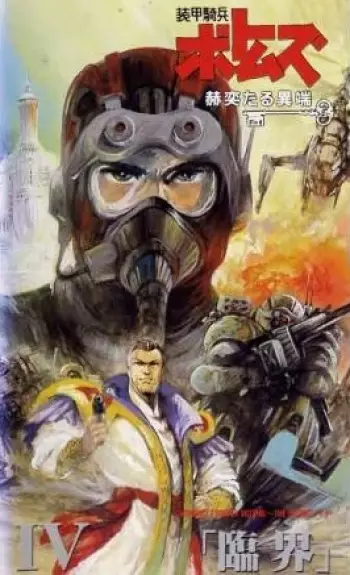
Chirico is awoken from cold sleep and separated from Fyana. His attempts to find her come to the attention of a Nextant, the replacement for the Perfect Soldier program. At the same time, the new Pope is to be nominated, and Chirico is religiously considered to be "The Untouchable". With one of the nominees related to the Nextant, Chirico's actions will have far-reaching political ramifications.
(Source: ANN)
4,801 Members
Worth Watching? — Global Verdict
5.8/10
Average Review Score
40%
Recommend It
5
Reviews Worldwide
International Reviews
zaogon
Not Recommended
3
TLDR: Shining Heresy is a 5-episode OVA series that is a good 2 episodes too long, choosing to focus on dull church bureaucracy rather than Chirico or interesting mech action scenes. Full review: The strongest two arcs of the original VOTOMS TV series were easily the middle two arcs (Kummen and Sunsa) in which Chirico is rivalled by Ypsilon for the affections of Fyana. It's an oddly engaging love triangle stuck in the middle of a real robot series that focuses on the mentality of a soldier. Shining Heresy attempts to go back to this by introducing a new rival for Chirico in the form of Teitania,a "Nextant" who was created ostensibly for the purpose of replacing ATs and I guess also destroying Chirico. However, it also incorporates notes of the Woodo arc of the VOTOMS TV show by setting her up as a female love interest for Chirico.
This is done in the most awkward and illogical way possible; Teitania literally falls in love with Chirico for no really good reason after he shoots her. Let me emphasize that Teitania sees Chirico like two times and is shot by him before falling madly in love with him and deciding to follow him forever. It makes Fyana's reasons for loving Chirico seem completely legitimate.
The biggest problem with Shining Heresy is that it is not about Chirico. Chirico barely ever appears on screen; the other characters certainly do a lot of TALKING about Chirico but the focus of the OVA is clearly on a completely unrelated story about "The Catholic Church, Except In Space" and a yawn-worthy competition over who is going to become the next Space Pope.
To the OVA's credit, the original VOTOMS show did not really explore the role of religion in the VOTOMS universe so in theory it's a cool idea to explore it, but the problem is there's no context given. Why does this church matter? What do they control? What are the stakes at hand in this competition to kill Chirico in order to become the next Space Pope? None of these questions are resolved by the end.
Oh yeah, Fyana is there too. But she has like a total of 5 lines and is pretty much just a plot device.
And here's the thing about Fyana: She's always been a very flat character. She hit her stride in the middle of the TV series when she was actually fighting in her AT, but the latter half of the series reduced her to a damsel-in-distress sitting around yelling "CHIRICO!!" every so often. But they've gone a step past that in Shining Heresy and she's incapacitated for the entire OVA and then... well...
I won't spoil what happens but the conclusion of Shining Heresy left me scratching my head and wondering "OK, but why?" Well, the answer to that question seems to be that the writers wanted to take Fyana out of the story and replace her with Teitania. Seeing as VOTOMS is about Chirico, that is the only major development that has transpired by the end of this OVA, and one wonders why the writers felt the need for this development. Sure, Fyana wasn't the best character, but she was Fyana! 50 episodes and several OVAs of Chirico chasing Fyana, and for what?
The art and sound are OK for a 90's OVA; it's obviously a low-budget production but nothing stands out as ugly. There's a new OP that isn't quite as catchy as the original OP but is still listenable. The scarce few mech battles are pretty interesting as far as VOTOMS go, and I honestly thought Teitania vs. Chirico in episode 1 was the highlight of the whole thing.
Overall, it has a few fun action sequences but they're stuck in a swamp of boring dialogue about Space Catholicsm. It tries to ambitiously explore the role of religion in the VOTOMS world but it fails to properly provide context for why the story being presented matters at all. Still, if you plan to watch the other VOTOMS OVAs after this one, you may want to just grit your teeth and bear with it for the major plot development that occurs in Shining Heresy.
Episodes (5)
Filler Recap
Click an episode to read its synopsis.
Community Discussion
16 found helpfulMay 31, 2016
punishedsneed
Mixed Feelings
6
The worldbuilding in regards to the Church of Martial isn't as bad as some other reviewers here seem to think. Besides how cartoonishly old the space Pope is and how, well, absurd the elders act, the main reason why this expansion of Votoms' in-universe religion comes off as bad is because it doesn't click in with the original series. The Secret Society were a break-off group of this Church? I don't know, it's all very obviously written in after the fact. Not that the writers for Shining Heresy had that much to work with, but it seems like overkill. The mecha scenes are good, but thelast fight between Chirico and Teitana is rather ridiculous in how the protagonist wins.
All in all, Votoms is a very hit or miss series - and this OVA sequel is very hit or miss, too. Teitana's infatuation with Chirico makes little sense, as does the Church obsession with him. It would have made more sense if they brought up what Chirico does at the very end of the series. How does Wiseman fit into their Church? Does he at all?
Not boring to watch; definitely enjoyable to sit through. But rather disappointing.
4 found helpfulMar 5, 2020
young_kappa
Mixed Feelings
6
What we get out of The Shining Heresy is disappointing compared to the show it branches from, Armored Trooper VOTOMS. Despite being full of missed opportunities to expand on the story of VOTOMS and the previous OVAs based on the series, watching this one still has its own merits. The story is the biggest and probably only major weak point in The Shining Heresy as a whole. Shining Heresy's writers had to fish for a new conflict to make the next entry in VOTOMS ripe for watching and ultimately decided to turn the Space Church into a major factor, something that was pretty much onlymentioned in the original show. After a number of asspulls with Chirico and his immortality it was decided that he was a freak of nature and was deemed untouchable, and a Nextant (which is basically a human AT and the successor to the PS program, I have to admit it's actually a really badass concept) named Teitania is sent to either convert Chirico to their religion or exterminate him. The reason for this despite marking him as untouchable either wasn't there at all or it just slipped past me and I really don't want to go back just to find out.
A big part of the original VOTOMS story was Chirico's struggle to be with Fyana, who he fell in love with.. After seeing the two finally get together following being hunted down by entire armies, then subsequently watching The Shining Heresy you'll feel pretty duped because Teitania ends up replacing Fyana as Chirico's love interest only after they try to kill each other a few times or something. I don't mind good endings or sad endings but when one is already established and then soiled by another story it only comes off as frustrating to me.
In just 5 episodes there is enough to keep you entertained and maintain a continuous interest in watching however. Seeing the evolution of VOTOMS from the 1980s to the 1990s standard is really fulfilling in its own right and through time it still stays true to what made the original series so good, with its gritty combat and emulation of real war's expendable nature. Along with that it still has its jazzy soundtrack that works so well with the series and a new opening that I must admit I like better than Honoo no Sadame after hearing it so much.
If you're a fan and you want something that looks and sounds good, even if it doesn't really FEEL good, The Shining Heresy will satisfy you. If you're not interested after seeing this review take my advice, and let the story end where the show ends.
7 found helpfulMar 5, 2017
SliceofSlice
Recommended
7
This is less of a structured review and more so my thoughts on Brilliantly Shining Heresy as a sequel to Armored Trooper VOTOMS, discussing vaguely the direction and themes of the show without spoilers. Despite how wacky Brilliantly Shining Heresy may seem at first as a sequel to VOTOMS, I do feel like it is a good continuaton of the elements explored in the final arc of the show. Brilliantly Shining Heresy explored more of the religious and secret society beliefs in the setting which was interesting following the end of VOTOMS where Chirico is revelaed as an overman who is now a known entityto both the Gilgamesh and Balarant armies which he is pursued by. Considering this, the story is set within a schism between the religious factions and how to deal with the knowledge and reality of such a person existing.
Because of this the plot feels less grounded compared to early VOTOMS. My favourite arcs of VOTOMS were Woodo and Kummen so I do miss the action adventure side of VOTOMS with the merry gang of Gotho, Coconna, Vanilla and even Shako who are sorely missed from Brilliantly Shining Heresy. The story more so follows a new character, Teitania who is an answer to Chirico and in light of Chirico waking up the story explores the mystery of her backstory and destiny.
With this being the focus of the story Fyana is sidelined to being more of a princess in a castle. Lastly, the explaination for the ending seemed to me to lack pretext and felt shoehorned. If this was to be the finale to the franchise it is the inverse to the original series but writing this in 2024 i'm looking forward to seeing the other OVAs and sequel to Brilliantly Shining Heresy.
The standout aspect of BSH for me was seeing the worldbulding expand with more revealed about the church and the evolution of AT and PS technologies. Especially with the contrasting grungy 90s sci fi and baroque aesthetics.
1 found helpfulMar 11, 2024
BuRizzle
Recommended
7
Perhaps the most divisive entry in the entire VOTOMS catalog. The Shining Heresy is the first proper sequel in the series’ lineage, debuting nearly 10 years to the day after the TV anime had concluded. Despite repeated instances by series creator Ryousuke Takahashi that the VOTOMS’ story would not continue past the end of the original show, he still returned to direct this strange and contentious OVA. Truth be told, I was anxious going into this one. I’ve heard horror stories about Shining Heresy. How it killed the franchise, ruined the original series, and salted the earth of all who watched it. I was awareof the twist at the end, but everything else was new to me outside of there being a big focus on space Catholicism. The TV anime had ended so perfectly; was a sequel really necessary? Would it do justice to the themes and concepts of the original? Will the wind ever truly know?
32 years have passed since Chirico Cuvie (Houzumi Gouda) and Fyana (Kazuko Yanaga) went into suspended animation on the outbreak of the fourth Gilgamesh-Balarant War. Both wished to one day see a world without conflict, but fate has other plans. After their sleep capsule is accidentally retrieved along with other medical pods, Chirico finds himself reawakened and separated from Fyana. Once again back behind the wheel of an AT, and with the assistance of an army doctor named Godiva (Masashi Ebara), the Overman sets out to get her back. Hot on his trail is Titania da Montewells (Youko Matsuoka), a highly advanced cyborg warrior known as a "Nextant," under strict orders from the Church of Martial to eradicate he whom they call The Untouchable One at all costs.
One of the biggest issues viewers have with Shining Heresy is its focus on world-building and politics compared to Chirico’s adventures. The story primarily revolves around a power struggle in the Church of Martial, a religious body that wields immense influence in the Astragius Galaxy. A great deal of screentime is spent on a conclave to determine the successor to the current Pope, as well as Chirico’s sudden reappearance and what that means for the church. This can understandably be a bore for some. The original anime was notable in that it tended to shy away from focusing too much on the political goings-on in the setting (outside of the second arc), so having the sequel spend a considerable amount of time on debates and meetings for a newly introduced faction is quite the turnaround. However, I believe the criticisms of these moments to be overblown.
While these scenes do tend to focus on theological debate and schisms in leadership, they also serve to answer several questions raised at the end of the TV series as well as expanding and elaborating on the setting. Why was Chirico's and Fyana’s capsule ignored despite them both being a hot commodity? Why is the Astragius Galaxy seemingly so obsessed with conflict? What do people think of Chirico after his brief stint with godhood? Shining Heresy provides answers to all of these questions in a way that doesn’t feel intrusive or contradictory to other entries. These scenes also help further expand upon several of the themes put forth in the original anime. Luck and chance, faith and devotion, as well as humanity's relationship with God. There’s even some extra background provided for the antagonists of the Uoodo and Kummen arcs, which is always a plus.
However, because of this change in focus, I hesitate to really call Chirico the protagonist here. While he’s front and center in the opening animation, most of the story is centered on Titania and her role in the church of Martial. On one hand, I understand that this will likely be frustrating for returning fans. As others on this site have pointed out, the OVA spends more time talking about Chirico than actually featuring him. Thankfully Titania is an excellent character with a compelling story to tell, even if ultimately she is cut from the same cloth as Fyana is. While there are some aspects of her character that feel rushed, likely owing to the brief runtime of the OVA, Titania is still a likeable figure who helps drive the story forward. The rest of the newcomers aren’t really much to write home about, with the exceptions of comic relief Godiva and Titania’s father, Vyacheslav, a cardinal in the Martial church.
But what of our main man himself? What about Chirico? Well, there isn’t really much to say. Seeing as how his arc was completed in the TV show and how his screentime is noticeably limited here, Chirico is kind of just there, barreling forward towards his own goals while the plot progresses without him.
While we are shown more of his kind and selfless nature, as well as his intense devotion to Fyana, these were aspects that were already depicted elsewhere. The anime ends with Chirico’s character remaining stagnant, perhaps even regressing a little. We learn nothing new about him, and he does not noticeably change as a person by the end, outside of becoming even more miserable than he already was. Fyana is even less of a character here, being on ice until the final two episodes and with only a handful of lines. While her role in the TV show seemed to generally change depending on the arc, she was still a driving force in the plot and was developing as a character even when she was mostly in the background. In Shining Hersey, she’s more or less a glorified trophy. Like in the Big Battle OVA, she is reduced to a damsel in distress. An object for Chirico to retrieve, which kind of sucks, as it is not only a detriment to her character but it also robs the audience of her unique and compelling dynamic with him. Granted, Titania does fill some of these gaps, but even she has relatively limited contact with the man.
Of course we can’t talk about this OVA without delving into its infamous ending, probably the one thing the anime is known for. I won’t spoil it here, but if you’re reading this you likely already know what happens. To avoid going into too much detail, I’ll just say that despite my reservations going in and the sour feeling it left, it was still handled reasonably well. If I were given the choice to write this story, would I have included it myself? No, but even if I disagree with the plot choices here, I think the team did well with what they had, creating an emotionally moving ending without it feeling hackneyed or too melodramatic.
It appears Shining Heresy had a lower budget than the other VOTOMS entries, as while it still looks great, the animation is noticeably limited in some spots compared to the OVAs that came before it. The final battle in particular mainly relies on still frames to depict combat, which is disappointing for a franchise that is known for its high-quality action. In contrast, the character art is strong and visually appealing. Fyana in particular looks great here, the animators clearly pouring a lot of effort into her scenes. Like the other OVAs, not counting Mellowlink, there are few new mechanical designs here. But what is here is solid, mainly Titania’s custom Order Buckler and the new Scopedog variant: the Burglary Dog. As with basically every other VOTOMS entry, the music is great. Pretty damn funky too. Compositional duty is once again handled by series veteran Hiroki Inue, and while it may not reach the heights of the original anime and Mellowlink, the pieces featured here are still very strong and fitting. Opening and closing themes are also excellent, in particular the opener Kaze ga Shitteru (The Wind Knows) by Shinya Iguchi, a gorgeous song that stands toe-to-toe with Honoo no Sadame.
Comments made by director Takahashi in the afterword for his novelization of the original VOTOMS anime seem to suggest that his heart wasn’t in it when he returned to direct the OVA. That likely accounts for the bleak, almost spiteful nature of the story. Combine that with the highly controversial ending and it’s easy to see why fans were so resistant to Shining Heresy. The lack of a proper continuation for nearly 20 years after also likely didn’t help matters. Time has been kind to it, though, with sequels and novels helping expand on some of the OVA’s more contentious choices. But in a vacuum, Shining Hersey is still quite a strange watch. It’s even more depressing than usual for the franchise; the miserable and hopeless tone that seemed so prevalent in the other entries is even more all-encompassing here.
In a way, I have to wonder if there’s some kind of metatextual nature to the whole production. Fans had demanded a sequel for a full decade, desperate to see more of Chirico and Fyana’s exploits. A sequel finally comes out, and not only does it immediately split them apart and squash any kind of hope for a happy ending in this franchise, but it also seems adamant on moving the focus to an entirely different viewpoint. A majority of the discussions early in the plot center around how waking up Chirico is a disastrous idea and how it will upset the natural order of things. Chirico is widely known as “The Untouchable One”; Church doctrine mandates that he be avoided at all costs. Yet Chirico is awoken and once again forced back into the cockpit of an AT, destined to keep fighting until he dies, whenever that may be. He can never rest and he can never be happy. I’m probably reading too deep into it, but it does make me wonder. Was the cruel nature of the story and how it handles Chirico and Fyana the real Shining Heresy?
While I enjoyed my time with Shining Heresy, it’s difficult to really recommend it. Given its nature as a sequel, anyone who hasn’t seen the TV anime and some of the OVAs will likely be completely lost. On the flip side, its treatment of certain characters and the larger focus on world-building and politics will push away fans wanting more Chirico. If you come in with an open mind, Shining Heresy can be a rewarding and interesting watch, but its short runtime and dour tone can be hurdles even for committed fans.
Armored Trooper Votoms: The Shining Heresy is owned by Sunrise. It is currently licensed by Maiden Japan but is out of print as of writing.