Links go to search results. Availability varies by region.
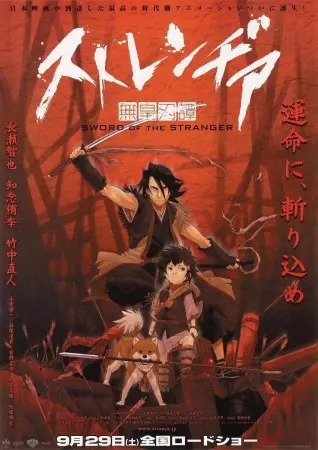
ストレンヂア -無皇刃譚-
1
Movie
Finished Airing
Sep 29, 2007
In the Sengoku period of Japan, a young orphan named Kotarou and his dog Tobimaru steal from unsuspecting villagers in order to make ends meet. However, Kotarou is forced to remain on the run when he finds himself being hunted down by assassins sent by China's Ming Dynasty for mysterious reasons not involving his petty crimes. Fortunately, the duo run into Nanashi, a ronin who has taken refuge in a small temple, when Kotarou is attacked and Tobimaru poisoned. Although the samurai saves the helpless pair from their pursuers, he feels that there is no need to help them further; but when offered a gem in exchange for his services as a bodyguard, he reluctantly accepts Kotarou's offer of employment—just until Tobimaru is healed and the two reach their destination. As the three set out on a perilous journey, it soon becomes evident that their path is riddled with danger, as the Ming Dynasty has now sent a terrifying swordsman after them to capture Kotarou and fulfill a certain prophecy. [Written by MAL Rewrite]
9.0/10
Average Review Score
95%
Recommend It
20
Reviews Worldwide
Sword of the Stranger is both unusual and refreshing in the way that it seemed to come out of nowhere and prove to be a remarkable anime. It seems, lately, that anything warranting a large budget and a lot of effort from a studio is either a sequel, an adaptation based on a successful manga or novel, or the next dull addition to a creatively stagnant franchise. None of these things, Sword of the Stranger is an unexpected big-budget film, which leapt instantly to the forefront of my favoured anime movies with exhilarating action sequences, captivating visuals, raw, evocative music and simple but affective characterisation.The look and sound of the show will instantly grab you, and perhaps even carries the film over the insubstantial plot backbone. Some people have already ordained this film as a classic of sorts, but I’d have to disagree with that, simply because, although it hits hard and fast with splendour, and resonates beyond mere eye-candy, it doesn’t have a crucial element to elevate it into that tier. The characters do have sufficient weight for the audience to empathise with them, and they are also very likeable, but I felt that my appreciation of the characterisation is due largely to the voice talent behind them. So, credit goes to the cast and not necessarily to the way the film was written, which perhaps had more featured characters than it should have. If the film had focused more on the central to characters, I feel it could have been a classic, or at the very least, deliver an even more powerful finale. Perhaps replacing some of the action scenes with more intimate, personal character moments could have helped. But that minor gripe aside, the big problem with the film was the gaping hole where the plot should be. A plot should always be more than just a vague framework to drive a movie from one scene another all the way to the climax. It should give credence to the movie, so that the film has a certain importance or reason. As it was, the plot, both simple and relatively silly, told me that the film existed for the sake of great action scenes. It’s a valid premise for entertainment, but it means there’s no lasting impact on the audience because it doesn’t really have anything much to convey. There’s no story here I haven’t seen before in this genre, and for much of the time the plot is a little too confusing. It seems I’d almost forgotten the potential for animation to be so visually compelling. On a technical level, the anime medium has frequent success, but transcending animation quality, it’s a very rare experience for an anime to be truly visually compelling, creating not just mood and detail, but also scenes of beauty. This film achieves that in a way that totally blew me away, and I don’t say that very often (I’m not one of those apt to calling every Kyoto Animation production flawlessly animated). The climax of the film, a roaring skirmish amidst snow and fire, is breathtaking and elegiac. More than just an impressive, visceral action sequence, it is tinged with emotion and dramatic tension, which drives the film up to its climactic pinnacle. As I say time and time again, the concept of a conclusion is highly important to me. When anything ends I expect more than a bit of excitement, or an explanatory wrap-up, I want the climax to resonate and to pay-off the themes of the series/movie. This film does achieve that, and even though it is devoid of really challenging and engaging themes, it still manages to be moving with likeable characters and endearing score music. In my mind, an anime that can end on a powerful high note, with stunning production and consistent pacing, is a winner. Even though the film falls prey to a number of action film clichés, and at times feels like a rehash of bits of the samurai film genre, and even though its plot is undemanding and almost silly, it is irresistibly engaging. Beyond anything else, this should definitely be approached as an action film, and with that approach, I can safely say it is a great accomplishment in its genre. It is fast-paced and features fierce, clever battle sequences, but more importantly, overshadowing the violence (which any action film can claim on), it is rendered with artistry and beauty, and effortlessly tugs at your heart. Frankly put, the only flaw in this film is the slight lack of depth to the characters, and the completely unremarkable plot. But if, like me, you’ve grown tired of the relative mediocrity of most anime television and want something to renew your love for the anime medium as an art form, this would be a good bet.
Wow. This movie has left me nearly speechless. There are scenes in it that are shocking, jaw-dropping, amazing...if you haven't seen this movie yet, and you like action movies, with a good plot, solid characters, and the best action sequences I've ever seen in an anime, then beg, borrow, stea---er, do whatever you can to get your hands on it. You won't regret it. Take my word for it. I guess I could just say that and be done, but if you're not convinced yet, I'll pimp it some more. Story - typical action stuff, set in historical Japan, but has twists enough in the plot tomake me unable to predict exactly what was going to happen next--and I've watched enough action movies and anime to know that this one stands firmly within its chosen genre, yet breaks out of it from time to time. This, I think, makes it interesting to watch (because who wants to be able to predict the whole story?). Art - Quite good, detailed backgrounds, though there aren't that many grand, sweeping vistas in this movie. There's some CG that's done fairly well. The action scenes is where the animation makes you sit up and question whether what you've just seen is drawn or not. I've never seen sword fights done this well before: without excessive slow-motion, artsy camera angles, just straight up, flat out, swordsmanship. Of course, it's flashy, but much more realistic than many live action sword fights I've seen in other movies. The characters are drawn realistically as well. Sound -There were distinctly Japanese themes and instruments in the soundtrack. Perhaps a bit over-dramatic at times, but I like dramatic music to set the scene, so though it may bother some people I liked it a lot. Character -Some cliche/stereotypical stuff here, but for the most part, sympathetic characters. There's no annoying characters, and the main characters are developed/change throughout the course of the movie, which in my opinion is hard to do considering the time constraints. Enjoyment -Well, if you don't like a lot of blood, then your enjoyment will be lower than mine. I don't particularly like loads of it, but in this movie, since the fight scenes are realistic, with swords and all, there's all the slicing and dicing of enemies you can possibly imagine that goes on. Ok, enough of my raving about it. Just go watch it already!!
Story: Stranger is first and foremost an action movie. Because the meat and potatoes don’t lie primarily with the plot, its straightforward and very typical “unlikely hero” premise is forgivable. A wandering swordsman reluctantly agrees to protect a child from an elite Chinese expedition. The local feudal lord joins the pursuit, stacking the odds further against the protagonists. By no means am I implying that the story is bland. The web of tangled motives creates conflicts between the feudal government and the Chinese, and also internal conflicts within each group. There’s plenty of plot movement here to justify a feature length filmeven though the simple premise of “samurai protects child” remains throughout. The overall simplicity is, in fact, a benefit to this historical martial arts epic; the story flows at a brisk pace, but remains cohesive and effortless to follow. This straightforward approach to the plot lends itself to the primal, action oriented appeal of this film. Animation: In the bread and butter aspects of the visuals, Stranger isn’t especially impressive for a movie. Though the character animations show consistent attention to details of weight and balance, the ugly CG and the lack of textural details in the background make the more mundane scenes easily mistaken for a half decent TV series. As soon as the first action scene shows up-and fret not, for this occurs during the opening credits, the merits in the visuals suddenly become abundantly clear. Aesthetically, these scenes are impressive. The characters are spritely and acrobatic, but grounded with a touch of realism in their body mechanics. Even in the fastest exchanges, the frames of animation are sufficient to keep individual moves distinguishable. Regarding everything that puts the drama into gratifying action scenes, Stranger delivers in spades. The action choreography moves at lightning speed with elaborate exchanges passing within the blink of an eye, but apart from a few of the villains’ excessively acrobatic flourishes, the characters’ techniques still manage to stay within their weapons and personalities. The main character, for instance, is an unambitious, get the job done kind of guy, which comes through in the action scenes with his simple, fundamentally sound usage of his two handed sword. The fact that he actually cuts and thrusts with two hands may seem like a trifle detail, but it contributes to the continuity of his character. Considering the characters’ personalities in the choreography make it altogether more believable, more engrossing, than if it had been treated merely as eye candy. This film puts the “acting” of the characters to good, tension building use as well. With their body language and facial expressions, most of the characters show fear as they barely manage to thwart an attack and an eruption of killer intent as they deal a finishing blow. A few of the villains are emotionally unphased by pain, which, by design or not (in this case, it is by the design of the plot), saps a little of the drama out of these scenes. Still, a good majority of the cast members, including the main character, deliver convincing performances that make these fight scenes more like a tooth and nail brawl, and less like a ballet masquerading as violence. Sound: The music primarily consists of the powerful orchestral pieces typical of epics. The ever present leather drum beats and flute solos give the soundtrack a distinct Asian flavor appropriate for the setting. The full onslaught of an orchestra of strings or a blaring leather drum beat are played against the action scenes, while unaccompanied flute solos match well with the more tender segments. Despite the range of emotions that the different tracks embody, the Asian motif keeps the soundtrack cohesive, as if each track was part of a single, larger piece of music. My one glaring issue is the “dub” put over the Chinese expedition. It’s shown many times in the movie that these characters don’t speak Japanese with any semblance of fluency. Most of the time, their lines will be dubbed in Japanese, leaving the viewer to imagine that in reality, the language they are speaking is Chinese. On the other hand, at seemingly random points, these characters will actually speak Chinese to each other. How the director decided when Chinese was appropriate as opposed to the dub is beyond me. One character may deliver a Chinese line, and the very next line he utters in the same scene will be dubbed. It’s also a little jarring when half of the expedition speaks perfect Chinese while the other half speak it so poorly that had the context not been there, I’d have sooner guessed it to be broken German than broken Chinese. Characters: The characters in Stranger have few nuances. Simply describing the two main characters as lone wolves, one a petulant child, the other a reluctant, carefree ronin, covers most of the complexities you will see in their personalities. From this description you could probably also guess that the two characters eventually bond, and bring out the virtues within one another. The child learns to be more appreciative and apologetic, while the ronin finds meaning in self sacrifice. The rest of the cast is equally simple, only the exact opposite of the two protagonists. They’re not malice embodied ala traditional Disney villains, but they do demonstrate the darker side of humanity: cowardice, ambition, blood thirst, greed, and several other character flaws. The heroism and purity of the protagonists are highlighted nicely next to the backdrop of immorality in the rest of the cast. The emphasis of these characters is the virtuous courage of our ronin hero; going against the world if need be to save an innocent child. The clash of heroic self sacrifice and greed inspired villainy gives the cast a bedtime story charm that is unhindered by simple and clear characterizations. The two main characters also avoid my two greatest peeves with one dimensional leads; their defining quirks aren’t obnoxiously exaggerated, and they prefer emotional understatement over melodrama. Instead of beating you over the head screaming “this is my unique personality!” or sulking and bawling at their own misfortunes, the two main characters retain a believable mildness that separates them from the droves of corny single-layer characters. You can, and ought to, leave your higher thought processes behind while watching Stranger. Its story piques our deepest, most primal sense of morality, and the action fuels our savage desire to watch violence unfold. If at any time you are too lazy to follow convoluted plots, too irritable to stomach pretentious lectures on philosophy, but you want to find release in heart pounding action sequences, then there is no title more elegant than Stranger that will satiate such a craving.
An epic tale of a young boy on the run for his life and a mysterious wandering samurai who coincidentially run into eachother at a abadoned temple. The rest of the story falls into place after thier meeting. Within the first 10 minutes of this anime you are engulfed in a small battle of thieves trying to rob a caravan whose guards are these mysterious samurai with red capes, giving you a taste of what kind of action and gore that is to come. Heads and limbs get cut off and arrows pierce necks and heads in a wonderful display of swordsmanship and archery. Ifany of you have seen Princess Monoke, this is a very similar anime when it comes to the art, sound, and battles. A must see movie, brilliantly composed. 10/10
I happened to stumble upon a little hidden gem, a couple days back by the name "Sword of the Stranger". I was surprised by how few people were talking about the film. The only threads I found about the anime were very specific and spoiler heavy; no general discussions, no recommendation topics. Naturally this lead me to suspect the worst, but I figured I'd give SOTS a shot anyway. Besides, at only an hour and a half in length I wouldn't be wasting that much time. I'm quite glad I did, because this movie is the very definition of ahidden gem. Setting: Sword of the Stranger takes place in Japan during its Sengoku period; I would estimate the year to be around 1550. It follows the journey of a vagabond rōnin, a young orphan and his pet dog; who are trying to reach the city of Shirato. Hot on their trail is a group of Chinese alchemists trying to capture the young boy for use in the creation of the elixir of life. Story: The story is well crafted and truly captures the environment of the Sengoku period. The tale starts out grim and holds its tone throughout the majority of the film. In many ways SOTS personifies the transition from the Sengoku period to the Edo period in Japanese history. The characters are made to suffer through great pain, just for the empowerment of others. There are no golden sun sets, just the cold grip of death at every turn. If I was too describe Sword of the Stranger with one word it would be consistent. The narrative flows at a steady rate, never leaving the viewer bored or overwhelmed. All of the action scenes are interspersed throughout the show to keep its audience constantly on edge. SOTS truly understands pacing and uses that to its full advantage. As for the plot of SOTS I can't be as kind. The story is interesting enough, and definitely has some unique aspects; but turns into more of a back drop for the characters to develop on, than being an actual focus point. It could have been anyone chasing after our characters, and I would have enjoyed it just the same. The movie makes it clear from early on that it does not matter who is doing the chasing, or why; just that the characters need to be pursued so they can grow together from the experience. In addition, there are a couple side plots shoehorned in for no apparent reason. I won't spoil the movie, but these side plots could have easily never existed and the story wouldn't have changed in the slightest. Art: The art style and animation of Sword of the Stranger is easily its greatest strength. Talk about fluidity; the fight choreography is some of the best I have ever witnessed. The "camera angles" capture each masterfully crafted battle with speed and grace. Many times I was sent into an state of shock and awe from the gory intensity thrust upon me. It's been a while sense a movie has got me so excited that I've stood up, face glued to the scene without even noticing until after the fight subsided. Even the minor details that often get over looked are well taken care of. Horses gallop in a natural way, disabled people limp or hobble correctly, clothing reacts to movement and gravity as it should, etc. The addition of these little details really brings the world to life. Speaking of the world, the art direction of SOTS is one of favorite in recent history. The weather and season (early winter) chosen for the backgrounds, brings out the harshness of the Sengoku period. The entire movie feels cold and wet; as if even the Earth itself is trying to kill the main characters. This was a refreshing change from the typical colorful, golden draped samurai series. The palate of SOTS is very grey and dreary; other than the color red, that is. Blood and gore is highly exaggerated, so each cut or stab unleashes a fountain of bright crimson. As subjective as the word is, I believe the "Art" of SOTS hits every mark perfectly. Sound: The sound design of SOTS is good. There's nothing special about it, but it does everything it needs to. I never found myself turned off by the design, but it didn't make much of a lasting impression either. The only sections of note are the sounds of impact; be it sword on sword or sword on skin. The crack of bone or squelch of bodily fluids really intensifies the fight scenes. The English dub is quite similar in quality. Each actor fits the character he/she is playing and the emotional projection is spot on; but only a week after watching I'm already struggling to remember any moments worthy of note. Either way, it comes recommended; just keep in mind what I've said. When it comes to the OST I give Sword of the Stranger a big ol' thumbs up. The soundtrack is mostly comprised of intense war drum solos and saddening flute melodies. My biggest complaint is the lack of variation between most of the pieces. While they are all good, the majority of the tracks reuse similar or the same melodies and rhythms. Characters: As I started describing earlier SOTS is filled with many characters, most of which aren't memorable in the slightest. Beyond our main trio, there are only two other memorable characters. Both of which only make an impression, because of their design and amount of screen time they receive; neither develop over the entire movie. Don't get me wrong, I understand that not every character should have a purpose beyond cannon fodder for the battle scenes; but SOTS gave far too much screen time to side characters for there to not be any sort of explanation and development. On the positive side the interaction and development between our main characters is quite good and a real treat to watch. This is where the heart of the film comes from. These three characters brought out the light in every dark situation and truly made the movie a whole lot better than it would could have been. It's not often that an hour and a half long movie can bring a tear to my eye; but these guys did it somehow. Personal Enjoyment/Overall: All flaws aside, Sword of the Stranger was great fun to watch and I'd recommend it to anyone looking for a entertaining and memorable film. As a side note I would highly recommend this as a starter anime for anyone new to the medium. The action is exciting, the atmosphere is tense and the animation is beautiful. I give it a rating of Must Watch on my scale of recommendation. Masterpiece-Best Must Watch Watch Try The First Couple Episodes Skip It Run For Your Life-Worst As usual I recommend you buy a copy, and help support our local dubbing companies and the anime industry as a whole. However, just taking the time to watch it is of greater importance. As a final statement I recommend that you take my numerical scores with a grain of salt; as numerical scores are easily skewed and each person has their own understanding of the 1-10 scale.