Links go to search results. Availability varies by region.
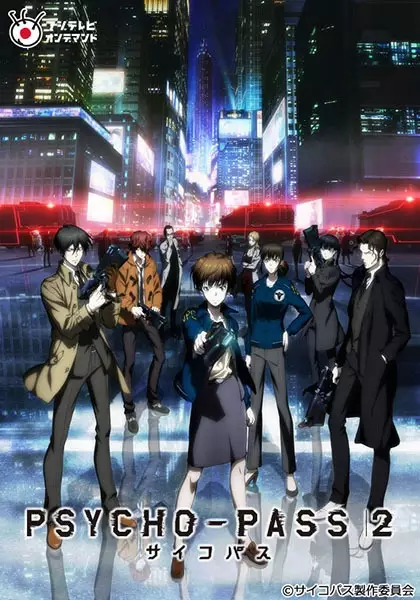
PSYCHO-PASS ă”ă€ăłăăč 2
11
TV
Finished Airing
Oct 10, 2014 to Dec 19, 2014
A year and a half after the events of the original sci-fi psychological thriller, Akane Tsunemori continues her work as an inspectorâenforcing the Sibyl System's judgments. Joining her are new enforcers and junior inspector Mika Shimotsuki, a young woman blindly and inflexibly loyal to Sibyl. As Akane ponders both the nature of her job and the legitimacy of Sibyl's verdicts, a disturbing new menace emerges. A mysterious figure has discovered a way to control the Crime Coefficientâa number compiled from mental scans that allows Sibyl to gauge psychological health and identify potential criminals. Through these means, he is able to murder an enforcer, leaving behind a cryptic clue: "WC?" scrawled in blood on a wall. Akane and the rest of Division 01 soon find themselves playing a deadly game against their new foe, coming face-to-face with a conspiracy threatening not only the authority of the Sibyl System, but the very foundation of Akane's own convictions. [Written by MAL Rewrite]
5.7/10
Average Review Score
35%
Recommend It
20
Reviews Worldwide
TLDR: Inverted Parabola. Starts out all right, gets better towards the middle, crashes and burns at the end. Psycho Pass made a huge splash in 2012 as a successful Urobutcher series. Its creativity, style, and execution flowed into an enjoyable and imaginative show - albeit with some missteps. Without Urobuchi at the helm, Psycho Pass 2 tries to take his universe and tell a unique story and, honestly, fails pretty hard. If you've seen the first season, you probably wonder where the plot for this dystopian thriller could go. After all, much of the original Psycho Pass was an introspective exploration into the world it created. Where,given all the plot developments of the first seasons, could this new series explore? Well, as it turns out, nowhere. Striking similarities to the first season become quickly apparent and there's an overlying feeling of deja vu throughout the entire series. The story revolves around the same conflict debated in the first series and doesn't add anything new. As the plot progresses further, it desperately tries to distinguish itself through forced and melodramatic plot twists that ultimately amount to a bizarre and nonsensical finale with a confusing, out-of-left-field take-home message. Most annoying is the lack of continuity from the initial series in characters. In some ways, Psycho Pass 2 doesn't feel like a sequel so much as a parody of the first series. Development seems to only really carry over for Akane; she is the only one in the cast who feels right. Ginoza, the other main protagonist from the first series, takes a backseat role. No, not like the backseat of a car; if Psycho Pass 2 was a Boeing 747, Ginoza would be sitting in the rear flight attendant's area. His developments from the previous season are ignored and he receives something like...15 lines of dialogue? Instead, Psycho Pass 2 introduces Shimotsuki, one of the most infuriating characters to watch on screen. Her backstory is left unexplained and viewers are left to decode the infinite mystery that is her decisionmaking logic. Tougane, on the other hand, exhibits the makings of a good character and is certainly the most entertaining aspect of Psycho Pass 2. Unfortunately, the last few episodes don't really capture the potential of his character, instead bogging him down in the far less interesting main story. Kamui, the main antagonist, is a washed-up recycle of Makishima with essentially the same character traits and demeanor. These similarities make it incredibly difficult to appreciate him as a stand-alone character. While he may have had some distinguishing features, the resemblance to Makishima in both his methods and his goal detract from an otherwise decent antagonist. Psycho Pass 2 tries to throw in some twists to make him more interesting, but the show can't escape the shadow of the first season. All in all, a much weaker cast than the original Psycho Pass, which wasn't even that great to begin with. Of course, the animation and sound of Psycho Pass 2 reflect the budget. Animation more or less matches the original show - perhaps slightly better given an 11-episode length compared to 24-episodes. The soundtrack is good, but worse than the first season. Ling Tosite Sigure offers a serviceable opening; however, not nearly as catchy as their work in Psycho Pass's first OP and Tokyo Ghoul. The ending song is my easily favorite song of the show and accents the ending of each episode nicely. The removal of the "Dominator" insert song brings down the score a full point, however. I really wouldn't recommend watching this show if you've seen the first season. Even if you haven't, just watch the first season instead and leave it at that. Episodes 1-6 build up suspense and anticipation that Psycho Pass 2 fails to deliver on. Everything you'll see about the Psycho Pass universe occurred in the first season; Psycho Pass 2 doesn't offer anything dramatically different. It's simply a less interesting version of the first season that leaves you with questions like: "What the fuck is wrong with Shimotsuki?" Story: 4/10 Character: 3/10 Art: 9/10 Sound: 7/10 Enjoyment: 5/10
Click an episode to read its synopsis.
I suspect that the writer for Psycho Pass 2 created the script after surfing through conspiracy theorist sites written by potheads, followed by using the most hackneyed checklist of what constitutes a âdark, edgy thrillerâ: Somewhat sympathetic villain. Devoted, eye-patch wearing female accomplice in a red cleavage-baring outfit. Innocent puppies being killed mercilessly. Mutilated human faces hanging on walls. People being burned alive while âNessun Dormaâ plays in the background. (No, I am not joking about the last one.) Psycho Pass 2 is a terrible sequel. By âterrible sequelâ, I do not mean a mediocre sequel that paled in comparison to the original but servedas a solid continuation of the story otherwise. I mean a sequel that ripped out all the things that made the first season interesting and shoved the pieces up its ass. Letâs start with the distinguishing factor of the Psycho Pass universe: the Sibyl System. An utilitarian system that valued the collective happiness of everyone, viewing certain strong emotions as impediments to its ideals. Although it suppressed free will and denied space for self-actualization, it was successful in creating a stable society that escalated levels of happiness. It was not evil, it simply prioritized values differently - and this, interestingly, was what made it such an unsettling system. However, the Sibyl System in Psycho Pass 2 is clearly evil. Its once cold, calculating nature has been replaced with a comically wicked persona that involves itself in all sorts of conspiracies for selfish reasons. It might as well be a maniacal, moustache-stroking dictator plucking sandwich crumbs from his beard. The writing decision to make the Sibyl System act too human ruptured the thematic axis built up by Season One. The original delivered a compelling critique of utilitarianism by highlighting the dark side of optimized rationality, but season two depicted a form of broken irrationality that didn't even resemble utilitarianism. The chaos did not stop there: the show abandoned its allegory on individual-society relationships and delved straight into a conspiracy thriller plot. The result was a mess of nonsensical conspiracies that ignored the rules established in the previous season. The writer seems to think that the more complicated the villainâs scheme, the better the story. The main villain, Kirito Kamui, is an expert programmer, hacking into several security systems, pulling convoluted tricks on the police, brainwashing people into becoming his cult followers, carrying out multiple organ transplants, and God knows what else. The twists and new details created too many logical gaps in the story to keep the viewerâs investment. It only got more pretentious towards the end with all the theories that have no substantial contribution towards the showâs themes. As for the characters, the main Inspector Akane Tsunemori started off promising and confident. However, she displayed no real growth by the end of the series, even after all the tragedy she witnessed, after how Sybil System was revealed to be a corrupt dipshit. Her pacifist beliefs did not shake one bit, neither did she offer any new insight. The new characters were nothing interesting either, although Sakuya Tougane, the Enforcer with the highest Crime Coefficient ever recorded, had potential. Of course, he eventually descended into self-parody along with the show. Thereâs also Mika Shimotsuki, the new Inspector whom everyone wanted to electrocute since episode 1. It was obvious that the show was trying to make her a poster child of the Sibyl System, but her character was utilized very poorly. Lacking initiative, useless, with cow manure for brains, it is hard to imagine how she even qualified for the job. Even after witnessing violent accidents that were partially her fault, she did not come to any realizations, her behavior painted her more like a caricature than an actual person. Yet, the show continued to focus on her childishness, which only served to annoy the audience further instead of articulating any interesting points. In regards to the art and music departments, the animation is passable, although it took a slight dip in quality compared to the first season. Iâll give extra props to the music department though, for giving us the comedic gold that was the âNessun Dormaâ scene. In conclusion, Psycho Pass 2 had me questioning if the writer paid any attention to the first season at all. In fact, the show seemed to undermine its audienceâs intelligence with the sheer stupidity of its plot and made-up fictional details, every episode in the second half did a good job of destroying half of my brain cells. To put it straight: Psycho Pass 2 failed to add anything meaningful to the original. It tried too hard to be âdeep and edgyâ by throwing in shock and violence, even though it lacked thematic resonance of any sort. Itâs like trying to improve the taste of burnt buffalo wings by pouring a bucket of hot sauce on it: not only does it still taste terrible, you are probably going to end up with a bad case of diarrhea, idiot.
Thereâs no easy way to describe the Psycho Pass franchise. To put it together it simply, the story becomes a complex tale to tell in a dystopian world. Just think about it: imagine if you feel like being watched 24/7 in a Big Brother style surveillance society. How would you feel about that? Fearful? That should be a normal feeling considering every person is measured by a state of being known as âPsycho Passâ. It tells the limits of a personâs mental state and their probability to commit a crime. This may sound all cool and dandy but in reality is a system with somany possibilities. Psycho Pass 2 serves as the direct sequel of the first season to bring those possibilities into chaotic levels. The second season revolves around several changes. Technical wise, Production I.G. is no longer in charge of the project (oddly enough, they are still involved with the movie production). Instead, we get Tatsunoko Production directed by Kiyotaka Suzuki. Secondly, the series only runs approximately half the length of the first season. Thatâs right. 11 episodes and apparently, the show is confident enough to craft a story based on the setup of the premise and what it has shown us from the first season. Make no mistake though, certain characters do make returns while new ones are added. Finally, thereâs an absence of Shinya Kogami. Thereâs obvious reasons why he doesnât appear in this sequel especially for fans who have seen the first season. In regards to these changes, this sequel brings a different picture to view. From the start, the second season offers a story involving a new mysterious case. To end, it also adds a host of new characters as well as returning ones from the first season. Protagonist and inspector Akane Tsunemori returns after learning the truth about the Sybil System. Her choice is to obey the system by following a philosophy of doing the right thing is in her mind. Joining her includes Ginoza, Yayoi, and Shion as part of the new police unit. They also get some new helping hands including six new characters who plays a variety of roles in the second season. While the show still retains their state of duty, the season is left without Kagami, a man who dealt pivotal blows against the system. At the same time, the Sybil System itself reveals startling new revelations that may change the story forever. For Akane, this season is also about her own personal battle and against another mysterious individual. This can easily be seen at the conclusion of the first episode as we meet Kirito Kamui, a mysterious antagonist who tampers with the Sybil System. Letâs get a few other things out of the way. The absence of certain characters is something that season 2 suffers from when it comes to expansive development. Fans who have become attached to Kogami will surely feel disappointed with his lack of presence. And to make it worse, we no longer have Makishima Shougo (for obvious reasons). He was a complex character with a dark personality and a difficult antagonist to replace. Itâll take time for people to get used to a guy like Kamui despite their similar dark personalities. Still, thereâs also a mistake about the second season with the addition with Mika when it comes to her characterization. The first episode leaves no time to depict her character as someone who is literally a complainer desperately trying to defend the Sybil System. Her ignorance and opposition against her own boss Akane is something to that can be on the line of hair pulling annoyance. At some point of the show, it would come as no surprise if most viewers label Mika to be an idiot. Despite the additions of such a foil character, the new season still has enough to keep fans involved and eagerly await each episode. I can say this with confidence as some episodes leaves off with thrilling cliffhangers after a built-up of events. Itâs also easy to interpret the show that is shrouded in mystery with secrets and foreshadowing. There are also parts during the season as we witness Kamui commence with his plans in secret with hidden motives. Itâs easy to tell that he is the type of man who is careful with his moves after he kidnaps and seemingly brainwashes Mizue Shisui, an inspector from Division 2. His smooth talking tells us that he is quite a manipulative character who uses words as his primary weapon to get people to join his side. Not only that but he seems to be personally interested in Akane, a contrast to Season 1âs Makishima Shougo where he is disappointed at her actions. Like I mentioned before, Akane fights on personal terms with her internal struggles as his friends, family, and comrades are put in danger. Season 2 exploits many points with twists of fate with a grim sense of purpose. There are definitely some problems with the direction of the episodes in this season. In particular, one episode introduces a group of new characters from another unit; a direction that I feel as inappropriate with the lack of characterization already on the current roster. But letâs make this worse. This one particular episode turns into a sour blood fest after some choices are made based on the behavior of the Sybil System. And if you want to guess, Mika is as useless as ever while Akane herself does little to secure the problem. What we get in the end is nothing more than more exposition and graphic violence to add to the shock factor. Thereâs also the situational âcat and mouseâ gimmick that returns in this season as the new police unit begins to hunt down Kamui. Guess who is Tom and who is Jerry. Still, the main part of the showâs problem revolves with Kamuiâs methods to manipulate people. A part of his past connects with events of the present that deconstructs the way the Sybil System work. Unlike season 1 that is focused on the flaws of the system, it now becomes a shallow writing with terribly mishandled concept. Honestly, if that is the method that Kamui uses to manipulate people, then this season is doomed. Youâll have to watch it yourself to discover the stone cold truth. Character relationships are of minimal impact and nothing on par with Akane and Kagamiâs development from season 1. There are also strange twists thrown in revolving around with Tougane as well as Mika learns of a terrible fact. Otherwise, most of the other new characters lacks any depth with their characterization. Even Ginoza becomes less interesting despite his initial impressive introduction in this season. I say this with a potential romance angle that was doomed from the very start. Finally, donât forget about Mika. Or perhaps, I think it should be in best of interests to forget her as much as possible since she is so focused on her own ideology. (even after being exposed to the truth) Itâs hard for anyone to feel sorry for her to be honest. Iâll warn you right now. This show can be a bit of a pain to the stomach at times to watch. If youâre not used to gore and blood fests, then some of the episodes will not be suitable enough. For shock value and blatant attempts to illustrate the grim society of this showâs world, we get graphic violence. With total uncensored footage, thereâs bodies exploding with blood raining down that makes this Fall Seasonâs Terra Formarsâ violence look like a joke. On top of that, the showâs visuals downgrades a bit on some episodes with character expressions. You wonât notice it much since itâs not as explicit as the actual violence. Nonetheless, the artwork is only decent with the setting and character designs. I do give some praise to the action sequences though except some parts that are lazily coordinated. Soundtrack is perhaps a stronger aspect of the sequel. While it doesnât surpass season 1 in any way, thereâs a good measure of coordinating the cryptic OP song to illustrate its themes. Not only that but the OST remains top notch during key moments in this season. Unfortunately, character voice mannerisms becomes a concern at times especially with people like Mika and Sho. The seasonâs soundtrack does rebound this back though with some of the expressive tones during climatic moments, usually thriller endings that makes the audience hunger for more. By the end of this season, I scratch my head to wonder what went wrong with the second season. It had a good momentum from the beginning with the introduction of new characters and antagonists. We also found out more of the seasonâs motives especially involving Akane. Then somewhere down that road, the season decided to turn into bloated writing of its former self. It becomes a shameless example of how not to do a sequel. And in this case, the characters too follow down a road of deconstructing formulation. Now, this season isnât garbage though especially when it comes to some action and technical features. The initial few episodes in the beginning had a solid momentum and almost every episode leaves with a feeling of thrills; to keep the audience in their seats to look forward to more. There are moments that makes me hunger for more but in the end, it still remains meh.
I really liked the first season of Psycho Pass. It had everything I wanted in a cyberpunk crime Anime, from the atmosphere to the characters to the setting. So, after the announcement of Season 2, I was really excited. But, after hearing it would be only 11 episodes, I was worried, since I thought it'd be rushed and would be of less quality than the first season. Unfortunately, I was right. I'll move on to my review.Story:- This season takes place a couple of years after the events of Pyscho Pass. We are introduced to Akane's new team in the MWPSB, along with some familiar faces. After a brief introduction, we are thrust right into the action, where we at the end see the main antagonist of this season. I'll be honest, as far as the story is concerned, it was disappointing. The story's really similar to the first season, but never as interesting. With the introduction of the new antagonist, Kamui Kirito, I expected something different. Story is the same old ''Person wrecks havoc in the city, MWPSB must stop him at all costs''. There are a few twists and turns throughout the series that legitimately surprise me, but those really didn't save the story from being a mess, with plot holes and nonsensical things happening just for the sake of progressing the plot. It's a shame, since it was really good in the beginning, building up the tension with each subsequent episode. The series reached its peak at Episode 6, which was really intense and even had me shaking in my boots. But, the Anime ended in a really bad way, which I didn't enjoy one bit. It left me with more questions than answers. Art and Sound:- Definitely the best part of Pyscho Pass 2. It's just as good as the previous season, if not better. Characters are designed brilliantly, though I still can't get used to Akane's odd eyelashes(they creep me out, man!). The detail in the city, lighting and other such intricate little things just make it better to look at. And as usual, the Dominators look badass no matter how many times I see them being used. The sound department is also great. The Opening ''Enigmatic feeling'' though not as good as the Opening of Psycho Pass 1, is still great to hear. The ending ''Fallen'' is amazing though, best ED I've heard in a long time. It's even on my playlist now. The rest of the sounds for the Anime just get the job done and are nothing special. Character:- Out of the main cast, Akane is the only one who got a decent amount of character development. We see her troubled, on the brink of getting her crystal clear Psycho Pass getting coloured on a few occasions. Rest of the old cast hardly has any development, Ginoza in particular. Really was sad that he barely had anything to do in the Anime, considering he was one of my favourite characters in Psycho Pass 1. We also have a few new characters. The new officer, Shimotsuki, who works alongside Akane. Bluntly put, she's a flat out bitch. I didn't liker her from the beginning. She thinks highly of herself and believes she is right all the time. She even looks down on Akane's methods to handling various situations, and she doesn't even have much of a backstory. There's also the new enforcer, Togane Sakuya. I liked him a lot. He provided the season's most entertaining aspects. Sadly, he wasn't used the way I would've liked, in the end. As for the main antagonist Kamui Kirito, there really isn't much to say about him. He doesn't have the charisma or panache that Makishima possessed. He's just a plain old villain trying to destroy the Sibyl System. He had his moments, some of which were actually quite good, but in the end, he hardly left an impression on me, hence was forgettable. Overall, the set of characters in this season are severely underwhelming and not memorable. Enjoyment and Overall:- It was an okay season. It had spectacular highs and excruciating lows. It's not close to as good as the first season of Psycho Pass. But it still warrants a watch, even if it's just for the sake of watching it in order to see the movie. I really hope the movie makes more sense and ties all the loose ends together.
As a preface, this "review" focuses a lot more on the differences and relations between the first and second season, and not so much on this season as its own thing. At the same time, these are my thoughts on why I think a follow-up can never be as good as the first season (it's a long read). ------------------------- I want to start this off by saying that I absolutely love the original Psycho-Pass. The journey into the human psyche, the dark mood looming over the story itself, and the intense development seen in all the characters all contribute to whatâs come to be one of mypersonal favorites of all time. In the same vein, Makishima is one of my favorite antagonists, because he feels like such a real character, especially when it comes to anime in general. His motivations are far beyond that of âjust being evilâ, and the sort of intelligent personality he presents is as enjoyable as ever. Then there is the society itself, or rather, Sibyl. As a concept, this is a really awesome sci-fi society, and even in execution, it works surprisingly well. This is, I think, largely because of how Sibyl interacts with Makishima. If we momentarily remove Makishima (and any others like him) from the equation, what weâre left with would pretty much be an episodic detective-series, focusing on tracking down individual criminals. This is not necessarily bad, but it lacks the same overarching feeling of grandeur and darkness as with a mastermind connecting each case. However, it technically isnât possible, because of the way Sibyl works. It could be interesting, and definitely gruesome, but ultimately, I feel like itâd severely lack in terms of writing. Enter Makishima - the criminally asymptomatic. The entire system is now thrown into chaos. How do you deal with a problem like this, when you are so reliant on the system to do things for you? Should you circumvent the system to remove the threat, even if it means you may slip into darkness yourself? These are all questions asked by Psycho-Pass, and they make for very interesting story and characters. Then comes Psycho-Pass 2, a sequel I think many of us wanted, because who doesnât want more of their favorite series?, but at the same time something we dreaded, as a sequel would pose quite a few issues in terms of writing. The biggest one, and the one Iâm focusing on here, is the fact that theyâve written themselves into a corner, of sorts. Itâs not a corner in the sense that they need to do something drastic to get out, but rather that the only way forward is further into the same corner. To clarify, Iâm talking about the fact that the original series leaves very little to work with in terms of a sequel. When you create such a massive world in fiction, you place upon yourself a responsibility to stick to the rules that you have created. In Psycho-Pass, the highest âruleâ of all is how Sibyl works, and what it does. If you really think about it, how many (good) scenarios can you come up with, thatâs not too similar to that of the original series? Because Sibyl is nearly omnipotent, it creates this setting where only those unable to be judged, in one way or another, are able to act as worthwhile antagonists, which leaves little in terms of variation. What this means, is that we have to ask ourselves âare we okay with such a similar setup, or will it simply be too much of the same?â. With Kamui being the antagonist in Psycho-Pass 2, theyâve succumbed to the fact that this is the only way, but have tried to change it up by changing the very way Kamui functions, in contrast to Makishima. Instead of being able to remain at a constantly low crime-coefficient, Kamui is outright unable to even be detected by the system itself. While this, together with the way he operates on his âmissionsâ, still provides a good story, weâre once again forced to ask ourselves if continuing this series is truly a good idea. When it comes to the story itself, I want to quote reddit user /u/Redcrimson who I feel really captured the feeling of this season, to an extent. âIt's grimdark for its own sake, with twists that undermine its own narrative, and exists just to be violent and shocking with no greater resonance with the thematic throughlines or characters established in S1.â While my opinions on this season may not perfectly align with his, the points he makes are undeniably accurate. When watching this second season, youâll quickly notice that there are a lot more (gory) deaths spread out everywhere in the show, and as a result, we viewers will (most likely) become sort of desensitized to the deaths of characters, because we simply see it way too much. This, I think, is a huge step back from the first season, where every death got, at least from me, almost the same âoh shitâ reaction. The deformation, into the explosion, and the remaining characters taking their time to really take in what had just happened. It all felt really well done, and now that thereâs death around every corner, it has simply lost that feeling. Not only is this a bad thing because we donât care as much about characters dying in general, but it also affects our view of characters directly. Notable mention of Kamui here. Having a character as calm and collected as Kamui, suddenly killing an entire room full of people (albeit not without reason) does not make me fear him as a character. Iâm not on the edge of my seat in every one of his scenes, hoping he doesnât snap and kill the others with him. I think, when a character makes every kill symbolic - actually meaningful in some way - it gives this almost fearful feeling towards that character. Not because heâs scary, but because it makes you fear for the others, I guess. However, this season does offer a few new things, even if they donât drastically impact the general gist of the story. Examples here are Tougane and his backstory, Shimotsukiâs rivalry with Akane going too far, and so on. These all add an extra level of tension to the writing, which I think is pretty needed, what with the aforementioned issues. In the same manner, I think the upcoming movie may end up good, since it supposedly doesnât involve Sibyl in the same way. Though at the same time, itâs hard not to think that maybe that shouldâve just been the second season to begin with. In the end, I want to say that even with all this, I donât really think this is a bad season. I definitely think it couldâve been skipped, in favor of the movie, which actually changes things up, and there are a lot of things I think theyâve done much worse (the overly tense writing, too dark for the sake of being dark, and some characters), and itâs not going to be anywhere near as good as the first season was, but if youâre a fan of Psycho-Pass as a whole, I think youâll still very much enjoy the second season.