Links go to search results. Availability varies by region.
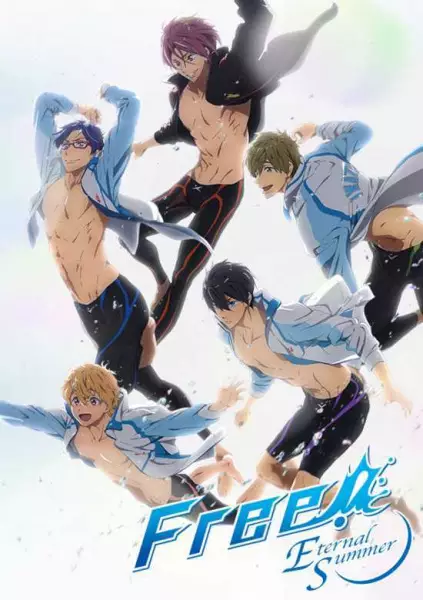
Free!-Eternal Summer-
13
TV
Finished Airing
Jul 3, 2014 to Sep 25, 2014
Even though it has been a year since the Iwatobi High School Swim Club has been created, new members have yet to join the club. Now that Haruka Nanase and Makoto Tachibana are senior students, along with their younger friends Nagisa Hazuki and Rei Ryuugazaki, they have to find a way to attract new members. If not, the club will be forced to close the following year due to a lack of membership. Meanwhile, with impending graduation, it is also time for the seniors to decide their plans for the future. Unlike their friend Rin Matsuoka, the new captain of Samezuka Academy Swim Club who is determined to fulfill his dream of being a professional swimmer, Haruka and Makoto are unsure about what career path they want to take. Further problems arise when an old friend of Rin's, Sousuke Yamazaki, comes to the city to study at Samezuka Academy; the recently scouted swimmer's arrival causes tension in the relationship among him, Rin, and Haruka. [Written by MAL Rewrite]
7.4/10
Average Review Score
75%
Recommend It
20
Reviews Worldwide
I guess there's a bit more to Free than 'shirtless bishounens jump in water'. For a series that began with a crescendo of confusion, Free has come a long way in carving its identity as a genuinely decent, though largely forgettable sports anime. While I don't think it will convert anyone who detested the first season (and there were indubitably more than a few of them), those who enjoyed or were indifferent towards Free's first offering will find a large improvement in quality. And yes, heterosexual dudes can now watch it without feeling uncomfortable. That's not to say that Free has forgotten its primary audience (teenagegirls and Tumblr fujoshi who squeal at the slightest homoerotic undertone), but at least now KyoAni has tried to justify the anime's existence by creating a story of value. It is less about clothes being thrown around and close-up butt shots and more about the boys growing up and finding their place through the love of sport. And each other... just, no, not in that way. Free's second season shines largely due to its focus on Rin and his close friend and rival, Sousuke. Rin's character development continues throughout the second season with much more detail than previously, taking him from 'antagonistic jackass' to a genuinely believable and complex person. His goals and reasons for swimming swimming are clear and sensible, and so it is easy empathise with him when things take a turn for the dramatic. On the other hand, Sousuke's motivations are purposely made unclear until his secret is revealed in the final episodes. There's nothing complex or excessively grim about his secret-- just that he makes mistakes as all teenagers do and wants to alleviate his regret by competing against his friend. Sousuke's goals are nothing so grand and cliché as being the best in the world, and that's precisely what makes it feel authentic. Furthermore, the two interact with each other as friends in the real world would in their situation. They aren't characterised by archetypes, catchphrases or 'moe' appeal as many of the others are, and the purity of their friendship is not dragged down by cheap fanservice and fujoshi appeal. They fight, disagree and have each other's back just as real friends do. I just can't say the same for the Iwatobi four. The Iwatobi four are far less interesting. Haru represents one of my largest issues with the series; by the end of the story, I did not understand him any more than I did at the very beginning. He swims and sweats for himself and then casts aside years of effort for absolutely no reason at all (unless you consider "I'm bored" to be valid characterisation), only to be fired up again when Rin pats him on the shoulder. Uh-huh. Much like the first season, he is blander than a piece of cardboard. Nagisa continues to exist largely as a vehicle for shota appeal and yaoi doujins, behaving so effeminately that even girls would find themselves feeling boyish in comparison. Rei on the other hand is much more interesting, fulfilling a sort of outsider role that the other three do not, but his presence feels a little bit on the uncanny side when you consider that he is a gender-swapped clone of Azusa from K-ON, right down to the inflections in his voice. And then there's Makoto who is just... there, neither offensive nor any great asset to the story. He's characterised more by his friendship with Haru than he is as his own person. Some of the side characters, like Rin's sister, Gou, add plenty of colour to the cast... but then you have Nitori who exists only to remind us what the show was originally created for. Nitori (who I have personally dubbed as 'That Fucking Guy' and found myself rushing towards the mute button whenever he appeared) is pure, shameless pandering for the fujoshi crowd. There is no reason for him to exist in the story. All he does throughout the series is follow Rin around like a stray kitten, blush and cry repeatedly, and ruin important moments by jumping into arguments that have nothing to do with him. He destroys half of Rin's scenes with his "d-don't fight!" and "y-you can do it!" and for that I despise him. The ending of Free certainly carries its share of emotional weight, and those who like the Iwatobi four more than I do will probably find themselves tearing up once or twice in the final episode. I just wish there was a bit more to it, something with more complexity than the typical "power of friendship" fare. It feels like that's all we ever see in sports anime these days. It's also worth nothing that the penultimate episode, set in Australia, actually has western people speaking proper English instead of the incomprehensible Engrish common in anime. Wow! There's still the "all foreigners are blonde" stereotype, but at least KyoAni shows they're willing to put effort into the smaller things. It should not come as any surprise given KyoAni's seemingly infinite budget, but Free looks amazing. The swimming matches are rendered with finesse and the backgrounds with incredible detail, resulting in a predominant feeling of awe when the characters find themselves in the massive national stadium for the first time. I also wouldn't be surprised if members of KyoAni travelled to Australia to gather research for the episode, given how alive and real the scenery feels. It certainly does more than just look nice. Had Free been drawn by almost any other studio, I'm not sure the characters and story would be anywhere near as effective. The music of Free is so great that it does not even need good writing in order to draw emotion from its audience. All that's needed is to listen and the scene will come alive. Even when it was a situation I would not normally give a rat's ass about, the background music grabbed and held my interest in what was going on. To be fair, though, there's no big, memorable track that defines a moment in the story and the ending theme does kinda ruin the moment in the later episodes as it transitions from drama to some upbeat pop song. Is Free a worthy sequel? It sure is, and I don't think there's any sane individual who could possibly think that the second season is a step back from the first. It improves upon its predecessor in virtually every regard, elevating itself from "fun garbage" into something that's consistently decent, occasionally even verging on the point of being 'good'. But that doesn't change the fact that it's Free and that Free has a very specific audience in mind. It certainly tries to increase its appeal by toning down the fanservice, but with Nitori's increased screen-time and various questionable scenes (like Rin and Haru sharing a bed in one episode), I still don't think KyoAni has any qualms about alienating those outside its primary demographic. And I guess that's how it's always been and always will be. KyoAni still has a long ways to go in order to redeem themselves, but the second season of Free is at least a step in the right direction.
Click an episode to read its synopsis.
The swimming boys are back! Free! kept its promise from season one ("See you next summer...") and returned for another season of swimming, slice of life and manservice. After the first season of five guys swimming competitively and their daily (mis)adventures turned out to be a huge success, it was no surprise that it would get a continuation. And now that the second season finished, how does it compete with its prequel? Following the story of season one, Free!: Eternal Summer starts off with a new high school term. Makoto and Haruka are now third years, while Rei and Nagisa are now second years at Iwatobi.And how else would they start off a new year if not with swimming? They return to the swim club and begin with the search for new members - failing in the process, participating in a friendly competition against the team of Samezuka, dealing with their individual struggles, and much more. All that while they practice and try to improve their swimming even more to participate in the regionals - in hope of success this time. Speaking of Samezuka, in the meantime Eternal Summer gives us an insight on the swimming team of Samezuka as well - with Rin as the new team captain and a couple of new members the Samazuka swimmers are up for a fresh start and ready for more challenges. A huge focus here is the addition of Sousuke - an old childhood friend of Rin's, who transfers from another school for certain reasons. But swimming is of course not the entire focus of the show. Just like season one, Eternal Summer is filled with lots of slice of life moments, because as we are all aware, Free! is not all about sports. It is not trying to be, anyways. Unlike other sports-themed series, the focus on seemingly "plotless" scenes is a huge one, and Eternal Summer is continuing to deliver great slice of life moments that evoke all sorts of emotions. If Iwatobi's hopeless yet funny search for new members, the heartwarming Nagisa-centered episode or the stunning trip to Australia - in the slice of life aspect, Free! is undoubtedly convincing. Another central theme of the second season is future. As Haruka, Makoto and Rin are in their last year of high school, it is an unavoidable question of what they will do after graduating. Definitely an interesting topic, and a good set-up for drama. Now, the drama - and the resolution - in Free! is often cheesy and overdramatic - and in the case of this season it is the case too, but still an improvement from season one. Especially episode nine shows how good drama in Free! can be - in this episode it was very well executed. Story-wise, if you enjoyed season one for its story (or the lack of it in most parts) then you will like it in season two just as much. Lots of friendship, drama, slice of life, swimming is just as present here and just as enjoyable. Character development is very much noticeable in season two. And this even though the cast has not changed much - the main group of five is still the same. The only important additions to the characters are Sousuke, whom I mentioned before, and Momotarou, Seijuurous younger brother, who joins the Samezuka swim team as well. And even though the change is small, the characters go through crucial developments, making them even more interesting than in season one. Starting off with Haru, who already opened himself a little more compared to season one - while in latter he did not really take interest in swimming competitively ("I only swim free.") the final of season one showed its effect. Haru now likes swimming together with his friends, and competing against them. And over the course of Eternal Summer he goes through development too - his struggle with the question if he wants to swim professionally or not makes for some really good drama. Rin's character is also a very interesting one in this season. From the angry and frustrated guy he was in season one he appears now as an easygoing character. It really shows how swimming with his old friends again returned him the joy of the sport. And as the new captain of the swimming team it shows even more. Makoto, Nagisa and Rei do not get as much focus as Haruka and Rin, though go through some development too. Makoto decides how he wants to continue after high school and continues to support his friends with all his might. Nagisa gets an episode dedicated to him that gives us more insight in his character and is the usual moodmaker of the group. Rei continues to improve his swimming and strengthens his bonds with the group. Just like season one, Free!: Eternal Summer stands out in the art aspect. The character designs look great as always and the animation is fluid. Especially the scenes where swimming is involved have spectacular animation. One other thing I noticed is how the background drawings are very detailed and beautiful too. It is especially noticeable in episode 12, which has a different setting from the other episodes. The scenery is stunning. Besides that, the series is as colorful as ever, fitting the mood of the show nicely. A thing I could criticize here is that some scenes were not as well animated as others, but this does not disturb the overall performance. In terms of music, season two continues with the same old recipe for success. For the opening, we get a new catchy J-Rock song by the band OLDCODEX, that holds well up with season one's opening. The ending song is another fun song by the main cast of the show, accompanied by a hilarious ending animation. The background music continues to be nice, too. Overall, Free!: Eternal Summer continues to be a fun series with great character development and nice music and art. Thus, I give it an overall rating of 9/10.
Although sequels can be a hit or miss, Free: Eternal Summer extends on the organic setup of the first season. From shirtless guys to competitive swimming, this show brings the reincarnation of the swimming genre, a sports series that revolutionizes itself with what it has already accomplished from season 1. A good impression for a sequel usually require the essence of the original. While Eternal Summer doesnât blow the original out the water, neither does it sink beyond salvation. From whatâs shown, Free builds on the foundation of its characters and virtues with connections. Characters connect with one another for a common interest and passion. Inthis case, it would be swimming. The first season gave the audience a well-rounded introduction of the characters ranging with a variety of personalities. The sequel expands on this by forging connections and relationships. A prominent example is Rin, a character who used to share a rivalry with Iwatobi High Schoolâs Haruka Nanase. Rather than putting on a âwho the hell do you think you are?â attitude, his character becomes more blooming as he builds his own team. His new position as a coach of Samezuka Academy is a testament of this development as Rin becomes a role model for his teammates. These include returning member Aiichiro Nitori but also new members such as Momotaro Mikoshiba and Sousuke Yamazaki. Perhaps the most other prominent character of this team is Sousuke, a childhood of Rin. His personality is interesting to notice because he is almost similar to Rin from the first season. Tough, relentless, and intimidating, the sequel expands on his character through his relationship with both teammates and rivals. Of course, Samezukaâs rivals are members of the Iwatobi High School. All the members return from the first season with little change to their personalities. One noticeable aspect though is how some of the members begin to seek their potential futures. Because even though swimming is a big part of their lives, their future careers also requires focus to what theyâve learned. The never ending waters still follow the swim members though. The second season titled as âEternal Summerâ follows perhaps all of our charactersâ development as that itself is never ending. Itâs a rare sequel with significance because it expands on the story without recycling with material it has to work with. Characters such as Nagisa, Makoto, Rei learns through more experience and to work with others. Perhaps what might drag the show down though could be a lack of interest on some of these interests such as the diehard attempts during competitions. But letâs face it, this is swimming and competitions breeds rivalries. Rivalries breeds a dedication to achieve, a will to accomplish. Swimming doesnât ride far from the sequelâs objective either. We see how characters improve as well as the impressions new players enter such as Sousuke. But what really stands out is the hidden development with some of the characters on technical terms. Haruka and Sousuke become a part of this formula through their rivalry both in and out the waters. Whatâs even more important is how it affects them physically and mentally. The sequel preys on this concept with a clever motive as the latter half of the show fleshes out their struggles. Rin too becomes part of the angle as lines of friendship and rivalries are drawn out when it comes to swimming competitions. Humorous and lighthearted, the show is a feast for the ladies. As the sport requires guys to take off their shirts and dive into their water, you can expect washed out abs flowing smoothly in the pools. You want muscles? You will get muscles. Gestures and movements are also brilliantly rendered with a degree of both realism and imagination. We see how characters move in the waters that captures their dynamic improvements. The whole thing could feel sappy at cases though as some of the swimming competitions zooms lightning fast without much thrilling moments. In retrospect, shirtless guys are delicious to look with its ebullience. However, it still takes its easy path without digging too far or make surprises; except on a few possible occasions. The visual front still retains its phenomenal quality thanks to Kyoto Animationâs high class production. Waters are smooth with delicacy while the guys are drawn with well toned muscles. Thereâs a less emphasis on fashion though with characters like Rei from season 1. Most of it is replaced with lighthearted comedy on various degrees of successes. What I do give praise for is the visual expressions of the characters in this sequel. This is especially shown in the latter half as characters show a variety of emotions such as in the case of Haruka. Nonetheless, the artwork enhances their expressions with opportunistic camera angles and face features. But taking a simple look at the visuals, the series is aim to please, especially for the ladies. Soundtrack doesnât change much from the first season with pop tunes and light-toned OST. Character voice mannerisms also retain their way of speaking. Sousukeâs stoic voice stands as a sharp contrast to most of the other members of his team though. In essence, itâs a contrast to the show itself because Free has all this energy while Sousuke seems to hold it back. Similarly, emotional scenarios has fitting music and credibility. I do also give credit for the creative attention of the ED song. Seriously, that song is more than just firemen, merman, or a male stripper. Itâs a free style of art! Free Eternal Summer isnât by any means an improvement of the first season. I should say itâs probably more or less equivalent but different with its execution. Character relationships are developed with all building up to a climax through initial processes. Its light toned atmosphere combining with a diverse cast of characters will definitely catch your attention. In fact, the sequel is similar like most of Kyoto Animationâs projects with an ability to lift your spirit. Had a bad day? No problem. Free Eternal Summer will bring back the liveliness of what Summer feels like beyond just the naked bodies and swimming movements. For people who love Summer, people who love swimming, and people who love hot guys being wet, this sequel wonât be a disappointment to you.
There is a limit to how much weight can a single shark lift. Free!: Eternal Summer is a sports comedy slice of life show and a direct sequel to the first season, Free!. It is a reverse moe trope anime, with moe tropes found in girls given to the guys instead. Usually dubbed as a fanservice show for girls with swimming as a backdrop, does it have anything more in it? The answer is yes, it does, but not so much. Plot: Another summer comes and the swimmers of Iwatobi and Samezuka High School swimming clubs are once again in a rivalry. It is the last school yearfor Haruka, Makoto and Rin, and they have to make their career decisions and find out how much the passion of swimming can help them in the future, all in meanwhile an old childhood friend of Rin's appear to spice up the situation. The plot is pretty simple: the characters start swimming and battling each other again while some of them sort out their personal problems and look forward to the future. The problem is though that KyoAni forgot how to make good drama. We witnessed that in Chuunibyo, we now witness that here. The anime fails to have a clear indication of what it wants to be, hovering around fanservice, sports and drama, and does neither well. The main plot element of the story, swimming, is not of much relevance, since the only thing driving it are characters wanting to swim a relay (which by definition is stupid and more on that later on), and is done horribly wrong, and as a sports anime it fails to create a climax and general hype. Characters: The cast from the first season returns with some new additions and a little bit more development on some, so I'll introduce them shortly: Nagisa, Makoto, Rei, Gou (Kou), Miho on the Iwatobi side, Aiichirou, Momotarou on the Samezuka side are the basic one dimensional characters that can be described by a pair of personality/motivation traits, and are used mainly as plot devices, comic reliefs or assumes a cliched position (like teachers/mentors in Gou and Miho). That's a lot of characters. That's 6 characters in a show that has like 10 total characters that are atleast relevant of some sort. Excluding Makoto, none of these characters get any development apart from simply getting better at swimming (but there's no perspective provided, so that point is irrelevant). Next on the list is Sousuke, a new (old) Rin's friend. His personal drama was the best in the show, and he is the only character where I could understand why he wants to swim the relay so much. Sousuke is a nice addition to the anime, helping the 2 mains develop and having enough characterization for the audience to care about him aswell. Moving forward we have Haru. Oh, I personally hate him so much. As the main protagonist he is extremely shallow and unimportant to the story for the most part. The problem with all silent protagonists is that usually they don't show any emotions, meaning that there's no room for characterization from their perspective. You just don't who they are exactly, you can't relate, you can't care for them. "I like swimming because I don't know exactly" doesn't give me enough information to care for you. However, Haru's lack of emotions did not go unnoticed by the rest of the cast and ended up being a prrety decent plot point to spark things up. Fortunately, Rin saved him by dragging him to Australia and telling to develop the f*ck up, and he did. And it was actually believable. It doesn't change the fact that he was the worst character for 20 episodes, but he got a legit ending for him and is one of the rare cases where the silent protagonist turns out okay. And here we have Rin, by far the best character in the show. He gets a huge amount of characterization, development, and backstory. In contrast to the other one (or at max two) dimensional characters of the show, he is miles ahead of them. There's nothing so much to talk about him, other than everything makes sense in regards to his character and personalization. All of his actions are completely reasonable and reflect on who he was, who he is now and what he wants in the future. However, he can only do so much alone, and he's not even the main protagonist, only a deuteragonist and even an anti-hero in the first season. If the anime was centered around him, boy that would have ended up so much better. The problem with most of the characters again is the lack of characterization. The members on each team exist solely to form a relay, and otherwise are irrelevant. Motivation alone is not proper characterization, that's just a personality quirk. Some of them are so shallow, like Rei and Momo, that it is safe to say that they are just plot devices. Also, their girlish behaviour to reflect on the reverse moe nature of the show just doesn't work. All those blushes and cute moments should be left to girls, as it ruins other aspects of the show that are rather serious, like coming out of age. Furthermore, there's only like 10 characters in the show, the rest are 0 dimensional people that are there for the realism. Where are the other swimmers? Why is it only focused on 8 people when there are thousands of different kind of athletes? Global perspective? The perspective of the best? Nah, those don't exist. Sadly. Writing: And the swimming is as bullshit as ever. KyoAni, if you wanted to make a sports anime about swimming, please research on what the hell you are trying to create, because swimming does not work that way at all. It reminds me of NASA using the "Armageddon" movie as a training program, where they asked the trainees to present all the scientific inaccuracies in a 150 minute film. A total number was 168. In this anime, I counted atleast 60, and with the first season combined that would be well over 100 swimming inaccuracies. That is, ladies and gentlemen, a lot. It's so much that you can safely say that the swimming is executed poorly and without any logic. Having a 12 year (and counting) swimming career experience, this completely destroys any enjoyment I could possibly have had from the races and swimming bits in general, and it saddens me that this anime disgraces swimming so much with its inaccuracy. I will tell you right now, don't get the idea that this sport works like that because it definitely doesn't. It's not K-On where everyone can just take a guitar and form a band, it takes years and years of proper practice and only the select few are successful, something that this anime failed to show us. Moving on, the comedy is pretty simple. We have two comic reliefs on each side, Momo and Nagisa (Nagi is more of a pseudo). The jokes are mostly reactional, like Gou glancing over muscles, the teacher giving her literacy analogies, Nagisa's playful personality induced character interactions, basic stuff that can be assigned to be a specific character trait (sadly some of the characters are only defined by that single trait). It is not distracting, and it is funny and nice at times, so the comedy's fine. The drama is sometimes mishandled by a long shot (Nagisa runs away from home), or sometimes hits right on the spot (Sousuke's struggles), but the biggest problem is that it is not focused enough, and the anime is not long enough to cover and expand on every plot element. They did have 25 episodes over two seasons but only Rin is the one that got enough focus as an actual character. There are a couple of illogical things in the show not regarding swimming (as much as I loved episode 12, them going to Australia was just whaaaat in terms of logic), but for the most part it's okay, since the anime doesn't try to have deep and complex situations and instead restricts itself to simple problems. There are no parents in this show (again), apart for them being mentioned, and I already wrote once that parents are an important piece to developing the personality of the characters, as they are typically the ones that influence children the most, and that especially applies in a coming out of age anime such as this one, where our characters face a dillema of what the future holds for them. As for the actual competition, they overuse the "power of friendship" way too much and that symbolism sometimes destroys immersion (like the last episode.... yes, I came to see them swimming with the dolphins, totally) Animation and Sound: Once again, KyoAni gets the animation done right. It's always a pleasure for the eyes to watch works animated by this company. I have a slight problem with how swimming is animated though, as everyone swims exactly the same and there's no variety at all, and on top of that the hand movements do not look like how it is presented in the show. It doesn't have much of an effect of those who don't know swimming that much, but it is a problem for those who have been a part of competitive swimming or follow the competitive scene. The character designs are okay, except the fact that they made Rin's teeth like that to show us that he's kind of an antagonist in the first season, and that totally goes out of character in the second one. The blushes and cute boys doing cute stuff is well, reverse moe thing, you can't say much against it but they don't do anything to serve the narrative. The soundtrack is unmemorable, the sound itself is pretty okay. The swimming sounds well and that's about it, nothing much to talk about here. What I could talk about though is the amazing decision to hire Aussie voice actors that speak with an Australian accent instead of getting some local japs to do their bad English gibberish impersonations. That was one of the highlights of the show for me and I was just stunned at the amazing English that was spoken here, something that is very rare. That bit alone made the Australia episode so much better (and one of the reasons why I liked that episode in particular so much) The first OP for the show is very manly but otherwise forgettable, same with the second ED where instead of that you get fanservice pondering, cool but uninteresting. They made it better in the first season. Summary: Free!: Eternal Summer is a rare case of a show which not only does the first season justice, but actually surpasses it (well, the first season was below average anyways). If the swimming was executed well it would have been a really good anime, sadly that wasn't the case. Apart from the KyoAni visuals style and fanservice for girls, there's really no reason to watch this series. Everything has been done elsewhere and better. Still, this might be your average jack-of-all trades anime where nothing stands out (and some elements stand out as bad), but overall you find it enjoyable enough to follow. Final Verdict: 5.2/10
The first and start of the second season to this anime was AMAZING. It was 6th on my top fave anime list. But as it progressed through the second season it just became really, really, really cheesy. I expected Rin and Sousuke to start kissing or something, which totally ruined the story for me. I enjoyed the rush it gave when they were partaking in tournaments etc, but once that side was over it just became a gay romance anime (not to be taken in offence, this was actually how the characters began to act towards each other) Thefirst series was SO GOOD though, like I was literally addicted to it and I was impatient for the second season. I recommend watching Free!: Iwatobi Swim Club, but if you watch this season you will understand what I mean, hopefully. I'm sorry if you were offended by my opinion, I have nothing against homosexual romance animes. I've actually enjoyed many in the past, my favourite being junjou romantica, but it just didn't suit this storyline. It pretty much killed my attraction to the makoto and haru friendship. (If you're a fangirl/boy of this "shipping" stuff, you will probably ship haruxmako or haruxrin) Anyways, I have it a 5 overall. It would've been a hell of a lot better if it wasn't for the cheap ending and the weird character friendships that were taking place etc. I enjoyed the first series though. [THIS IS MY FIRST EVER REVIEW]