Links go to search results. Availability varies by region.
è±ç©èȘ
5
TV Special
Finished Airing
Aug 16, 2014
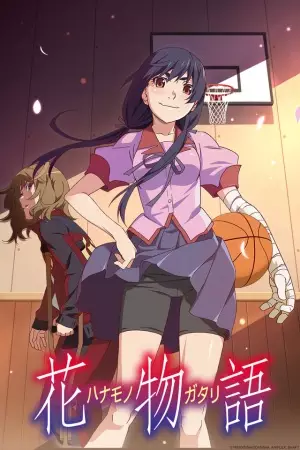
Now that Koyomi Araragi and Hitagi Senjougahara have graduated, very few familiar faces remain at Naoetsu Private High School. One of these is Suruga Kanbaru, holder of the Monkey's Paw. When she begins to hear talk of a mysterious being known as the "Devil" who will magically solve any problem, Kanbaru immediately thinks these rumors are about her and decides to investigate. She discovers the Devil is actually Rouka Numachi, a former basketball rival from junior high who is no longer able to play due to a leg injury. Rouka provides free advice to those who seek her out. Acting as a collector of misfortune, she enjoys relieving the stress of her clients by providing them with the false hope of having their problems solved. Although Kanbaru sees no real harm being done, she reprimands Rouka for lying and heads home, relieved she is not the cause of the rumors. But she may have a reason to worry after all: she finds that her left hand has reverted back to its human form. [Written by MAL Rewrite]
7.8/10
Average Review Score
80%
Recommend It
20
Reviews Worldwide
Watching Hanamonogatari is like reading your favorite book on a weekend afternoon. And essentially, it is adapted from a novel written by NisiOisin. But rather than adapting it as a full TV series, Hanamonogatari debuts as a 5-episode show that offers more than just a sensational appeal to its fans. Hanamongatari (literally translated as Flower Story) is like a flower â beautiful, elegant, and has the pedals that shine like no other. For its creativity and cleverly thought out written story, we witness the story of Suruga Kanbaru and what her life is like after Koyomi Araragi graduates from high school. Similar to the style ofthe previous Monogatari series, Hanamonogatari quickly takes command and lures viewers in with its cleverly constructed dialogues. The on-screen text serves as both a practice and testament to get a viewerâs attention because viewers wants to know their meaning. They also want to know their purpose, idea, and in general the message of the show is about. Directed by Tomoyuki Itamura with Akiyuki Shinbo serving as the chief director, Hanamonogatari is aimed at fans who wants to see the continuation of this franchise. Itâs rather important to get yourself familiarized with the previous seasons such as Monogatari Second Series so that the experience will be that much better when venturing into this show. Itâs probably also said often that the show might not be for everyone. The style of Hanamonogatari has that avant- garde feeling with its style. But without jumping on the shark too hard, we also get a thrilling narration with referencing to the devil. Taglines such as âthat person is a devilish oneâ and âthe devil just might be meâ drills a thrilling thought into a viewerâs mind. It becomes like a puzzle with pieces that fit together. And in Hanamonogatari, those pieces come together with its cleverly crafted story. For starters, the show advertises itself with Suruga Kanbaru as the main event. Sporting an athletic set of clothes and matching personality, viewers will quickly find that she has fragile part of her essence. Perhaps this could be the arm that is bandaged with a story to tell. And this is where exactly Monogatari series shine â the ability to articulate its story and tell it to the viewers with cleverness. The show has a narrative-like tone and depicts Kanbaruâs side of the story. Despite taking place after Araragiâs graduation, several key characters make their presence well-known. A tragic example would be Rouka Numachi. Not only do we learn more about her past but also witness her influence in the present. Numachiâs rivalry with Kanbaru is perhaps a highlight in this show as it consists a variety of emotions; fear, anxiety, fiery, just to name a few. On the other hand, Numachi herself experiences pain but tries to ease it away through her own methods by delivering misfortunes. It justifies her own beliefs to make herself feel better despite her injury. After several events that intertwines the story collectively, the show highlights a climatic moments as Kanbaru fights against Numachi in a game of competitive sport. The show takes risks during this by introducing characters in sequence leading up to the moment with the anticipation and built-up. And thanks to Shaftâs extravagant style, the game lives up to its promise with innovative creativity. Character dynamics is a key success with this seriesâ presentation. Despite the fictional story with Kanbaru, her past is very realistic. From minute one, the show commands attention with Kanbaruâs mother and the cruel words she strikes upon her daughter. The imagery it creates has a spellbound moment as it illustrates the essence of Kanbaruâs life. Not only do we find out about herself as a character but also what she is capable of as a person. This is what exactly makes the show so appealing and attractive. Luckily, there are also characters returning to this series that fans may find most welcoming. Their roles also play both humorous and important parts to enhance the storyâs overall direction. Itâs also refreshing seeing them like a breath of fresh air. Engineered by the clever writing and dialogues, itâs easy to say that most if not all the characters are thought provoking. The reason for provoking thoughts lies in Monogatariâs ability to discuss and break the boundary of supernatural mystery. Like its previous predecessors, the series doesnât rely on cheap shounen antics but instead on fighting against oneâs inner demons. Highlighted in perhaps the basketball game, the show clearly details and provides purpose leading up to the match. Thereâs a lot on stake but at the same time, the game becomes something of a battle â to not only for the win but also against themselves. Similarly to other installations of the Monogatari series, expect word plays and extensive dialogues. Thanks to the clever writing, you wonât get massive amount of mind indulging info dumps. Instead, what you will expect and receive is stylized dialogues with attractive interactions. The characters react with precision while also detailing their emotional appeal. At the same time, the dialogues themselves have deeper meaning and motifs that breaks the boundary of literature. NisiOisinâs explicit chattiness isnât something to just take granted but also by the way it tells a story in its unique fashion. On the artistic front, Hanamonogatari has a similar feeling as its previous seasons. By that, I mean it as fantastic. Characters are designed artistically with distinctive features. Kanbaru in particular has a tasteful design and reflects her character visually with attentiveness. Fan service also returns of course with high class style. Unlike most ecchi shows that draws their appeal from clichĂ© values, Monogatari applies exactly whatâs needed to command attention. If youâre a fan of Kanbaru, this is a must-see for its eye candy. Even if youâre not, thatâs okay because the return of two other characters are bound to make you jump from your seat. Ultimately, Shaft gets the job done not only just with its head-tilts but ability to describe and tell what the story is with the characters. Soundtrack is put up with more of as a supplement appeal. The OST hits home base with its purpose by anticipating certain scenarios while climatic scenes weaves a mystical aura. However, where Monogatari truly shines is the dialogues that are played out. Thankfully, characters portray them well. As an abstract narrative, Hanamonogatari exceeds expectations with conversations by fusing together humor, mystery, and creativity all the same time. Voice mannerism is crucial to make these come to life and I have to say, it does just that. While it does feel occasionally forced or out of space, the way characters deliver their lines and performance is ecstatic and dosed with a level of energy that is hard to forget. Similarly, the OP song âShirushiâ by Marina Kawano achieves its purpose with its symbolism. Hanamonogatari is more or less for fans who have appreciated the series at its core. Familiarization with some of franchise is crucial to gain a full appreciable experience. Otherwise, you may be left stranded and wondering if itâs worth the time. But trust me, Hanamonogatari uses its time wisely. Even though itâs only 5 episodes, each of them play out the story artistically with its characters, themes, and setup that leaves you with memories you wonât forget. The technical aspects can be a hit or miss but for loyal fans, it hits home base again thanks to its style. Still, Hanamonogatari is more than just about style or storytelling. Itâs about drawing attention and fantastically delivers what it tries to achieve. It might seem over-the-top-ridiculous but letâs face it, Monogatari is the epitome of that. Why? Because it said so.
Click an episode to read its synopsis.
Over and over again Shaft stands and delivers, this time is no exception. Being a fan of the Monogatari Series, you (and I) were probably excited to hear about the adaption of Hanamonogatari. While its release was delayed a bit I have to say that the wait was well worth it. Hanamonogatari is kinda the odd ball in the Monogatari Series Second Season. Released in the middle between Kabukimonogatari and Otorimonogatari, Hanamonogatari is set after all events of the Second Season and is told through the narrative of Suruga Kanbaru. While we are use to most arcs being told through the eyes of Araragi, Hanamonogatari adifferent look and deeper insight into one of the Monogatari Series overlooked characters. Shaft once again creates something that only Shaft can create. Anyone who has seen any of Shaft's titles know what I am talking about. I found Hanamonogatari to be an overall entertaining and enjoyable. The story is above all captivating and compelling and will leave you wanting more. The lack of characters nor non traditional episode setting can take away from it. All I can say is it is a must watch for fans of the Monogatari Series and to those who aren't or haven't seen any of the series, I urge you to. A brilliantly beautiful story adapted into a brilliantly beautiful anime adaption. Bravo Shaft... Bravo
There are numerous characters and their characteristics that exist in anime community, starting from the most common and arguably the most famous, tsundere, to kuudere, darudere, megadere, yandere, dandere and many more. However, those who have either read or seen any of nisioisin's--the writer of monogatari series and katanagatari above others--work would know that the characters he make are quite something else. They are obviously not normal, thus letting the story progress without boring the viewers/readers, but they are complex. They get angry like a normal person would, they get happy like a normal person would, they cry like a normal person would, and mostimportantly, they think like a normal person would. Of course, people may argue that some of the characters of monogatari series and nisioisin's characters in general do NOT think like a normal person should, and I agree. However, letting aside the abnormality and the comical setting nisioisin's characters convey, they are the most human characters in perhaps the entire anime world. Then, without further adieu, let's begin the review to the ninth part of anime adaptation of the monogatari series, hanamonogatari. Story: 8 An anime must not bore the viewers. This is not just for anime. Movies, TV shows, music, etc. The entire purpose of any entertainment is to entertain the viewers. The light novel, hanamonogatari, was actually published before the third arc of the monogatari series: second season, otorimonogatari. By Shaft's airing hanamonogatari after the end of monogatari second season, the viewers' attention was captured before it faded away in the dull and peaceful mood hanamonogatari inevitably created. By putting hanamonogatari after koimonogatari, the last arc of monogatari second season, a not-too-surprising factor became a ground-breaking factor for the hanamonogatari to capture the viewers' attention. (For those who do not understand and have seen the show, scroll to the bottom) Hanamonogatari also successfully captures the attention of the viewers by doing what all stories of monogatari series did: eroticism. Although it is a very controversial issue, eroticism is a powerful tool to draw in viewers. It might give certain age or gender groups displeasure, but as long as the severity of sexual content is not too high, it serves as a strong hook to the readers. But most of all, the beauty of hanamonogatari is in its ability to surprise the viewers and prove it can do something in the last 16 minutes. Plot twist at the last second is something that is not recommended, and naturally not done well, by many anime of all genres. They can give the viewers displeasure by its quickened pace of story and unsatisfying resolution. Hanamonogatari, however, uses this wonderfully. Although the story gave a sense of melancholy and resolution a minute earlier, hanamonogatari managed to quickly, in literally matter of minutes, completely change the mood of the story and resolute it beautifully. The reason I gave 8 instead of 10 despite saying all these is the same reason I did not give 10 in any of the monogatari series franchise. The talk can be boring. Hanamonogatari contains quite a huge amount of dialogues and monologues rather than action and facial expressions. Because of this, the viewer/reader can get easily bored. Sometimes, by Shaft's bizarre adaptation from the book, and by revealing an important plot point, this is resolved, but a conversational anime definitely is not enjoyed by everyone. It certainly gives boredom to some viewers, and for those who have trouble reading subtitles, it can make the readers miss important details. Despite the heavy influence of conversation/monologue, however, hanamonogatari manages to re-spice the height of the story by continuously surprising the viewers or by the use of bizarre anime production, this is mostly not noticed or unnoticed, but hanamonogatari's method of story-telling definitely is not for everyone. Plus, because of the eroticism, it adds up to the reason hanamonogatari is not for everyone. For that, I gave story eight out of ten. Art: 9/10 As mentioned in story, Shaft does a great job of animating. It is not that it has remarkably high-quality battle scenes like Bones or ufotable, or that it has an unbelievably fluent movements like Production IG or Kyoto Animation. Shaft covered up the flaws of the original hanamonogatari it was based on. By the use of colors and random shots, shaft again proved that it was able to deliver the message of the anime viewers. The only misgivings of Shaft is that there are limits to the number of people the bizarre adaptation can influence. Some people might get distracted by these bizarre adaptations and some people might be confused on what the anime is trying to say. Above all else, the flashing texts that are used to manage air time and also deliver messages are quite distracting and might get the viewers confused. Still, there is no question that Shaft is the best weapon that can send any of nisioisin's bizarre works to its highest heights. Shaft did the best it could do with the choices that were available that, before the first of monogatari series, bakemonogatari aired, was a risky course of action. Art itself is also a job well done. The characters and the background, via the help of famous animation studio such as PA works, were done in quite a high quality that is not always present in Shaft's animation. For these, I gave a nine out of ten in art. Sound: 6 The opening and the ending were not too bad, which I would give normally about a seven. They followed the usual catchy and beautiful themes that the past op/ed themes of monogatari series were infamous for. The voice actors were remarkable as well. Sawashiro Miyuki was able to convey Suruga's feelings quite well throughout the anime, which was not easy considering that Suruga's feelings changed from jumpy to serene to serious to so-happy-that-she-could-cry to so-sad-that-she-could-cry. The new character of the series, Numachi Rouka, was also given a well-known voice actor, Asumi Kana, who is famous for method acting--in this case, voicing--that gives her the ability to "be" the character she is voicing. I would give nine for the voicing, minus one for araragi koyomi's a-little-too-nonchalant voicing. The problem was with the BGM. The number one job of the BGM is to do its job. When the anime calls for battle themes, the BGM must give a sense of power and rush to the viewers. When the anime calls for a foreshadowing, the BGM must give a sense of mystery. When the anime calls for happy mood, BGM must do so. However, the music failed to give a sense of foreshadowing. A huge portion of the anime is based on talking--about 9/10, roughly calculated--and thus, the BGM must do a proper job of keeping the viewers interested while forming a mysterious environment. While the other monogatari series' animations did not require this as much, hanamonogatari did, being that it was a nonstop air from episode 1 to episode 5. The music failed to keep the viewer interested and sharp-minded and in the end made me miss some important details of the storyline. Normally, this would seem like not a big deal, since it is just factor of BGM's work that was not done well. However, if it is hanamonogatari's BGM, it is a big deal. It is almost safe to say that any talk-based animation requires a BGM that does its job wonderfully, and Kousaka Satoru, the composer of most of BGM's of monogatari series animations, does this quite well, but Haneoka Kei, hanamonogatari's BGM's composer, did not reach up to Satoru's works. It is not to say that one is greater than the other, but hanamonogatari, an anime that aired for nearly couple of hours, requires the support of BGM more than others. For this, I gave hanamonogatari's BGM a three out of ten. With nine in voice-acting, three in BGM and seven in op/ed, I finally gave 6/10 for the sound portion of the anime. Character: 10 Kanbaru Suruga was the narrator. THE KANBARU SURUGA. The infamous pervert of monogatari series. One of Nisioisin's finest qualities is his ability to make characters unpredictable. He can make a main character a total pedophile, a villain the final heroine, a heroine a villain, a gag character an important plot character. Kanbaru Suruga is infamous for her voyeurism, constantly making erotic jokes with Araragi Koyomi, the main character of the monogatari series in general. However, when she was the narrator, as opposed to the expectations, she was quite serious-toned and rarely made a joke. Her being a narrator showed what she "truly" was inside, and not the character setting she kept on building. This characteristic of any character is not easy. Making a complex character is sometimes harder than writing the story itself. However, Kanbaru Suruga, Araragi Koyomi, Numachi Roka, and pretty much all of the characters in hanamonogatari are complex. Trying to understand them as a certain type of one archetype of character is difficult, if not impossible. They are very human-like, as said, except for the inevitable character settings they show. What can I do but give a ten for the character? Enjoyment: 9 Despite the music's failure, I quite enjoyed this. It has been a while since I clapped to the end of an anime and smiled in content. It had been more than I could have asked for a story with Kanbaru Suruga as the narrator. However, this is definitely not for everyone. For those who does not enjoy eroticism and severe verbal story progression, this is not an anime for you. For this, I gave 9 out of 10 for the enjoyment section. Overall: 8 Great story, great animation, and a perfect character. For those who have not watched this yet, or any of the monogatari series' animation for that matter, I have only two words for you. WATCH IT/THEM. As always, may anime be with you and happy anime-ing. ------------------------------------------------ ******************************** 000000000 SPOILER 0000000000 ******************************** ------------------------------------------------ Kaiki's alive. Koimonogatari aired after this, we wouldn't have been as surprised. ------------------------------------------------ ******************************** 0000000 SPOILER END 00000000 ******************************** ------------------------------------------------
I really enjoyed Hanamonogatari and much of the dialogue (and that Kanbaru-service!!) was superb throughout. It was great to finally get a huge focus on Kanbaru Suruga alone and have SHAFT flesh out her character, her past and her continuing issues because I felt as though she never got the treatment that she deserved in her previous arc and episodes. Her rival basketball player and our "antagonist" of sorts, Numachi, acted as an incredible foil (or as a mirror if you payed attention more closely later on) to Kanbaru and her naivety and unwillingness to move forward. It was interesting to hear Numachi's philosophical takeson her "misfortune" and "devil" collecting. That being said, Hanamonogatari was a little light on action, variety and progression at least until we got to the last 2 episodes or so. It was probably the most dialogue heavy of all the arcs that we've encountered so far in the Monogatari universe. Also, the "twist" at the end wasn't all that big of a shocker for me either. I never got really hit with the major feels at any point like I did during Second Series or Bakemonogatari but the ending dialogue with Araragi was pretty nice and touching. It was a nice journey to see the progression of Kanbaru's character into accepting her decisions, wishes and herself. This was not my favorite arc but it seemed like SHAFT adapted it about as well as they could from the story in the LN. The art and animation was beautiful without a doubt with plenty of head turns, delectable fanservice (I pray to God that Kanbaru eventually swings the other way eventually) and spectacular backdrops (the "sinking" basketball court for the win). This was definitely some of SHAFT's best work in terms of imagination and variety here just based upon the source. I guess the problem was that there just wasn't much to really animate or really go off of. Story: 8/10; Art: 10/10; Sound: 8/10; Character: 9/10; Enjoyment: 8/10; Overall: 8.25/10 I'll give this a solid 8.25/10 (maybe a bit higher) and I'd probably put this around the same level or higher than Nekomonogatari: Kuro and obviously better than Nisemonogatari. Doesn't come close to Bake or the perfection of Second Series. Now, bring on Kizu! There are no more excuses left. I'll leave the end card here as my last memory of Hanamonogatari and Kanbaru's journey. Just beautiful. http://www.monogatari-series.com/2ndseason/special/img/endcard27.jpg
Hanamonogatari's frequent malignment, or perhaps indifference, within the Monogatari series is always something that has puzzled me. It is without a doubt my favorite entry, one that is characterized by the profound, inexplicable feeling of melancholia that is left in the wake of what is perhaps the most tense, oppressive atmosphere the series has established. Hanamonogatari, like many other arcs in the second season, is a fairly serious character deconstruction which highlights facets of the new narrator's personality that were hitherto mostly obscured. I would say this is a good thing, because as much as I often enjoy Monogatari's stream-of-consciousness banter, fourth wall breaks, and inopportunelechery (which, let's be real, quickly lost its impact/appeal no matter how tongue-in-cheek it was, but alas became a key aspect of Araragi's character and relationships), these things, as I see it, often hurt an arc's pacing or mood and actively degraded the viewer's suspension of disbelief, which sometimes made it difficult to enjoy my favorite things from the series, which, from a writing perspective, are namely the compelling characters and their growth/relationships as well as the poignant and clever arcs surrounding them. It isn't that I inherently dislike Monogatari's humor, as I in fact enjoy it more often than not, but the timing and moderation of its many gags are often handled poorly and are not always welcome in context. Many people don't feel this way, which makes it easy to appreciate how people can enjoy Isin's writing on different levels. Some call this a product of his subversive genius, at which point I am very inclined to call BS as you can extend this argument to pretty much anything given enough effort. At any rate, this is Hanamonogatari. It is free from these potential trappings, and it is masterful. I definitely consider this to be Itamura's best directorial work within the series (and, as far as I know and expect, outside of it) and would argue that it is more impactful than either of Oishi's projects; Hanamonogatari is one of the less "eventful" arcs, and yet every scene is handled in such a way that you can feel truly feel the weight of Kanbaru's emotions and interactions, something that is facilitated by the transportive, symbolic images and deliberate pacing by which you can categorize Hanamonogatari. The cold, mathematical imagery and use of suspended objects (i.e basketballs, water droplets) that are presented as Numachi leads Kanbaru around the school, dragging her (and us viewers) into the depressing abyss that is her psyche, represent her more cynical, pragmatic nature, as well as the stagnation of her state of being (it is no coincidence that she is referred to as a swamp). By contrast, the cherry blossoms outside Kanbaru's house, from which the story takes its name, symbolize the ephemerality of Kanbaru's youth, and life itself; what could have happened to Kanbaru had she taken the same path as Numachi. Certainly an appropriate symbol for an insecure third-year who misses her seniors, but as a token of spring, the cherry blossoms also represent new beginnings, Kanbaru's humble diligence and the hope that she has for her future. I will refrain from elaborating any further to avoid spoiling specific events, but the way the importance of such simple things as Kanbaru running or falling and scraping her arm is accentuated through visual and auditoryl direction are a sight to behold, even compared to the rest of the Monogatari series. Hanamonogatari's music was composed by Kei Haneoka, who was also responsible for the score in Tsukimonogatari and the Owarimonogatari seasons. Compared to Kousaki's scores in the rest of the series, Haneoka adopts the same style of moody ambience mixed with more jangly, upbeat television music. His compositions, however, feel more involved and progressionary, as opposed to Kousaki's more riff-based, "ringtone-y" pieces that are used throughout the majority of his soundtracks (Kizumonogatari being a notable exception). This makes individual songs less memorable, but they serve as a more appropriate backdrop, giving scenes a more immersive and dynamic emotionality that is missing from much of the series, and which no doubt contribute greatly to Hanamonogatari's intoxicating atmosphere. The opening song by Mito is standard-fare j-rock that is in line with the rest of the series, but the animation stands out as one of the most bittersweet and memorable that Monogatari has seen. The closing song is not particularly noteworthy, but has some excellent lyrics. At its core, Hanamonogatari is a coming of age story, and includes such themes as the absurdity of youth, the transience of memories, regret, the ambiguity of good and evil, identity; our hopes and dreams and how they are molded by the people around us. It shows how close the things we love are to us, and how we all too often take them for granted. We forget, only to later remember when it is all to late. In a sense, the inexplicable melancholy that I mentioned earlier can perhaps be attributed to a sorrow-tinged feeling of deja vu, and yet Hanamonogatari is not a story that likes to dwell on the past. In fact, it places no particular importance on its own events: Kanbaru did what she wanted to do, and the punchline is that there is no punchline. The things we do in our youth are as transient as youth itself, and will ultimately be forgotten by our strongest critics. Time often does heal all wounds; maybe Numachi was wrong because she was hurting herself, but she wasn't completely wrong. At the same time, Kanbaru wasn't wrong either. She couldn't explain why she did what she did at the time, but she felt so compelled to do so that she stood at risk of losing her identity had she not. Ultimately, nobody will remember who was right and who was wrong. Of course, that is not to say that there is no right or wrong, no empathy or morals, but rather that it is a case of assigning triviality, lazing in on the the things important to us, and acknowledging the effective transience of things that exist outside of ourselves. Even Numachi, when confronted with serious issues from her clients, would refer them to the proper authorities. In a way, her circumstances are a direct parallel to the story of Hanamonogatari itself. The cruel twist to her character, however, is that she could not extend this same empathy to herself, and suffered greatly for it. She represents the ugly underside of the same coin comprised of Kanbaru and herself, the quintessence of regret we could find ourselves in at any moment. If there is a punchline, then, it would be to love yourself. A common theme, to be sure, but one that Monogatari, and especially Hanamonogatari, handles in a very nuanced and convincing way. As someone who was not particularly fond of Kanbaru's character, this is definitely the most invested I've been in the series and I would readily consider this arc my favorite. "The only ones who can claim that regretting what you haven't done is worse [than what you have done] are immature outsiders who have never experienced the regret that comes with what you have done. But, you know, the best by far is not regretting what you've done." Brilliant.