Links go to search results. Availability varies by region.
はだしのゲン 2
1
Movie
Finished Airing
Jun 14, 1986
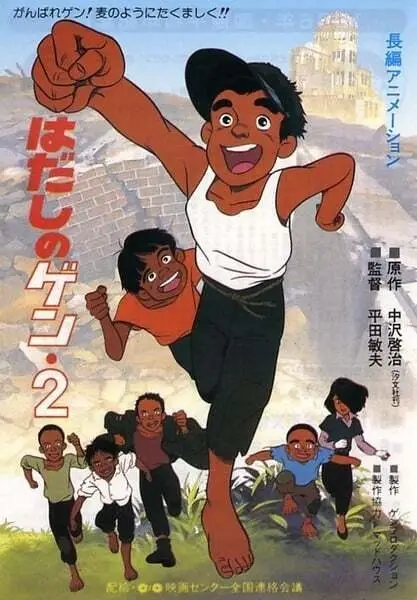
The year is 1948, three years since the atomic bomb destroyed Hiroshima and much of the Nakaoka family. Gen Nakaoka, his mother, and his adopted brother, Ryuuta, struggle to survive in the ruins of their once flourishing city. And yet, after befriending a group of homeless orphans, Gen realizes that in many ways, he is lucky. As the effects of radiation poisoning and the insensitive actions made by foreign troops continue to shape Hiroshima, Gen and Ryuuta must find strength within themselves if they ever hope to prosper. [Written by MAL Rewrite]
7.5/10
Average Review Score
100%
Recommend It
4
Reviews Worldwide
Barefoot Gen 2 is a film you probably should not see without having seen the first one. That being said, Barefoot Gen 2 is not nearly as good as the first one besides. The art, here as in the first one, is still one of the key strengths of the movie. While the character designs are a little different - the story takes place three years later, after all - the art is near the level of the first movie, though still not quite as stellar overall. The advantage this movie has over the original partially lies in its story. In the first Barefoot Gen,you knew the bomb was coming - the movie even told you that it was, as if you were somehow unaware. However, Barefoot Gen 2 takes place three years after all that and uses that to its advantage to tell a fresh story of survivors, full of new characters who weren't in the first title. In this way too, the movie is more upbeat than the first. While there is still the desolation and people struggling to survive, the plucky kids are happy and hopeful, living for each new sunrise. This helps make the movie much less sad than its elder. That is not to say that it isn't sad, however. The movie is still dealing with the harsh reality of trying to survive in post-bomb Hiroshima and to that extent very sad - though somewhat predictable - events do occur. It seems here that the movie is more in love with its hopeful tone though, and is not interested in bumming you out. Rather, the movie is serving its important purpose - to encourage and promote a 'never give up' attitude. While the first movie did clearly expouse this, the second is much more hopeful and less dour as well. In this way, Barefoot Gen 2 is a rather different movie from the first. That being said, Barefoot Gen 2 isn't nearly as enjoyable. The story, while fresh, is still predictable in spots and simply is not as interesting or engaging as the original. Without the horribly depressing events of the first movie, the second seems significantly more upbeat and hopeful. Its not a bad thing by any means, but the movie suffers by contrast to the original. The sequel simply seems to lack the emotional power the original was able to conjur in its moments of sadness. Barefoot Gen 2 is a sensible sequel - but is not as good as the original by any token.
Taking place 3 years after the original Barefoot Gen, Gen and Ryuta are still struggling to survive as Japan's economy is slowly rebuilding itself and her mother working to support food for Gen. He also encounters a group of orphan children, in which their families died in the bombing in Hiroshima and Gen decides to convince the kids to be strong and have faith in themselves no matter what. Barefoot Gen talked about the bombing in Hiroshima, but in Barefoot Gen 2, it talks about the effects of the bombing known as "pika", in which it causes that person to have cancer, getting intestines brokenand die. It also gives a message of hope to the audience through the eyes of Gen in this movie and the scene where he learns the words that his dad taught him 3 years ago is incredibly heartfelt in the end of the movie. The animation and music in Barefoot Gen 2 is much more improved. Madhouse gave it a nice colorful upgrade to the art style and it shows with better fluid character models and better background art than the original. Music is less corny and more subtle in the film with tracks ranging from happy to sad to just depressing as hell. The Japanese voice acting is improved and the new voice actor that plays Gen was excellent in his performance and also, no sh*tty dub to ruin this film unlike the original Barefoot Gen English dub that almost ruined the film for me. Overall, while not as good as the orignal, Barefoot Gen 2 still manages to be a damn good sequel, with all the heartbreaking emotions that the original had in this sequel.
A respectable movie compared to its predecessor. The story was well done for the most part with one or two minor flaws. A plot not too complicated and was easy to understand. The pacing was alright for the most part but a bit too fast. Although we didn't get the same emotional attachtement as much as the original. The animation was pretty much the same as the original but a teeny tiny bit better. We are introduced to new characters who are pretty likable and we'll written for the most part. Overall an enjoyable sequel with similar levels of tension to that of the predecessorbut lacks some originaility and had some reused elements.
Journey Through Madhouse Episode #17: Because a movie about a boy who loses everything in the atomic bombing wasn't enough. We also needed a sequel so he could lose everything he had. The film is set in the post-World War II era. It attempts to show what life was like for civilians in a collapsed and defeated Japan. It depicts the negative effects of radiation on people's health, as well as the American intervention in the country. Through the children, it seeks to illustrate the hardship of the situation, in terms of employment, the economy, and education. It's not a movie for lazy Sunday viewing. It hasa rather dense plot that requires your attention. It doesn't aim to be a comedy or a tearjerker. It's a film with the message, "We must not forget that this happened." It's a very important educational resource, especially for historical understanding. If, like me, you were born in the 90s or later, you know about World War II from history books. Except we didn't experience the consequences firsthand, and by the time we became aware of ourselves and our surroundings, Japan had already recovered. Watching the film shows a reality that seems very distant to us, so much so that we can easily forget it ever happened. The film is a good representation of the saying, "Hard times make strong people, strong people make good times, good times make weak people, and weak people make hard times." It shows how children born in the post-war era had to fend for themselves. They didn't have the freedom to choose their education because at home, people needed to eat. I don't recommend this film for people who are just looking for entertainment. You need a certain level of commitment to watch it. You're not coming to be distracted; you're coming to understand how difficult that era was for the people who lived through it.