Links go to search results. Availability varies by region.
ćŒ±è«ăăă«
38
TV
Finished Airing
Oct 8, 2013 to Jul 1, 2014
Sakamichi Onoda is a cheerful otaku looking to join his new school's anime club, eager to finally make some friends. Unfortunately, the club has been disbanded and he takes it upon himself to revive it by finding students who are willing to join. Without much luck, Onoda decides to make a round trip to Akihabara on his old, bulky city bicycle, a weekly 90-kilometer ride he has been completing since fourth grade. This is when he meets fellow first year student, Shunsuke Imaizumi, a determined cyclist who is using the school's steep incline for practice. Surprised by Onoda's ability to climb the hill with his specific type of bicycle, Imaizumi challenges him to a race, with the proposition of joining the anime club should Onoda win. And thus begins the young boy's first foray into the world of high school bicycle racing! [Written by MAL Rewrite]
7.5/10
Average Review Score
70%
Recommend It
20
Reviews Worldwide
Peer pressure often prevents us from being the person we want to be. The teenage years entail a necessity for conformity and a fear of change. Physical appearance, grades, money and social status are used to determine someone's value in society. Or so it seems. For Onoda Sakamichi, he finds his place by pedalling and pedalling forward. Yowamushi Pedal is a story of a weak-willed, unattractive and friendless otaku finding joy in life through the sweat of sport. Nobody, including himself, thinks him capable of more than shopping for manga and singing embarrassing anime songs. He rides his cheap bicycle from school to Akihabara once a weekand the dismal cycle begins anew. But through a series of fortunate coincidences he finds untapped talent and a place in his school's cycling club. Unlike most protagonists in sports anime, Onoda is not a hot-blooded maniac with a craving for victory. He is timid, weak-- but earnest. He pedals on not out of proud, but because his aching muscles and the wind beating against him makes him feel alive. In a race he does not need to worry that he is shy or awkward; all that matters is that he pedal forward and dominate the asphalt. While Onoda may not be likeable in the traditional sense (his timidness can occasionally reach the point of frustration), much like Mihashi from "Big Windup", you can't help but root for the poor guy. The other members of Souhoku's cycling club are fairly exciting, though most of them are nothing you haven't already seen before in a sports anime. There's Onoda's rival, Imaizumi, but the rivalry seemingly vanishes into thin air as the Interhigh tournament approaches. Naruko represents the life and energy of the club, while the three seniors unsurprisingly serve as mentors to the first-years. The most interesting of all the characters (sans Onoda) is Makishima. His long, green hair, lanky body, molester-like smile and spider-like cycling manoeuvre has him come across as a creepy little bastard, but gradually he develops and adds a distinct personality to the show. Souhoku will certainly feel the loss once he graduates. The rival cyclists are, well... they have quite a personality. One of them is a muscle freak who names his pecks (Andy & Frank, in case you were curious) and regularly screams "Abs!" while riding with his jersey unzipped, exposing his bulging, twitching muscles. Yes. Yowamushi Pedal is a very strange show. Others are more conservative in their personality, with the unbeatable Hakone High serving as the second main cast of characters. Their rivalry with Souhoku feels genuine as a result of a number of flashbacks, and these scenes fortunately are handled gracefully, only ever shown when pertinent to the story. The individual members of Hakone High are all fleshed-out, too. Even Muscle Dude. The one blemish in an otherwise fun cast of characters is Midousuji of Kyoto Fushimi. He takes ridiculous to a level that I don't believe I have seen before in a sports anime. He does not stop at simply being the arrogant antagonist; he is a goddamn animal masquerading as human. He slurps with his long, lizard-like tongue, bends his body in positions impossible for the human body, loudly grinds his skeleton-like teeth in front of his opponents, strangles his team-mates and leaves death shrieks like a complete lunatic. Okay, I understand that the show wanted to create conflict by having a villain that the entire audience can despise and root against, but he did not need to be exaggerated to such an extent. His character simply creates a pervasive, ceaseless sense of imbalance within the show. And he does not ever stop frustrating the viewer. By the power of God, Jesus, Allah, those Hindu deities that I can't remember the name of, my mom and every other person in the history of mankind, won't somebody please please please beat the fool senseless? Midosuji aside, Yowamushi Pedal does an excellent job of being accessible to those who have no prior experience or interest in the sport of cycling. Basic terminology is concisely conveyed to the viewer without being condescending, and it focuses more on the abilities of the cyclists rather than the intricacies of some obscure technique they are using. It does occasionally stray from realism during the Interhigh tournament, though. Every main character seems to have some sort of superpower. And you have to wonder how the characters don't lose their breath from talking so much while cycling. Yowamushi Pedal is a visual feast. It is easily one of the best-looking sports anime produced to date. In the thirty-eight episodes produced thus far, there has not been one where the animation quality has dipped to any noticeable extent. The amount of CG used is thankfully minimal (usually limited to the scenery and the legs of the cyclists), though to be fair, it does skip many of the expensive shots by focusing more on the faces of the cyclists, with said faces given extra prominence by the blurring of the backgrounds. However, the best part of the visuals is the most basic: colour. Too many shows forget the importance of colour. Grey and brown is not fun for the eyeballs. The musical score is great, but the real beauty is in how well-timed it is. All the tracks start and end at the perfect moment; a final dash towards the finish line being accompanied by a hot-blooded orchestral piece with guitars riffing in the background, or a tense 'eleventh hour' piece playing as the characters run out of strength and fall behind. One of the best moments in the entire show occurs in the thirty-first episode, with Onoda motivating his teammate by forcing him to sing along to a cheesy anime song (the way he's always encouraged himself), it later switching into a guitar solo of the song before finally crescendoing into the show's main background piece. Even if there's no particular stand-out track, the excellent usage of these tracks makes every episode a joy to watch. It's also pretty damn motivational, to boot. However, it should be noted that the first season (should they even be considered separate seasons?) does not have a conclusion. It ends in the middle of the Interhigh tournament during one of its climaxes, the final sprint of the second day with no 'to be continued' to assuage the viewer. Watching the second season is an absolute necessity, so you will have to prepare yourself for a fairly long ride. Yowamushi Pedal is first and foremost an inspirational story of the weak surpassing the odds and triumphing over the strong. It will not leave you with something you haven't already seen before, and while it is most certainly not deep or philosophical, it excels at doing what matters most: leaving a smile on the viewer's face.
Click an episode to read its synopsis.
Yowamushi Pedal is not a good show. It's a standard, predictable shounen sports series that does nothing memorable or exciting. Every conflict in the story is caused by not having enough pride in your team, and every conflict is resolved by having more pride in your team. The characters all fit neatly into their pre-determined stereotypes, and nothing really changes between the start of the show and the last end card. But this show does excel in one area, and that is copious amounts of balls-to-the-wall MANSERVICE. Now, I don't claim to be an expert on the admiration of the male physique. I like my ladiesmore than I like my guys, which is why I lean towards shows like Highschool DxD more than Free. But I started this show with no idea what I was getting myself into, and for the first, oh, 10 episodes it was a so-so show about bicycles. Then it started happening. The outfits got tighter, the shorts got shorter, and the amount of screen real estate taken up by sweaty butts increased dramatically. I was bewildered by this sudden turn. âTruly,â thought I, âthese camera angles are those reserved for fanservice shots, but there is nary a panty to be seen!â It wasn't until 2 episodes before the show ended that I finally had a complete conception of what I was seeing. It was a shot of two cyclists crossing the finish line, one positioned triumphantly behind the other with his arms held to the sky, hips thrust proudly into the rear of the one in front. The loser was wide-eyed at this sudden shock, overcome with the realization that the winner had completely taken him by surprise. It was then that I knew just how far from home I had come. Yowamushi Pedal is a show built entirely on a foundation of manliness. You're apt to see so many sweaty, panting men with their firm butts thrust high in the air, grasping at each other and fighting for dominance, that you'll never want for another slash fic again. There is a veritable smorgasbord of masculinity on display for any tastes you might have. Do you fancy the stoic leader type? Take your pick from any of the team leaders. Do you prefer a foul-mouthed lone wolf who secretly cares deeply for his friends? You got it. Want a tall, awkward guy with a big heart? Well, you're getting one anyway. The dogged nice guy with a dark and troubled past even makes an appearance. Like your guys with a more bishounen appeal? Here's a fun activity: count all the female cyclists you see on the character page. Done? Those are all guys. Do you love big beefy bros? There's not one, but TWO massive mountains of man-meat here, one of which even names his muscles for easy reference in fan fics. âOh Arakita-san, please rub lotion on my Andy...â Like long, spindly guys with no bones and a sociopathic hatred of humans? You may want to talk to someone about that, but in the meantime, enjoy Yowamushi Pedal! No matter your preference, this show's got you covered. Should you watch Yowamushi Pedal? If you've read this far, you should already know the answer to that. If you like men's butts and you cannot lie, pick this one up and tough out the first two arcs. You will be richly rewarded. If you just want to watch a by-the-numbers shounen then by all means, pick this up as well. But if you're not in the mood for manservice and you don't want to see something that insults your intelligence, then give Yowamushi Pedal a pass. Now if you'll excuse me, I have to go marathon Seikon no Qwaser to reaffirm my sexuality.
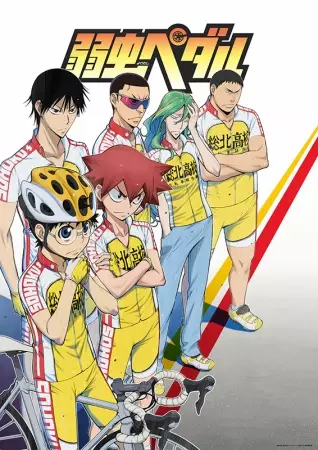
Hobbies. Everyone has them whether when you were just a kid, during high school, or as an adolescent. But everyoneâs hobbies vary. Hobbies pique interest and interest can lead into an obsession. For Sakamichi Onoda, his hobby is watching anime to the point of obsession. You remember that one time when you forgot to record your favorite show that airs late at night? Well for Sakamichi, that could be a catastrophe. But little does Sakamichi know that his hobby will lead him to an encounter with destiny. That encounter leads him to ride the winds and steer the Yowamushi Pedal. A tour with Yowamushi Pedal willquickly reveal the essence of this show surrounding the sport of cycling. Itâs not just the promotional picture but rather the way the characters are designed. Besides Sakamichi, almost every supporting and major character has a degree of athletic form. Itâs their passion, their desire, and love for bicycles that drives them to become the best in the world of cycling. But for Sakamichi, he is still riding a mamachari, or better known as the âmommy bikeâ. It doesnât take a genius to figure out that heâs a beginner. Yet, thereâs something that makes Sakamichi draw attention with his wit. And by that means, I mean potential. That potential leads him to join the Souhoku High Bicycle Club, the core group of the series starring individuals of all angles. The show builds paths for our characters to take. For Sakamichi, his journey to stardom begins with his meeting with ShĆkichi Naruko at Akihabara. The encounter isnât anything mind crushing but strikes a bit of curiosity. After all, the two seems nothing alike based on their personalities and appearances. Naruko, the boy with red hair, has a fiery passion with a competitive nature in sports. Sakamichi is the boy with otaku passion with an obsessive nature in anime. Get the picture now? Nonetheless, the episode detailing their meeting highlights a potential for Sakamachi. He is able to ride through the winds and break forth his timid nature. In retrospect, Sakamichi creates an impression that some people might of not originally anticipated. While the show does not warp itself with mind games, Yowamushi Pedal does offer plot twists viewers will be surprised by. Sakamichiâs first step to becoming an elite cyclist is one of those surprises. However, the real question remains if Sakamichi can talk the talk, but also walk the walk. Comparing to characters such as Shunsuke Imaizumi, this seems to be overkill. Shunsuke is like the professor of cycling, knowing the nature of the game and presented as logical thinker. His competitiveness and dream has no boundary. In fact, the rivalry between him and Naruko is quite intimidating like tiger vs. dragon. Drawing from rivalries usually brings out the best of a character. In this series, it does that easily with the way characters compete whether itâd be friendly competitions or a battle of pride. At the paramount of the story, Sakamichi also shines with brilliance with how much he improves. For a show like this, character building is important and the focus is adamant to draw interest. The competitive atmosphere brings out that focus with obstacles the characters must overcome both physically and mentally. These obstacles ranges from a simple steep slope to catastrophic bike accidents that can lead to potential death for the characters. This is expanded to supporting characters as well and rivals of the Souhku High Bicycle Club. The success here is that the show embraces characterization on them with clever flashbacks and well-timed scenarios. It clearly makes its point across to show what the character wants and desire to achieve. Characterization becomes an important aspect of this show and I am thoroughly impressed by its aspects. Thereâs also a niche for sports series that doesnât need to be unique to set itself apart. The catch for this show is that it can transform cycling into a form of art. Characters brings their skills artistically during competitions with their unique styles of skills. These include a variety of signature moves like Narukoâs rocket sprint, Makishimaâs spider climb, Midousujiâs leaning style, Tadokoroâs human bullet train, among others. Even Sakamichi develops his own signature move that truly shows how far he comes across. He might not be a prodigy but potential is one word that draws in peopleâs attention. As a member of Souhoku High Bicycle Club along with some of the main characters, Sakamichi sets himself as a journeyman. His interaction with characters brings out his potential especially during training camp. When he rides up that slope, Sakamachi is building character with his spirit. Weâd like to appreciate his development as he takes on challenges that are seemingly impossible. He has to figure out solutions to difficult problems where they are real, not like the ones in the anime world he came to embrace. Itâs also said that competition often draws out the best of a person. After all, competition has rewards, tests, and strives to make us accomplish and achieve. Despite playing roles of supporting characters, some of them really tests the Souhoku High Bicycle Club. A few of them even have dynamics focused on their characters through clever usage of flashbacks. It ties directly with the story to bring forth development. Itâs not just their gimmicks but their nature that will draw out interests for viewers. This interest leads to both friendships and rivalries to bring out the best of the best. There are also other ways to look at this show. One is from the realistic angle with the mechanics of cycling. There are fundamentals explained that draws in techniques of cycling from the real world. Brand names are also featured to bring credibility with the competitions. From another angle is the comedy that sometimes will feel unrealistic. Characters such as Izumida will draw attention with his signature phrase âABS, ABS, ABSâ or Akira Midousujiâs nightmarish face. At the same time, some of the feats these cyclists performs can seem superhuman and unreal. Thereâs a boundary that blurs in between fiction and reality as the competitions gets tougher and heated each episode. And donât forget the ending after the credit song. Thereâs a little gimmicky afterwards that offer laughs for nearly everyone. A philosophy to get used to for sports series is generally development and training. Perhaps this show focuses a bit too much on the latter. The training session can feel repetitive and dragged. In fact, the first half exclusively focuses on this with appealing image but will take patience to get through. Furthermore, Sakamichi isnât exactly a model to look on firsthand. His blend design and obsessive hobby isnât something to write home about. The crux of the series focuses on his development but this could come as a mixed bags for viewers. The weaknesses also comes forth with his biking style that doesnât bring impression at first glance. Furthermore, thereâs a lack of this showâs style itself when it comes to competitions. Some bits can be predictable while others will feel like a repetitive cycle. And when it comes to destinations, there are times when you might not like what you see. Season 1 is also noticeable for cliffhangers and the endgame isnât far from that. Artwork is attractive on most parts of the series. The backgrounds feels natural with the mountain fields and rural roads. Although the characters doesnât all look cutting edge, they do have a well-built presence. Each character has a design style that matches their persona whether itâs Narukoâs fiery hair to make his equally intense personality, Makashimaâs long green hair, captain Shingoâs trademark sunglasses, or Midousujiâs malevolent expressions. Itâs silly to say but Sakamichi is probably the most normal looking main character we see. Luckily, thereâs limited fan service. (unless of you count Izumidaâs friends nicknamed by him as âAndyâ and âFrankâ) What you get is characters that looks real, competitive fields that look consistently natural, and a respect for the nature of the game. With an intense sport such as cycling, youâd expect soundtrack as a major backbone for support. The hype is real and the soundtrack does not disappoint with its well-coordinated orchestra. The OST is a strength that is fierce, adamant, and vigorous to the core. Incoming climatic scenes are set up well with thanks to the OST. Along with pacing, we get what fans deserve â high caliber races of integrity and well-timed music. The OP and ED songs also demonstrate degrees of such integrity. Character voicing is also respectable with their voice mannerisms that matches their personalities. Thereâs also a silly gimmick with the infamous âHime Songâ that will knock your socks off. If youâre not ready for each episode, the soundtrack will get you fired up. Itâs admirable that such an exercising hobby such as cycling can be turned into such a competitive sport. For Sakamichi, he never thought of going from a mommy bike to riding the glorious winds of a national competition. Just note that season 1 serves more as a built-up (for the first half) and execution with the remaining course. The ultimate conclusion isnât exactly what should be designated as a suitable ending. Still, the experience you gain out of this show will also feel like a journey after you watch the rivalries, the charactersâ creativeness, and a story about so much more than just riding a bike to burn calories.
At one point or another, one faces a metaphorical wall, and no matter how much effort one puts into breaking it, it is futile. What does one do, then? Give up? Wait? Have the willpower to try again and again? This, essentially, is what Yowamushi Pedal is about. Yowamushi Pedal, Weak Pedals in English and Yowapeda for short, follows Onoda Sakamichi and his journey to have fun with friends he never had, as well as his struggles in the world of road racing he gets dragged into. Itâs, of course, not a unique concept by any means â after all, many sports shows follow the scheme ofa rookie exploring the sport in question. But instead of giving the viewer what they want â Onoda, and the bicycle team heâs in â Sohoku â to be at the top after hard work, Yowamushi Pedal rather makes the members suffer through one obstacle to the other. But letâs start from the beginning. Onodaâs biggest wish when entering high school is to join the anime club and to gain some friends with similar interests, since he was mostly alone in middle school. But this is going to change in high school, he tells himself, and it does indeed, as he doesnât join the anime club as intended, but the bicycle club instead, after meeting the tall, serious Imaizumi and the flashy, short Naruko, to test his own potential. And Onoda does show lots of potential, especially at climbing hills (true to his name, which means âhillâ in Japanese), and at catching up to opponents, eventually determined to help the Sohoku bicycle club in any way possible to gain overall victory. While the story per se is not particularly good â especially paired with pacing problems in the second half of the show, unnecessary time extensions as well as the ending â its themes are very heartwarming and realistic. For one canât say that they canât identify with the theme of failing, and the constant struggle of overcoming obstacles, and Yowapeda has it in all facets and angles. Every character looks for ways to overcome their struggles, and for ways to motivate themselves. And in the middle of all that, there are comedical slice-of-life moments that strengthen the interactions between the characters after every ending song. The world of road racing is explained well, as the viewer has just as much of an idea of it as Onoda does, bit by bit so that it doesnât come off as a boring info-dump, especially with every piece of information almost directly demonstrated in the scene. The cast is certainly an odd mix. It never really fits any archetype, though it is close to, but that doesnât exactly mean theyâre very unique, either. Onoda fits in the otaku archetype, but is more presented as a timid, shy person who tries to give his best. Imaizumi fits in the serious, arrogant boy archetype, but there are moments where he is simply very awkward, and the list continues. The Sohoku team, save the green-haired third-year Makishima, who is an âirregularityâ as he refers to himself and grows to be a distinct personality in the team, is very conventional with nothing new. But Makishima is by far not the only one who develops over the course of 38 episodes; the previously mentioned Imaizumi and third-year Kinjou are some examples as well. Of course, Yowapeda doesnât only focus on Sohoku only (even though the first half does invest on the team); the rival team and champions Hakone is worth mentioning as well. Theyâre a lot odder than Sohoku â thereâs the aggressive Arakita, the eccentric Toudou, laid-back Shinkai, muscle-freak Izumida and Onodaâs rival Manami. And despite being such an odd bunch, they get their flashbacks and development as well, even their stone-faced captain Fukutomi. The rivalry between Sohoku and Hakone feels real, too. Last but not least, thereâs the antagonist Midousuji with his team Kyoto Fushimi. Heâs the oddest of the cast, disturbingly so, and most of the time Kyoto Fushimi serves as a shock factor to Sohoku and Hakone. While not everyoneâs past is revealed and not everyone is developed, a lot of them are, and they help making the characters seem very human with their faults and motivations. Indeed, the characters are Yowamushi Pedalâs strongest point. The animation is average, sometimes even cringeworthy, but at least consistent. The CGI is not very annoying nor very remarkable. As for the sound, it certainly never feels out of place, always suiting the current mood. The problem is though that it is very repetitive, as certain tracks for racing or dramatic moments are used over and over again. The opening and ending themes deserve a special mention as well â almost all of the song fit the mood to the corresponding arc, the best of them being the second opening (Dirty Old Menâs âYowamushi na Honooâ) and the best ending the third, âGlory Roadâ, sung by the voice actors of the Hakone members. Speaking of voice acting, it is certainly well-done. Many of them are B-list voice actors, and still pulled off the character theyâre voicing without effort, especially the performances for Onoda and Toudou. So in conclusion, Yowamushi Pedal is not the most unique, but a very touching tale about friendship and overcoming obstacles. Even though it has pacing issues at times as well as a non-existent end, it makes up for it with loveable characters and intense matches, as well as the great opening and ending themes. It does not rely on âpseudo-homoâ moments, nor on magically winning because itâs the main character, but rather on the strength of willpower and how actually motivating friendship is. Should you watch Yowamushi Pedal? Yes.
This review has grown big enough, so I'll cut the chase and let you jump right into it: -Story- 7/10 I'll go right ahead and say that I'm not usually "into" sports manga and/or anime, mainly because I'm not into sports in general. Thus, I can't really say how clichĂ©d or not clichĂ©d the story is compared to other titles in the genre. I do know a few things about shĆnen though, and seriously - this is so shĆnen. A lot of determined faces, seemingly impossible odds, close failures that get solved in the nick of time by the power of some good ol' JapaneseSpirit(TM), speeches about friendship and teamwork, and homo-eroticism. My god, is there a lot of that last one (this is excellent fujoshi-bait, so keep that in mind fellas). Anyway; yeah, as far as shĆnen goes, this story probably has seen the light of day more times than can be counted. And honestly? I don't mind. The characters tries, works hard, support each other, fails and then tries some more. The competitions are exciting, the friendships are touching and the funny moments are genuinely funny. Have we seen it before? Yes, definitely. Does it matter? No, I don't think so. (It's also nice to be able to truthfully say that I actually learn something new when watching it; Watanabe, the mangaka, is a cyclist himself and all the facts and techniques that show up are real, if sometimes exaggerated.) -Art & Animation- 8/10 Nothing really special. There are shots that linger a teensy bit too long, many close-ups of the eyes, looped footage, CGI in a few places (though it's not as jarring as you might think; I for the most part didn't think about it) and probably some other tricks to make the animation seem not-as-cheap-as-it-most-likely-is. At the same time, the art still looks nice. The art in the manga is at best stylistic and at worst sloppy, but the anime makes a good job of cleaning it up and giving the character designs a little bit more consistency. The result is polished, if slightly generic. (I'm also happy to tell that there's a considerable lack of side-mouths or "fish-faces", which is always a welcomed virtue.) -Sound- 9/10 Absolutely lovely. If the music wants to get you pumped, you'll get pumped. If it wants to break your heart, reach for the tissues. If it wants to make your heart grow three sizes and fill it with fluff, don't fight it - embrace it. It will get you, sooner or later. All of the opening and endings fit very well with the concept and are pretty damn good songs on their own to boot. The voice acting is equally satisfying; among the cast there are some known and some less known, but all of them are doing a great job and every voice fits their character superbly. -Character- 10/10 The trump card of the show. These characters are WONDERFUL and I love every single one of them. Each and every one have their own special blend of talent and eccentricity that makes them stand out and be charming both by themselves and when paired with another character. Perfect since much of the humour comes from the guys' personalities playing off each other. Like probably many other sports anime and practically every shĆnen anime there are rivalries in abundance, but so far only one of them is actually malicious, which is a nice change of pace. It's safe to say that the characters alone are reason enough to check YowaPeda out. -Enjoyment- 10/10 If you haven't realised it already, I enjoy this show immensely, both in a written and animated format. It's fun, exciting and at times incredibly sweet. I was amazed at how something as simple as racing up a hill could pull me into the action and struggles of the characters. Sports anime and manga might not have been my thing before and, hell, maybe it still isn't, but after watching Yowamushi Pedal I'm at least willing to give the genre a try. Overall, a 9/10 - lowered only because of the art and story which we've unquestionably seen before. Still, I cannot stress enough how worthy this show is of your time and attention. And about the fujoshi-thing I said before? It's actually not that bad, so please - don't let it be a deterrent (just stay away from certain forums and art sites and you should be fine).