Links go to search results. Availability varies by region.
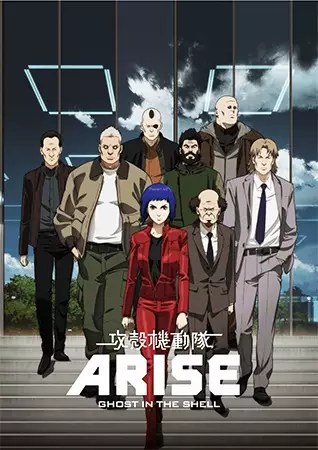
攻殻機動隊ARISE -GHOST IN THE SHELL- border:1 Ghost Pain
1
Movie
Finished Airing
Jun 22, 2013
The anime's story is set in 2027, one year after the end of the fourth non-nuclear war. New Port City is still reeling from the war's aftermath when it suffers a bombing caused by a self-propelled mine. Then, a military member implicated in arms-dealing bribes is gunned down. During the investigation, Public Security Section's Daisuke Aramaki encounters Motoko Kusanagi, the cyborg wizard-level hacker assigned to the military's 501st Secret Unit. Batou, a man with the "eye that does not sleep," suspects that Kusanagi is the one behind the bombing. The Niihama Prefectural Police detective Togusa is pursuing his own dual cases of the shooting death and a prostitute's murder. Motoko herself is being watched by the 501st Secret Unit's head Kurutsu and cyborg agents. (Source: ANN)
7.0/10
Average Review Score
75%
Recommend It
20
Reviews Worldwide
Bold and cryptic, the original Ghost in the Shell movie (1995) is considered by many fans to be the apex of sci-fi anime within its decade. Over time, Oshii’s adroit directing influenced a multitude of many abstract ideas, both ambitious and creative. However, it was Kamiyama Kenji’s Stand Alone Complex iteration of the series that helped further the franchise's reputation as a result of its superb action scenes, script, and sophistication. With that said, Ghost in the Shell: Arise is a series that needs no introduction. But perhaps in an ironic way, it is essentially the introduction for the franchise. Although the franchise is largelyan elaborate piece comprised of intelligent crime cases that tackle thought-provoking issues, the cast remains enigmatic as a whole. In its entire run, only bits of backstories about the characters are scattered throughout, and Motoko’s relationships with the rest of Section 9 are not specified until the second season of the Stand Alone Complex. Arise however, gives very little in the way of answers for the amount of questions that it brings to the table. In many respects, the premise of a cybernetic hacker is redolent of the original Ghost in the Shell movie, though the unsettling atmosphere is construed and explained in a very different manner. Arise is very much focused on Motoko herself, rather than the broader social scope. In the event of Border: 1 Ghost Pain there is an alleged conviction that Motoko is the culprit of a murder case, and Motoko must confront herself in the midst of confusions to clear up her name. Consistently incorporated throughout the movie, Arise's ambiguity is the foothold for its mysterious components. While murky at times, the enigmatic nature of the movie allows for the truth of Motoko's conviction to surface in a tangible fashion. The beginning of the movie arouses a sense of confusion (in a good way) and easily attracts the audience's attention. However, the nature of the Arise series being separated into 50 minute entries very much limits the extent of the storytelling. In the case of Border: 1 Ghost Pain, this is especially true, as the riddle is unraveled in a predictable succession of preface, hinting of a villain, uncertainty, and then a final battle with said villain. The conflict is weakened in the process due to the simple mistake of a rushed pacing, leaving us with a shallow sense of suspense during the latter parts of the movie. Despite the contestable issues with the pacing, the essence of the character dynamics hasn't lost its touch in this movie. Motoko slowly re-encounters and stumbles upon many future members of the soon-to-be Section 9, and their relationships remain underdeveloped yet still sturdy. For an introductory plot, Arise made a first-rate effort of delivering the story in a simplistic yet appropriately mystical pattern. Unfortunately, the said deliverance is occasionally soiled by the inclusion of one-dimensional villains, whose actions conveniently fit as plot devices where needed. By and large, the animation is pleasing to look at. On one hand, the action scenes are all fluid and splendidly done. Likewise, the aesthetics generally illustrate appealing appearances. On the other hand, while the character designs are fresh and new, they could be viewed as dubious alterations by older fans. Similarly, the music is not as excellent as hoped. It is perhaps too high a bar for one’s music to live up to Yoko Kanno’s distinctive style. However, as individual background music, the OST is actually fine in setting the gloomy mood during the movie. As an experimental film to follow up on an imposing legacy, Border: 1 Ghost Pain has done a surprisingly fine job of providing basic background. While some lesser parts drag down the tension of the story as a whole, the core of the franchise is still there. Although it does not pay homage to the long-lived franchise, Arise proves to be a fascinating take on the sci-fi genre. For that, Border: 1 Ghost Pain still deserves a try for its creation of an intriguing thriller. Naturally, there are still three other movies that are subjected to their own merits, so it'll be interesting to see where it goes from here.
::NOTE:: This is a review of the entire of Ghost in the Shell Arise because splitting them up is only done by dumb people and MAL admins. So basically just dumb people. Ghost in the Shell has gone through a few hands in its life. From the cyberpunk manga origins by Shirow Masamune, before he turned into a weirdo who only drew calendars full of pictures of impossibly proportioned naked girls covered in machine oil, it then went to Oshi. There it had its most visually striking entrant with a gorgeously directed movie, albeit one lacking a little in character. Then he made a second moviewhich we should all probably not talk about. Then it was handed over to Kenji Kamiyama and was allowed to spread its wings a little in two full length TV series. With this space it was able to explore a wide range of typical cyberpunk topics with frightening levels of depth in what I consider to be the strongest the franchise has ever been. The latest instalment sees it placed into the hands of Tow Ubukata as the chief writer and I will admit I was a little bit worried. This is the man whose most famous previous work was Mardock Scramble, a novel series that certainly had its interesting ideas but sorta lost track of them around about the time Norio Wakamoto was being eaten by flying homosexual sharks. Actually I think it was the dolphin that was homosexual…anyway, gay marine animals aside, it was a huge mess. So I tuned into Ghost in the Shell Arise with my expectations tempered significantly. So, Arise. It’s a prequel-of-sorts to Stand Alone Complex (apart from the fact characters’ backstories have changed so it’s not actually a prequel at all but it hardly matters) featuring a younger Major Kusanagi leaving her old military unit to form Section 9 on behest of a boring old man called Aramaki. Despite the backstories changing and therefore COMPLETELY RUINING the franchise, each character introduced feels like slipping back into comfortable old shoes. The Major is still her headstrong self with that self-doubt and temper hiding beneath. Batou is still the cyborg dudebro with a kind heart. Togusa is still that intelligent family man. The rest of the crew whose names you can never remember are still hanging around in the background being not as interesting. The story for Arise over its 4 episodes is about the nature of memories and how can you trust your cyborg brain when it can be hacked and change you as a person. Things you considered vital parts of your psyche could be lies and you doubt your own humanity when you can be so easily rewired. Who do you let past those defences you have built up in your fear that you may become something you are not. Who are you really and can you trust your body to represent you. Are you defined by your memories? Pretty standard stuff if you’ve ever experienced any previous iteration of Ghost in the Shell, but it hasn’t stopped being a fascinating subject in that time. Arise focuses on memories most of all and builds on this theme in some really quite excellent ways that aren’t immediately apparent from the start. Part of this is because the show is so bloody difficult to follow. Episode 1 is the worst in this regards. Being incredibly complicated to the point that you can feel your brain slowly dribble out your ears through exertion is again something very common to Ghost in the Shell. Making a Ghost in the Shell not complex would be like making a Gundam anime without robots. But when you start throwing in an unreliable narrator created by false memories altering what it is she sees to the point that you question whether anything you saw previously is true, that’s when you’re just being mean. The show is complicated enough as it is without making us doubt everything we’ve seen. Thankfully it improves immensely after that. Episode 2 is a perfect example of how to do it and should be a good outline for how to do every Ghost in the Shell episode. It’s about a military unit who have been put on a show trial for war crimes they didn’t commit so their boss shuts down the city by hacking into its traffic computers, so the Major and her team have to track the perpetrators down through both an epic car chase and hacking battle. It’s an episode that’s simple enough to wrap your head around with understandable motivations but still with the depth to the conflict that makes it interesting. It even has a twist involving the false memories that works because it’s only a single change that you can instantly understand the implications of and even throws in some character depth and themes of how our memories can define us. It also has a kick-ass car chase involving Arise’s versions of Tachikoma doing their best Attack on Titan’s Survey Corps impressions, swinging through the cyberpunk city with their absurdly cute high pitched cheers. For as much as I like to talk about all the depth and complexity of Ghost in the Shell, I also want to see the Major punch someone in the face so hard her own cyborg arm is crushed. The production values here are about equal to that of Stand Alone Complex, which is a little disappointing in that we haven’t progressed that much in the 10+ years since then but since Stand Alone Complex still looks fantastic today that’s not as negative a point as it sounds. Fights feel impactful and I even like the Major’s character design revamp (it’s about time she put on some bloody clothes). Where is has really upgraded is the CG. Where Stand Alone Complex CG cars look awful, Arise looks a lot better and even exciting. That car chase wouldn’t have looked anything like as good had Stand Alone Complex tried it with its CG. It can admittedly jump back and forth in quality though. Arise uses a hell of a lot of CG animation and it can be jarring when a character changes from one scene in CG to the second in hand-drawn, and it still lacks that all important weight that CG seems to be permanently saddled with. But it didn’t make me go “ewwww CG” which is an improvement in almost all other CG. On a cinematography standpoint though I feel Arise is the weakest in the franchise. The best it gets comes in the fourth episode when it makes some very deliberate call-backs to the movie. In the end I came away feeling quite positive about the whole experience. It definitely has its weaker points. It can’t match the movies visual flair nor have the space to recapture the depth and character of Stand Alone Complex, but it does get somewhere in between the two. The most positive thing I can say about it, as a huge fan of this franchise, is it definitely feels like Ghost in the Shell. Its characters, themes, writing and even general flow feel like Ghost in the Shell. It doesn’t come across as bad fanfiction tacked onto the franchise or anything like that (which this same author seems to be doing with whatever the fuck he’s done to Psycho Pass). It has all the things I love about the Ghost in the Shell franchise. Not any more than that, but not any less either.
Perhaps this question may have popped into your mind one of these days: What happens to our future after the events of a world war? Perhaps we still exist but on the other hand, what would our new world be like? Well, it's a question that not many of us may care to know given our current circumstances. But world wars have happened in the past and they left devastating results. To quote from a famous German physicist, Albert Einstein once said: "I know not with what weapons World War III will be fought, but World War IV will be fought with sticks and stones." Well, it'sback. Even if it's not in original form, I am quite happy to see a revived Ghost in the Shell animation in some way or form. At the same time, it should be noted that this first film (and the rest) are considered prequels. In other words, this film does not belong to any of the original three series. This is an alternate series. Kenji Kamiyama , the director of the series, in fact isn't even involved with the project. Anyways, Ghost in the Shell: Arise - Border:1 Ghost Pain is the first of four films of a saga that takes place in 2027, apparently one year after the end of a non-nuclear world war. The setting takes place in New Port City where there's all sorts of drama and crimes. The film runs over 50 minutes but just under an hour. Its atmosphere reflects on the dark and grim like futuristic world where there's crime and anxiety. Even in the beginning, there's a bit of investigation related to the murder of an individual. Then of course, there's the investigators. Among one of them is our main female protagonist Major Motoko Kusanagi of Unit 501. There's not much we learn about her except for the fact that her body is made up of cybernetic enhancements and is fully cyborg. Identified by her fierce eyes, Major plays the role of a dominant woman-cyborg hybrid who is fully capable of handling situations herself. Being set in a futuristic world, there are obviously futuristic themes and gadgets. Beyond just Major's cybernetic advancements, there are interactive AI, powerful surveillance devices, and machines that are capable of destruction. With its cyberpunk settings, it's no surprise that the futuristic world has more developed technologies to our own. Perhaps World War IV triggered more than just fear. Rather, it created a state in which the technologies we depend mayb become our own destruction. In the world of GITS, there's crime and weapons who falls into the hands of dangerous individuals can be a catastrophic. Among other factors in the film, there seems to be a little mystery regarding on the murder of the particular individual from the beginning. In fact, whoever killed him had his or her motives. The job is obviously handed to our Major who seems to struggle quite a bit in the case, at times even putting her colleagues' lives at risk. Her action girl skills puts her in the shoes of a dominant female though as she is independent and often works at own her discretion. Mounted by her cool Kaneda style bike and red suit, Major fights with style and her own way. The way she handles cases seems to be straight out and to the point although surprises can take her on a different scale at various occasions. No discussion with GITS can be complete without returning characters right? Among one of the returning characters from the original series is a large man with strange eyes and also full of cybernetic enhancements. His name is Batou and there's definitely some suspicion that falls under his eyes. In fact, those eyes of his aims suspicion at our Major. As strange as it sounds, their reunion gets a bit rocky with fists aiming at one another. However, trouble brews faster than it comes as our main characters finds themselves in jeopardy at the mercy of many of the dangerous gadgets in this film. As I had expected, the OST mixes well with the action packed scenes. In fact, the action is fast paced with no holding back between many scenes. Handled by both guns and physically, the film adapts that straight out way of combat. Some of the battle scenes later on even resembles Terminator-like duels between cyborgs. In terms of mental aesthetics, GITS Arise also explores some of the inner parts of Major such as her 'memories' and causes of a pain that she experiences throughout the film. Connecting with the cyberpunk themes, it's no surprise that the film decided to adapt these ideas. "What's real?" and "What's the truth?" are just a few questions that pops up into Major's mind. The result of the animation by Production IG in this film seems a bit different. Namely Major, her hair is of a different color for some reason than compared to the original GITS series. I did find Major's new character design to be out of space and strange. Also, the amount of fan service was somewhat more than I expected. Her design is also fitted with numerous cable plugs that truly reflects her nature as a cyborg. (those cables do come in handy by the way...) The backgrounds definitely gives off that natural feeling of being a world set in futuristic times though. The high level structures and machinery are just a few example. Among another key factor is the idea of the title. It's mysterious but fits with the idea. As for soundtrack, the film handled it quite well from my perspective with its electronic beats. There's a sense of that science fiction feeling that matches the many scenes of the film at many occasions whether be Major's action scenes, the OP song, or the voices of the characters. Speaking of which, Sakamoto Maaya once again lent her voice in this film as our main character Major. The way she speaks reflects her serious nature and ideas of dealing with crimes throughout the city. Then, there is also the ED song that has that unusual beat. Well, if anything, I thought the OST worked well for the film. All in all, this film is nostalgic and brings back some of that GITS feelings back. It's been quite awhile after all and this is a rather refreshment of what's to come next with Major and her crew. The animation is a bit out of shape but ignoring that aspect, this film brings out a scientific flow of crime investigation. If you were a fan of the cyberpunk genre or the original GITS series, then this film is definitely something to keep an eye on. Even if you're fresh and completely new to the franchise, its' worth giving a shot. It's only about 50 minutes so consider that a standard for this film. Of course, there's three others to come later, with Ghost Whispers debuting in November. Simply put, give this film at least a try. GITS awaits you.
At the top of the cyberpunk hill stands the Ghost in the Shell franchise. First formulated in concept by Masamune Shirow, it has been Mamoru Oshii's Ghost in the Shell (1995) film and Kenji Kamiyama's Standalone Complex series that have amassed wide and overwhelmingly positive reception. Ghost in the Shell: Arise—a four-part OVA series—is the most recent installment into the franchise, serving as a prequel set prior to Section 9's establishment. With high expectations coming from a new Ghost in the Shell title, it may not come as a surprise that Arise's first piece (Border:1 Ghost Pain) wields variable success. Perhaps one of the most noticeablechanges in Arise is the single point of view focus onto Motoko. Her actions and behavior play off as slightly more human in the OVA, whether it be displaying discernible facial expressions or occasionally acting by emotion. This causes her to seem more like her physical age than her typical, cold and cryptic self. Additionally, she holds more bearing on the story than normal. Aiming to solve a murder and later being implicated as the primary suspect, Motoko becomes pivotal in whether Arise can subtly yet powerfully grasp its story. As a teaser and opener, Border:1 does a decent job. The mystery remains simple while still wafting that old GITS tension; it nicely paces through the narrative on tried and true grounds. The investigations murk about, action scenes go a-flurry, and exciting plot twists make the sketches of a solid storyline. Motoko also receives hints of development through a partially grasped backstory, and while this may seem incomplete, Border:1 is after all only one of four entries, and the allusions toward more (particularly Motoko's development and thorough introductions to future Section 9 members) work seamlessly into the storytelling. Yet, this is also one of Arise's pitfalls. The simple plot structure—combined with a singular point of view and occasionally awkward pacing—can cause a few scenes to feel slightly linear and dull. Moreover, the restrictive point of view may narrow the scope of the OVA's aims, and GITS's recurring characters (namely, Araki, Batou, and Togusa) make a nice cameo but that's about it. This leaves a lurking, uneasy feeling about the work's direction; many of the sci-fi themes prevalent in previous titles are also non-existent here. However, what's fortunate is that Arise manages to keep many of the subtleties and charm within the character dialogues intact. It may not exactly feel like the GITS we've all come to learn and love, but it's still a good sci-fi story nonetheless. Much of the streamlined narrative can also be attributed to the limited time allocated in Arise. After all, a one-hour treat can only do so much into framing the beginning, middle, and ends of a mystery. However, this limitation is surely not the only factor causing simplifications in the work; the villains come and go, the action scenes are numerous yet not always relevant to the plot, and certain dialogues seem out of place and unrequired. Still, at the heart of Arise's content lie the fundamental pieces which provide for good writing. While Arise's visuals proudly stands with its own style, its design choices have stirred controversy. The OVA beautifully flourishes a lighter opacity than previous installments. This luminosity offers a fresher appeal, leaving a tonal vibrance that nicely captures the ages of the slightly younger cast. However, paired with the more minimalist detail and brighter shade of skin tones, this can at times apprehend viewers. Motoko's character design, for instance, almost (note: almost) has that moe appeal trending among current shows. This no doubt has spurred contentions among the loins of all otaku and self-appraising viewers. Fortunately, what rare fanservice does exist encapsulates the same seinen bloodshed-and-boobies common in the genre. In other words, you won't be seeing Motoko pull off an Asuka catchphrase any time soon. The soundtrack remains true to the cyberpunk theme, offering circuits of electronic pop, jazz, and smooth guitar riffs. The choreography and overall animation are generally both fluid and topknotch, oozing out creativity with Arise's integration of cybertechnology in action scenes—realtime hacking wizardry, cybernetic organs, and quick-fire CQC. The 3D CGI works just as well as in Stand Alone Complex, with little to no intrusive vices; it's great to know these elements have (for the most part) marched the classic beat encased within the GITS franchise. With mixed success in its execution, Arise still serves as an admirable entry point into a new tetralogy. Production IG proves that its animation and visuals are still ever improving, and Arise's plot—while "off"—makes a decent segway for the next three titles to come along. Whether one is a fan of Border:1 or not, high hopes remain for the upcoming installments. ------------------------------------------------------------------------------- This review is written by members of the club Quiet Discourse. For more details, please see the club frontpage.
One of my first memories of anime really catching my attention for the first time was when I was about 10yrs old and I was in a video rental place and they had the original Ghost in the Shell movie playing on the TV. I was also obsessed with the Metal Gear Solid game for PS1 and something about what was on the screen just really struck a nerve. I immediately asked my dad to let me rent it, and my love of anime had begun. I had seen anime prior to that, but that was the first time I knew it was animationfrom Japan. I was hooked. Ghost in the Shell has remained one of my favorite series ever since, in fact not even considering just anime it is one of my favorite Sci-Fi series ever. So when I saw there was a new GitS I was happy to say the least, but also a bit skeptical. Story(8): Overall I think the story was well done, it was very much like what I would expect from Ghost in the Shell. That being said, it wasn't amazing or anything, it was like a stand alone episode from SAC(which really isn't a bad thing). It also becomes clear early on that Kusanagi isn't with section 9 yet, and the story is basically her first encounter with them. I know a lot of people may have an issue with the backrounds of the characters not being the same as in SAC, but this is an alternate version and I don't see that as a negative. All the things that make Ghost in the Shell great are here and done well, espionage, realistic sci-fi elements, action. I was overall impressed with it. Art(8): My first impressions from the trailers were that the animation was "ok". After watching the whole movie I have to admit the animation is very good. It does seem to not have quite as much detail as SAC or the original, but it shows a lot of promise during the action scenes and the details of the cyborgs. There's a certain scene where Kusanagi is in a fight and her limbs get ripped off slowly and her cyborg parts start to show, very reminiscent of the original film, and it looked great. As for the art style/character design changes, I wasn't as effected by them as I expected. I think they were very well done, just not what we're used to. I'm sure some people wont be able to get over this change though, for me it wasn't a big deal. Sound(8): I usually don't have too much to say in this category, but Arise had good sound quality and voice acting. All the sound effects for guns, hacking/computer noises, cyborg noises, ext sounded great. The music was also rather good, although I've seen people saying they dislike it. I personally thought it was good. The voice acting is great, I believe the voice actors for most of the cast from the original 96' film returned to play their roles, although I admit I watched the dub of the original so that wasn't a big deal for me. They did a great job though. Characters(8): The characters we already know pretty well, and while Kusangai seems to have a slightly different personality the rest of the crew seem very much like themselves. I know for some people "change=bad", but I got over it quickly and adapted to the slight differences in the new section 9 members. I will mention that some of the side characters were rather bland and not very memorable. I can't wait to see these new takes on the characters we love developed further in the next three movies. Overall/Enjoyment(8): I have to say, I enjoyed it a lot. More then I expected to, I expected it to be a decent Sci-Fi anime but not live up to the GitS name. It wasn't quite as good as SAC or the original, but it very possibly could manage to be in the next three movies. I really thought it was well done, and I was impressed with the action sequences and keeping the espionage moments interesting and on par with previous GitS outings. Overall, I could not be happier. This is exactly what I've wanted recently with there being a lack of good seinen anime. I can't wait for the next movie to come out. I'm still fairly new to reviewing, so sorry if I'm not as professional as some of the people on here. I don't cover the plot much, because it's a 55min movie, just watch it. No point in just repeating the description in my opinion. Hope my review was helpful.