Links go to search results. Availability varies by region.
東京レイヴンズ
24
TV
Finished Airing
Oct 9, 2013 to Mar 26, 2014
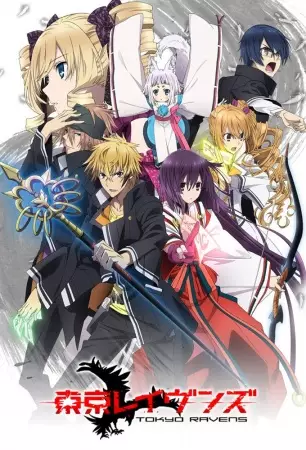
Onmyoudou magic was once a powerful technique used by the Japanese during the second World War in order for them to gain the upper hand and establish their nation as a formidable force. But Japan was quickly defeated after the revered onmyouji Yakou Tsuchimikado caused the "Great Spiritual Disaster," an event which plagues Tokyo to this very day. As a result of this mishap, the Onmyou Agency was established in order to exorcise further spiritual disasters and combat the demons that would make their way into the world. Now, Onmyoudou has become far more modern, simplified, and refined for use in a wide variety of applications such as medicine and technology. However, not everyone is able to utilize the magic, as is the case with Harutora, a member of the Tsuchimikado's branch family. Despite an old promise to protect Natsume, the heir of the Tsuchimikado's main family and Yakou's supposed reincarnation, as her familiar, Harutora has no talent and chooses to live a normal life instead. But when a prominent member of the Onmyou Agency attempts to recreate the same experiment which led to Japan's downfall, he decides to make good on his word and fight by Natsume's side. [Written by MAL Rewrite]
7.5/10
Average Review Score
90%
Recommend It
20
Reviews Worldwide
Tokyo Ravens Review: Sometimes shows come around that are completely generic and average on paper, but are unusually fun to watch. Looking at my 6 score for this show, many of you may think I didn't think the show was good. But this couldn't be further from the truth. Tokyo Ravens wasn't groundbreaking, memorable, or brilliant. In fact, it was pretty a pretty generic fantasy action anime with romance elements which is why I withhold too high of a score. However, Tokyo Ravens is without a doubt a very enjoyable show. Story - 7.1: Where Tokyo Ravens' story shines isn't through it's rather generic premise or predictableplot twists, but the solid pacing and backstories of the characters and the setting. The pacing of Tokyo Ravens is nearly flawless in my opinion, giving proper amount of air time to the intro, the time at school, and the more climactic parts at the end. The background of the setting is also very well realized and had me captivated with its mechanics. The lore of the world of Tokyo Ravens is also rich and actually significant when it comes to later events in the story. Yes, the overall story of a boy who gains powers teams up with his classmates to stop the bad guys has been told many times before, but the execution and care put into it all kept me caring from start to finish. Rarely were there moments that left me shaking my head in disappointment. Art - 6.8: For the most part, the art in this show is great.... Until they decide to use CG. The character designs are good, and the non CG action scenes are well done. Everything is fluid and the varied locations display a wide array of colors and artstyles. However, when they decide to use CG for familiars in fight scenes, things break down. Sometimes CG is done well in Anime, but for the most part it feels out of place and really cuts into your immersion as a viewer. Without the use of CG, this score would have been higher because the visuals were good. Sound - 6.3: There's not a whole lot to say about Tokyo Ravens in terms of the sound department. The voice acting was solid all around with a large cast of diverse voices. The OST was good and fit the show well. There weren't really many stand out songs however so I wouldn't say it was too far above average. I did enjoy the openings and endings especially the first ED. Really the sound aspect of this show was definitely good but didn't really stand out particularly. Characters - 6.7: Now, the characters in Tokyo Ravens are interesting for me. Because for the most part, the characters were just cookie cutter stereotypes. However, I found myself much more invested in the than I usually do for such one dimensional and predictable characters. This may just have been a personal thing, but who knows. A big plus of the cast of characters was just its pure size and variety. There was a large ensemble of good guys, bad guys, and characters that were in the Grey area of their intentions. None of the characters were necessarily weak, and a few were quite intriguing. The two main leads have a very interesting history and the interactions between characters rarely failed to be entertaining. Enjoyment - 7.5: Tokyo Ravens was without a doubt, very enjoyable to watch. It had this nostalgic kind of feeling to it and exceded all my expectations going into it. The plot twists were well placed and at times shocking, and the array of humor, drama, and action was well mixed to create an all around very enjoyable show. I personally find it hard to keep watching a show on a weekly basis for months on end unless I really care about the characters and and entertained by the events in the show, and Tokyo Ravens resoundingly delivered in those departments. Overall - 6.88: While it never really shined, Tokyo Ravens was still 100% worth the time to watch it. Keep in mind that a 6 in my books means "good", and if a 6.88 is any indication, this show was unquestionably good in my opinion. It isn't a caliber of a show that I would recommend to all, but if you are looking for an enjoyable generic action fantasy anime with romantic elements, look no further. The Verdict: A well executed anime that plays it safe, but was a pleasure to watch. Pros: + Solid job of executing its wide array of genres (action, fantasy, romance, comedy) + Large cast of characters (all of whom are bearable) + Lore/Backstory Cons: - CGI poorly used - Predictable story - Failure to stand out If you liked Tokyo Ravens, watch... Fate Stay Night Strike the Blood 6.88/10 - Good
Click an episode to read its synopsis.
I´ll admit that I fell pretty stupid for putting this anime on hold for such a long time. As it started of with a meh and ended with a YEAH, this anime was surprisingly fun to watch. As I started watching this anime, I had a feeling that the main character Harutora was going to be one of those boring mains to watch in the long run, but as I kept following the story, it became more and more interesting to follow this boring main and his friends. Taking on enemy after enemy, trying to become powerful shamans (exorcists) was only a fraction of what thestory was really focusing on. Still there are parts in the story that is halfheartedly explained, leaving you with a big question mark as to what is really going on and why. They also seemed to overcomplicate the story, making it harder to get in "The Zone" when it comes to characters and scenery. Still the story has plenty of upsides to it. As it is an well though story with good plot twists and a great rhythm and backstory to it, this story leaves me in nothing but awe. The art itself were also pretty good, fitting well in with the story and providing well expressed characters when it was needed. Some part were also a bit sloppy when it came to the art, but when it came to the fighting, the art were perfectly done in a way that fits perfectly with what I am looking for in a action anime. I was easily taken by the fighting scenery and style. As far as the sound goes, I have hardly much to say. The openings and the endings of the anime provides as beginnings and endings of the anime itself, making it easy for one to get right into the anime and the fighting without as great of a shock as what Ive seen other animes do. Following the story was no problem with such an intro to it. Yet I missed that little extra in the sounds, that little extra that leaves you with the impression "Oh, shits about to go down now" kinda sounds/music. Still it was fairly enjoyable. As for characters I feel it could have been done a little better. The amount of history put into them, doesnt add up to the amount we are shown. I feel as if I know the teacher Ootomo better than Harutora and the rest. Even though there is given alot of history to them, I still have no clue as to what really happened when Harutora was younger or when anyone was, theres simply a lack of debts to them. I mean, isnt it weird that the story is mainly focused around this Tsuchimikado Yakou guy, and we hardly know shit about him or what happened to him when he was alive. Maybe they should have freed some room for a little backstory instead of providing us with small, unnecessary fillers. Even though I said all that, this show still provided me with a lot of enjoyment and fun, and as to the ending being an ending I prefer over any other, there was no major disappointments to this show (that i noticed). So dont do as me and put it on hold after 6 episodes, make sure to watch it trough to the end straight away so it doesnt get confusing. I highly recommend this anime to all you out there who hasnt watched it, and lets all pray for a Season 2 :)
-I'm going to skip the synopsis as you can go ahead and read that on your own - I'm strictly writing a review as to my reaction when watching Tokyo Ravens- To be honest, when I first began watching this show I felt as though I was lacking originality, in both character and story. The originality wasn't so bad like 'I've seen it a million times' sort of deal, but It was interesting enough to make me want to watch the next episode. The characters seemed overdone and over the top, opening with the feisty chick friend of the male protagonist picking on him and hiscool and calm best friend. Even if it started out quite cliche, I still kept watching it, mostly for lack of other anime to watch. It was worth it because this show had a lot more depth than meets the eye and gets better as it moves along. For people who enjoy magic fantasy action anime, you will probably like this as it has a nice mix of all of those genres with interesting plot twists. Though most characters remain stagnant throughout the anime, at least half of them have some sort of basic development, be it mind set, or physical ability. What bothered me the most about this anime's characters though is how most characters pick on the main protagonist. The anime already outlines him as 'dumb' and 'having a major lack of talent' so much so you wonder why he's even the main character . His interactions with other characters tend to end or start out with them calling him 'baka-tora', and describing how pathetic he really is. Even though he proves himself more than once to the gang, they still proceed to stick with that nick name. As usual, he is a typical shounen character that tries his best, despite his obvious lack in talent. The anime later drops these undertones though, making it A LOT more enjoyable. The music I found to be quite nice, the opening and ending were okay, not bad but not my favorite anime openings. The music during the anime is very nice, giving it a nice sorta mystic aura, adding a lot more epicness to the show. Without the music, I swear the scenes would feel a lot less intense. The story itself is a nice mix of magic and action, though it might not be the most original story ever written. Its enjoyable enough to keep watching. It may not be one of your favorite animes, but if you watched all the anime there is and happen to come across Tokyo Raven's, its pretty good, and you'll like it better towards the end so i recommend not judging it until you get at least half way. Even though I wouldn't consider it my favorite show, I did enjoy watching it. Its not one of my most memorable animes, but you definitely wont be wasting time.
There’s a saying that goes something like this: “two wrongs don’t make a right”. In Tokyo Ravens, this doesn’t apply as onmyouji magic is accepted by society as a form of dealing with spirits and apparitions in general. The show builds itself with the basic concepts and principles of a modern fantasy involving characters dealing with onmyouji, otherworldy beings that have been causing trouble in Japan. While most anime involving magic is forbidden, Tokyo Ravens takes the liberty to accept it as a form of art. Thus begins the adventurous tale of Harutora Tsuchimikado as he learns the truth about the world he lives in. TokyoRavens is an animated series based off the light novels of the same name written by Kohei Azano. It’s easy to notice quickly that the show is colored with modern fantasy themes such as the shrines and stylistic clothes that our characters wear. There’s also no doubt that the show has potential with its concepts. But what’s more important is the execution. After all, Harutora is labeled more as babyface with little skill in onmyouji magic. He has potential and Tokyo Ravens explores it in various aspects. What Tokyo Ravens went wrong in this part is its execution that becomes blend and sometimes insufferable. But despite this, the show itself does handle its structural set up in a tolerable fashion with credibility. Take the series’s story as a modern fantasy with the magic, curses, and spells in an all-you-can-eat buffet. There’s no special appetizer because everything is conventional and expected in terms of its general set up. The first few episodes establishes the premise and delivers itself in its traditional fashion. We meet Harutora and his friends whom doesn’t seem so different from folks you see from our society. However, realize there are abnormal beings that exists in their world. There’s a lot of information to absorb in the beginning, in ways that seems to cloud the story until we meet some antagonists. It also becomes more and more clichéd with the characters involving a typical childhood friend named Natsume that comes to visit, the flashy fireworks in the sky with a misunderstanding, and mecha-like gadgets popping out as adversaries because they look flashy and demonstrates a lethal presentation of modern fantasy. While all is fine when presented in the right fashion, Tokyo Ravens introduces everything together all at once that feels rushed. More than that, there’s also predictable plot twists that at times becomes bizarre and lands nowhere with Harutora’s characterization. Speaking of characters, there’s quite the diversity. Thankfully, none of them sits in the background but instead get their spotlights, some even more so than our main protagonist. Still, that isn’t exactly a gift to accept so easily because Tokyo Ravens only develops them on a substantial level. Natsume for instance never really changes with her time on the show. She is portrayed as an innocent girl who is willing to protect others. There’s obvious affections coming from her towards Harutora despite the latter being oblivious to her some of her words and advances. To make matters worse, most of the school they attend are under the belief that she is a guy. This is where the silliness comes into play with their “yaoi relationship”. As quirky as it sounds, the series actually doesn’t hide this as they play on this trope many times with almost the entire female student body believing it as reality. Other characters in the series serves as the support for Harutora’s development but most of them are more like friends to him rather than a coach. They offer him advice, training sessions, and details to unlock his potential. Unfortunately, Harutora is presented as an irrational man when it comes to textbooks and learning. He even earned the nickname ‘Bakatora’ which is a played as a joke as baka translates to ‘idiot’ by Japanese standards. At the same time, we do witness Harutora become stronger through experiences and determination to protect others. There’s a sense of hope when he really puts effort or when the people close to him are in danger. It’s there that we see Harutora shines by moments of his selflessness. Other times though, Harutora is hard to get attached to for his abilities and dull personality. The series itself also follows sequential arc style in presenting stories and characters. Like I mentioned previously, almost every main character gets their spotlight whether you’re former delinquent (Tojo), the youngest of the Twelve Generals (Suzuka), a shikigami (Kon), or heir of a famous family (Kyoko). Speaking of the Twelve Generals, the series presents themselves as a testimony of strength. Each of them possesses their own unique abilities that makes them both fear and respected. Unfortunately, because the show itself focuses on more of the main characters, they lose focus and only gets their chance to shine when the action calls for it. The action itself also can be a mixed bag. The usage of CGI and magic at the same time is certainly an odd mix. It almost feels like the show is running on an engine with a different set of gears. However, the show does well with its mechanics in terms of explanation. Every episode contains a little bit of explaining whether it’s the backgrounds or just in general of what’s there. Various terminologies such as onmyouji, shikigami, as well as events are usually easily understandable with attention. Furthermore, the term raven is symbolic for death (foreshadowing in the beginning) and matches perfectly with its presentation of magic linked to Shamanism. It could also be something refreshing to watch as it sometimes brings that fantasy taste in a way you might not get used to. What really makes Tokyo Ravens hard to get used though might be the asinine comedy that tends to be an overused way of delivery. This includes but not limited to Harutora being an accidental pervert, Suzuka’s fake relationship with Harutora, and Kon’s obsessiveness with her master. It also uses cheesy lines with little favor that often lacks sense. Natsume’s cross-dressing makes her a subject of attraction for girls at the academy they attend. It spells out laughter in the wrong way because the misunderstandings should be so obvious. Really, does Natsume look that much like a guy with her fragile face and long hair? Some of the characters’ personalities are also hard to figure out such as Suzuka and her manipulative actions. Kon’s personality changes almost every episode according to what circumstance she is and whom she is with. Tenma, a classmate of Harutora, also seems to be in the background most of the time and plays almost no significant role. While the show doesn’t explicitly present fan service or the typical beach episode, Tokyo Ravens still reveals more skin than it should thanks to mostly Harutora’s stupidity. Artwork remains standard on most parts for Tokyo Ravens. It is noticeable that 8bit is also in charge of producing both Infinite Stratos 2 and Walkure Romanze at the same while this show is also airing. But for judging its animation, Tokyo Ravens does it well only in terms of credibility. Supernatural familiars are believable with their designs while backgrounds reflects the modern fantasy style that it should be. Unfortunately, most of the characters stands out as blend. Kon is perhaps the most noticeable character because of her animalistic features. Suzuka on the other hand has bits of fan service in her design while Natsume’s cross-dressing literally covers almost every inch of her body besides her face. The strange usage of CGI will take time to get accustomed to. At several times, I almost thought this had mecha-esque concepts. Soundtrack wise, Tokyo Ravens surprisingly works out well. While Harutora’s voice is nothing special, there’s something noticeable about its OST with the way that fuses fantasy elements with reality. Not only that but the OP song “X-encounter” by Maon Kurosaki had an intense beat with bits of foreshadowing. Most of the characters’ voices also fits well that matches each scene. In later episodes, some of the characters’ voices also convey emotions well through their dialogues that almost seems realistic despite the show having fantasy elements. Tokyo Ravens is nowhere close to a masterpiece but neither is it an abomination. I guess in most ways, it takes time to get used to for its style of fantasy. The series offers a diverse cast of characters that the audience might favor. Unfortunately, their personalities are hard to describe and their characterization are limited. The story itself also takes time to get used to with every arc that has some sort of message or morality. Whether you get that message might feel different for everyone. For me though, Tokyo Ravens is just another standard series of modern fantasy that depicts the life of young man with much to learn.
There's a certain feeling of mediocrity that arises from simply looking at Tokyo Ravens. It doesn't really look like anything new, innovative, or fresh. Despite its generic appearance Tokyo Ravens still manages to do what it's supposed to: entertain. As far as story goes, there really isn't much of an intricate, deep, or immersive plot. The story is pretty sub par for a good amount of the first half, adhering to countless generic cliches like the childhood friend promise, amnesia, and what have you. Although it gets better during the second half, it's still not anything amazing. The key aspects that make the second halftake flight and become more enjoyable to watch is that there are actually Onmyo spell battles, familiar battles, the plot finally breaks out of its run-of-the-mill school life trope, and the concept of the shaman society is fleshed out a bit more. With all of that being said, it's awfully apparent that the adaption of Tokyo Ravens from the light novel to the animation is fairly bad. There are countless instances where moments, events, and key turning points in the story felt extremely underdeveloped, unexplained, rushed, or skipped over. The art and animation of Tokyo Ravens seemed pretty average, if not below average, in most cases. Most animes nowadays at least bring decent art and animation to the table, but that doesn't appear to be the case with Tokyo Ravens. The art isn't all that great and animations can feel stiff at times. Overall, the art and animation felt a bit behind the times in comparison to many of its visual contemporaries. The sound criteria was fairly average. There's nothing that stands out, but it's not bad. I think it's become pretty standard in anime for the male MC to be a fool and dense for a majority of the series. Unfortunately for the audience, Tokyo Ravens falls victim to this generalized male lead personality. Harutora, along with most of the other characters, are extremely generic and cliche. If you've watched a good handful of anime you can recognize most of the character tropes that are used here. Childhood friend blossoms into friendship(s) after many years? Preposterous. There are a few interesting characters amongst the Divine Generals, but they get far too little screen time to make much of an impact. There isn't much character development and most of the characters retain their original personalities throughout the series. Supporting characters often felt more interesting and almost as equally developed as main characters and that's saying a lot. Although there are many aspects about Tokyo Ravens that are extremely ordinary and plain, it still did a fair job of at least keeping me entertained. There are certain instances when watching average is entertaining. This is one of those times.