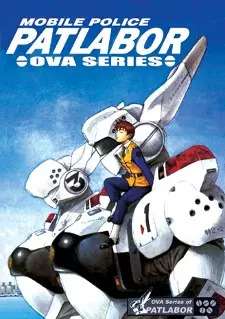
Links go to search results. Availability varies by region.
機動警察パトレイバー
7
OVA
Finished Airing
Apr 25, 1988 to Jun 25, 1989
As the human race evolves, so does its technology. Engineers have successfully created robots dubbed "Labors" for mass distribution, utilized by society for a number of everyday tasks. However, there are criminals who manage to get their hands on these Labors, using them for their own nefarious means. To combat this new form of delinquency, police around the world begin using "Patrol Labors" or "Patlabors" to put a stop to Labor-related crimes. Rookie police officer Noa Izumi is drafted into a special Patlabor unit, getting her own mechanical suit to fight crime. Naming this machine Alphonse, Izumi works tirelessly alongside her peers to keep civilization safe from those who would use this advanced technology to harm others. As Izumi becomes further ingrained within her unit, she must also learn how to navigate both her social and professional spheres with grace and wit. She befriends the aloof Asuma Shinohara, fellow pilot Isao Oota, and the other members of her brigade as she helps them to combat conspiratorial plots, workplace revolts, and supernatural beings. [Written by MAL Rewrite]
7.5/10
Average Review Score
76%
Recommend It
17
Reviews Worldwide
In my opinion a very good introduction to the patlabor anime saga and WAY lighter content compared to the movie, as well the early mecha designs that later on would be praised via movie 1 and overall. The persona in here is quite good , the 1st meeting with some collegue´s , their backgrounds and involvment in everyday life , as well the villians story´s and out come of it, bit too bad that the serie´s was short but that makes it all up with 3 more movie´s and more serie´s inbetween!
“For Pete’s sake, this isn’t some Mecha anime” - Goto Kiichi There's a multitude of Mecha shows that are talked about now and before, Gundam, GitS, and with this year we had FranXX, Gundam (again) and Planet With. As is obvious to an avid anime fan, Mecha shows are very big in Japan and as such we see a lot of buzz on such shows. Sometimes though, some shows do not get the love they deserve, especially when they're in many ways superior than most, this is where Patlabor comes in. Patlabor is perhaps the best sense I found for Mecha, in policing and the law, no,I'm not talking about Code Geass esque law enforcement, Patlabor is far better in showing how and why the Mechs called Patlabor are necessary for the country and the police. Not to fight Klaxosaurs, but to fight crime. And this Patlabor showed us effectively. Despite being a 7 episode OVA that's 30 mins long for each episode, we saw a good amount of information and not a second was wasted, that too despite being a little shorter than a single cour anime, which goes to show length doesn't always factor for quality at least for anime. Patlabor's biggest selling point is how the police are depicted. They're not gruff individuals who always rush off into life-or-death situations. The police aren't always involved in such cases, but neither are they always in jest. We saw the fun our characters had in the first four episodes along with the crime dealing as well, making for a nice blend of both seriousness and light humour, something less seen since striking a balance is so tough. Light humour obviously brings us to the colourful cast. Since this is a police anime, we see young adults as our main cast and this shows Patlabor is another of those few mechas with an adult cast and not teenagers. Getting into the details, the characters were bright, distinct and amazing in their own way, they felt real. Noa was our female protagonist who was in love with her Patlabor Alphonse, showing she's a cute mechanics lover and she had her fun moments. Though Patlabor is anything but romance, we did get a few nods with Asuma, a fellow police officer. Oota was your average short-tempered gun lover. Kanuka was the fun American transfer student who thankfully knows English and not Engrish (a huge plus point to the Voice Actor for doing well) along with Hiromi who wasn't seen talking much as he's a rather silent individual. Gotou was a relatable depressed looking man who would play an important part as the captain of the group and his role in episodes 4-6 were amazingly done. The rest of the cast was a playful bunch who was serious when they needed to be and hilarious when the situation demanded it too. Why did I spend so much time on the characters? It's because they were well done, we didn't see any major development over the course of the 7 episode OVA but that could be excused because their establishment AS a character was brilliant. Something else that was brilliant was the OST. The simple but intricate background music complimented the situation effectively and the Opening theme song was something I think will be stuck in my head for a few months, catchy and cute, it is an excellent way to start off a fun show. Since it was somewhat of a semi-slice of life show, the OVA had an episodic nature with the exception of the 2 part “Longest Day” arc which was in episodes 5-6. Despite being episodic, the independent episodes stood up for themselves and were all well done. The first three were an introduction to the Patlabor world and it introduced us to the daily life of the police, combining fighting crime and topping it off with light humour which as I covered above was an excellent blend of both. I never felt out of place with the plot or this approach but it being episodic meant things aren't tightly held up and so we couldn't see a long underlying plot although episodes 5-6 scratched that itch to a certain extent. Another thing I didn't feel out of place with was the artstyle, despite airing over 30 years ago it's artstyle was something I didn't find hard to watch and actually enjoyed and appreciated the art direction. From the character design to the emotions of the character to the action scenes involved, Patlabor’s artstyle was consistent, easy to watch and attractive despite it's age. As a comedy fan I always look for fun comedy shows to watch but I do step out of the comedy bubble a lot and when I tried Patlabor after a friend recommended it to me, I didn't just get a well done Mecha, I also got some comedy added as well. “Why do you call this a good Mecha?” you may ask. It's because the premise was explained clearly, it wasn't an obscure explanation with any external influences or aliens or whatever, Japanese technology evolved to the point that Labor could be used, but this could be used for crime as well, and so to monitor this, Patrol Labor, therefore Patlabor was implemented. Easy right? Apart from that even though it was episodic, it was a GOOD episodic show because each episode stood up for itself and there was still a small line connecting the episodes together. A lovable cast, interesting developments and a perfect blend of seriousness and comedy show that Patlabor Early Days is how a Mecha can be made fun, approachable, and funny. I haven't watched enough Mecha as most Mecha fans would but I really doubt I'll find something as fun as Patlabor Early Days. Definitely a show worth trying out, it's shorter than a single cour anime and yet covers a lot, an excellent introduction to the Mecha series and genre! Story: 8 Animation: 7.5 Sound: 7 Character: 9 Enjoyment: 9 Overall: 8.1
Click an episode to read its synopsis.
The first anime installment of the Patlabor franchise delivered one hell of a good time. The first six episodes were directed by the grand master himself, Mamoru Oshii, who would also direct the first and second film adaptations. The seventh episode served as a bonus with a different director by the name of Naoyuki Yoshinaga. From what I took of it, the seventh episode tried to make up for a lack of action evident throughout the OVA. I was fine with that, but the sixth episode still serves as a fitting ending. The premiseof the anime is near-future, as Oshii puts us in a world where the advancements of technology have made science fiction a reality. Humanoid robots known as Labors are a result of that, and they serve as the most important medium for Japan's expansion as a techno logic civilization. However, there's a bad element in Japan's society that leads to crimes committed by Labors piloted by insidious individuals. This leads to the creation of a Special Vehicles Division under the Tokyo Police Department, where Patrol Labors(Patlabors) have become the standard weapon to Labor crimes. This is where our main characters assume their roles and deliver fun adventures under the badge of the Section 2 unit of Special Vehicles Division in Tokyo. The OVA's plot for each episode, besides 5 and 6, followed a stand alone format as each episode creates a new setting with a new adventure for the main cast to endure. This cast includes the main characters of the films such as; Izumi Noah, Shinohara Asuma, and Goto Ki'ichi. These characters, and many more supporting characters, are integral to the plot as they bring something new to the table with their varying personalities. A fine example would be Yamazaki Hiromi, one of my favorite characters of this OVA, who's a giant of a man with a gentle side to him. As some of you might know, the 3rd episode had a strange ending, and Hiromi was inserted as the main point of interest for no apparent reason. It was pretty funny, but also there was no predictability to it... and that felt amazing. It wasn't for the hell of it, mind you, but rather,to make the audience ponder the meaning for themselves. It is my favorite episode of them all. In order to compliment the atmosphere of Patlabor, Kenji Kawai provides a beautiful score that really sums up certain moments with pizzazz. Then there's the Japanese voice overs, which were really well cast, as they've been with the franchise up to the second movie. That's not the case with the English dub cast, which was probably the only screw up with this OVA, as they were very miscast and just plain bad. Other than that, this anime was a riot to watch. The humor and plot really made up for a lack of action. The mech designs were really impressionable, the animation was crisp, and the score was really nice. This is a unique mecha I'd recommend any day.
(Check out my profile for a link to my site containing more up-to-date reviews and bonus media!) Mobile Police Patlabor is a multimedia franchise founded in the late 80s by a bevy of then relatively unknown talent. Most notable among these names is director Mamoru Oshii, the philosophical tech-mind behind other works such as Ghost in the Shell, Jin-Roh, and The Sky Crawlers. Being both fairly convinced of his talent and a mecha fan, I dropped in to give the much lauded Patlabor franchise a try. The Early Days OVA starts one of two anime continuities which the first two movies continue. This 7-episode 1988 OVA isa brief but effective peek into the world of Patlabor. A Japanese rookie police squad is transferred to a new district where they’ll uphold the law with the help of their Patlabors – giant mechanized Patrol “Labor Units” created to combat rising Labor crime. Patlabor is among the closest a mecha series has come to being a “slice of life” show, with little to no overarching plot and an episodic structure that details the daily life of the SVD2 squad and the environment they have to work in. It’s primarily a mix of comedy and drama, but is not beholden to both, knowing exactly when to divide and redistribute the mix to make its individual stories more fun or more emotional. It’s a show that’s convincingly capable of doing anything thanks to having talent great enough to know how to handle anything. It’s difficult to not undersell Patlabor because on the surface it’s a modest, unpretentious series but with excellent, tactful craft that overcomes its simple premise. The world construction is extremely similar to Ghost in the Shell: Stand Alone Complex (despite Oshii not working on that) in the sense that Patlabor has a very well-defined setting that’s constantly and gradually built on in the background through the broad range of subjects its cast has to deal with in their adventures. Despite Patlabor’s mostly light-hearted tone and humor, its surrounding is revealed to be a prescient future society rife with environmental concerns, increasingly concealed upper class bureaucracy, and red-tape clashes between the police, military, and government. It’s borderline dystopian without rubbing it in your face, but being able to both acknowledge that border while not succumbing to overbearing themes of pessimism and nihilism is why the series is so successful and unique. It’s a struggle of optimists in a world that’s increasingly not welcoming them, and Patlabor manages to have its cake and eat it too regardless of which tone it chooses to put on. Still, this OVA is largely a fun comedy driven by likable characters with strong personality traits that aren’t exaggerated to the point of having them become caricatures, and not overused to the point of making any of them annoying. Among the SVD2 squad is central character Noa Izumi, a tomboyish Labor fangirl who joins the police in order to pilot a mech. Her closest comrade is Asuma Shinohara, the spoiled son of a leading metal manufacturer’s president. They’re joined by the trigger-happy and sexually repressed Isao Oota, nerdy “whipped” husband Mikiyasu Shinshi, and peaceful giant Hiromi Yamazaki. They’re soon joined by an American transfer named Kanuka Clancy, an ace police officer who’s by far the most serious and intelligent of the squad. Squad captain Kiichi Gotou reveals himself to be the strongest member of the cast, a perpetually depressed-looking man with an unprofessionally sullen demeanor. What’s at first seemingly a personality played for a joke becomes the most important part of making Patlabor’s serious tone believable. Gotou is the weary cop who’s been worn down (but not broken) by the technicalities of the law and justice, and the suspicious self-serving nature of the higher-ups he serves. The only one who comes close to understanding him is Shinobu Nagumo, a more professional but ultimately more naive fellow captain. When the OVA climaxes in episodes 5 and 6, it’s Gotou’s presence in the storyline that hints at something beyond Patalbor’s usual comedic conceit, and since his character bears the weight of the drama the lighter tone most of the series has is not jeopardized. Gotou is Patlabor’s main connection to the more serious side of its story and yet he’s still funny in his complete frustration and exhaustion regarding his job while also being startlingly intelligent and competent. In summary, Gotou rules. That two-parter mentioned above is an exception in this OVA, however. It’s a little odd how the OVA doesn’t conclude on those episodes since they’re clearly the climax and the final episode completely skips over the implied consequences of the previous one which is puzzling and begs an explanation. The 7th episode could’ve and should’ve been placed before those two episodes. The majority of Patlabor: Early Days is effectively funny episodic comedy starring an easily lovable cast with well-animated action sequences. The pacing of every scene is always pitch-perfect, slow and natural when capturing the malaise of the bored squad members who celebrate being suspended from work, and slick and uplifting whenever action is required. Oshii knows what he’s doing in a consummate sense that’s extremely easy to overlook if you don’t consider how mediocre a lot of otherwise fine anime are directed. Patlabor isn’t a lazy production, constantly switching frames and camera angles so that its mundanity somehow isn’t boring to watch. When the objects on screen aren’t moving around a lot, the camera always is and no frame is sloppy or unfocused. Episode 4’s ghastly ghost story uses uniquely garish coloring over many scenes that sells the clash between Patlabor’s tone and the sort of horror it’s parodying, and Gotou and Nagumo’s relationship with the majority of it being told through facial expressions and things unsaid is always refreshingly mature among the more frantic cast. Yutaka Izubuchi’s mechanical designs are sleek but utilitarian. The Patlabors are literally giant police officers, armed with over-sized handguns and nightclubs. At first this may seem tacky, and yet it’s more plausible than your usual Gundam’s reliance on vaguely explained beam technology. Kenji Kawai’s score is typical for the time, a mixture of bright synth build-ups to electric guitar solos. Anyone who’s seen a fair amount of 80s anime will recognize the style, and while very derivative it’s a kind of style I personally love and I’ve already found myself humming a few of its tunes after finishing the series. Every credits sequence having its own unique theme is a nice touch, and the opening theme being a love song from Noa to her Patlabor (nicknamed “Alphonse”) is a cute and appropriate lead-in to Patlabor’s general tone. Patlabor: Early Days is not going to please a broad audience. It’s inevitable some people are simply going to find it boring. For others such as myself, its seemingly simple construction won’t feel empty at all and instead an honest, restrained approach that makes any of its more ambitious and potent moments much stronger. It’s made with a class that boosts its modest interests above many other series that wear their ambition on their shoulder but have a much less realized premise. For people who like the more commonly easy-going anime of its era and want a particularly solid-written series that never trips over any of its concepts, it’s easy to recommend Patlabor: Early Days.
Patlabor is a classic. The term comes with a lot of responsibility, and believe me, I truly do not like to take or give it lightly, but throughout the years Patlabor has cemented its name as one of the more well recognized and critically praised mecha franchises of the 80s. Managing to stand not that far away in terms of importance and influence, to the likes of Gundam or Macross. Sadly, my experience with it has been nothing short of underwhelming, basically making for a highly frustrating disappointment overall. On this analysis I will attempt to shed some light to what I consider to bethe pivotal structure problem with the series, the characters, which are my main reason for never managing to connect with some of its entries. As references for this I will be using mostly the ova series Mobile Police Patlabor, with some additional commentaries on its continuations, Patlabor Movie 1 and 2. My issue at heart here is actually philosophical one, on the writing of this OVA. The main ideal of characterization this series seems to be going for is something I fundamentally disagree. On the OVA’s first episode, there is a line by Gotou that describes perfectly, said ideal of character writing. On said commentary he points out how his subordinates, the main guys we follow through most of the episodes, are not the autistic pilots of Gundams, dangaios, Mazingers. This commentary lands a pretty decent joke and reference (you would have to kill me, to make me remember an instance where the jokes in this Ova actually made me laugh) but is also indicative of a bigger view on how these characters were purposefully created. It references a logic of taking out eccentricities, extreme aspects of personality, in order to portray their personalities as more mundane, normal, you could say as “realistic people”. Even in this case where the personas are a bit more expressive and show a wider range of emotions than in pretentious crap like Kara no Kyoukai. The problem being, this attempt at streamlining does not lead necessary to what I would call better characters. In fact, I think it plays the contrary effect on this franchise, the personalities are streamlined, to the point they really lack basic aspects of really basic character writing like engaging conflicts, arcs, motivations, depth, psychological introspection, making they really way less interesting as people to the emotionally unstable autistic pilots, who were portrayed in really exaggerated ways, that were kind of a genre cliché (blame Zeta Gundam for this). This for me is a clear example of confusing subtlety, in having the character aspect being more nuanced, having it to be implied through details and small actions rather than literally explained, for dullness in having barely anything in terms of content to these personas. Patlabor is an obvious attempt of going for the latter, but forgets to give the meaning on the small, in having a good grasp on ideas they were trying to imply, to give us a good enough of a sense as to whom these people really are. Credit where it is due, at the very least the cast here contains a variety of personalities. Each character has its own unique reaction and characteristic be it Oda’s aggressiveness, Nagumo’s rationality, Noah’s childishness. Such characteristic may never portray or give comprehension to a deeper true character, but the very least they serve to create scenes; each persona adds a unique facet and reaction to situations, which in turn makes for dynamic scenes. The developments in history are made on the basis of their unique personality, not on convenient character writing. But when we look to the foundational aspects of good writing, the characterization quite literally falls apart. How many of the main characters in Patlabor have well stablished and portrayed motivations and goals? The answer is two, them being the guys who have pretty much already accomplished their goals at episode 1(firing guns for Oda, being with Alphonse for Noah). So yeah the joy of seeing someone attempt for a goal, an objective, a thing of desire, and work his way through complications to get to that is completely gone here. This issue is only elevated by the complete disconnect between the conflict and the cast, the conflicts being presented through the OVA (with the exception of episode 5) have completely none personal stakes, they have absolutely no relation with whom they are, what they want, being that their repercussions only matter on a social scale (which also does not matter since the OVA has really bad world building, but this is a topic for later). It is a weird case where characters are not moved from desire, worldviews, personal issues, traumas, but because it is their job, they are paid for that and they just sort of have to do it. I usually prefer characters where the reasoning for their actions are explained and have more to them than simple duty, but hey that is just me. It also creates a weird instance where the lack of stakes or interest for the conflict in the characters themselves, also leaves me really disengaged on what is being presented, since it is through their eyes and perspective that we as audience members experience said events. You would think that in Ova where everyone lacks urgency completely, they would try to get us interested on them as people instead, develop those guys to be really compelling, well written. Which is completely not the case, throughout this entire fucking Ova most main characters never grow much from the way they were initially introduced. Take Shinshi for example, he is a main in this Ova and in the first movie. Throughout the course of both the only things we get to know about him is that he is a really passive scarred guy, and the fact he is married (which manages to be his most notable “trait”). At the end of the day we learn absolutely nothing new about the guy, he is still the same person he was in episode 1 (I would argue he is a worst character at this point, because now we know his existence is limited to that). I am not saying Patlabor needs to give ample characterization, depth, or psychological introspection to everyone, the kinds of basic layout which were being used here can work for simple secondary character. Take Sakaki for example he does not need much more than his gloomy obstinate and oozing in authority personality to work for his function, for the screen presence he occupies, and his relevance in the story, that is good enough. Giving this treatment to a main one or I would argue even less to some, is completely unacceptable though. The instances of character development that do happen are also so bizarrely handled. On its first movie Patlabor sets up what should be Noah’s most important flaw, an aspect that was a clear build up for a future arc in my vision (which I think the OVA was also trying to set up, but they were so incompetent at that I am not sure). Said flaw being her dependency on external objects, she named several things throughout her life as Alphonse, and implies her happiness can only happen in terms of being together with said objects. Of course the narrative has absolutely nothing to do with this flaw (it never does in Patlabor, because who needs conventional storytelling of tying conflict with characters flaws, and making arcs about overcoming those flaws, right). But then what happens in movie 2 really gets the cake as most awkward character moment ever. Said continuation literally starts with a scene of Noah saying she does not need her freaking Alphonse anymore and she is over it. Her infatuation with Alphonse the most important aspect of her personality, being built up and reiterated for an entire OVA series and a movie, and the resolution to all of that is part of a time skip, where what is shown is only the aftermath of said change. This movie in general also has this issue of presenting character change from previous entries with time skips, with barely any context, but it as least gives them new situations to react to and aspects of personality, which was more than I can say for most of the OVA, so well done, I guess. The bigger issue here is not really the personas sucking (which they do). But in how Patlabor needs way stronger character writing for the narrative it is attempting to work (the films 1 and 2 are exceptions for being a detective mystery and political thriller respectively, more focused on plot). There is a great focus on detailing the day to day of these people, the way they interact and play with each other (was this supposed to be comedy), those moments were really more important than the conflict and surrounding narratives at hand in some episodes. There is a focus on character here, which is really not paying off, and comes mostly as a waste of time. I also do not think Patlabor understands what makes said slice of life like scenes functional. Scenes without conflict are great to show the personality of the individuals, showing how they truly act in the absence of an external force, these are the moments where we truly see characters’ act, instead of react to things like threats to their lives. Those can also be great to show people in a great variety of circumstances, or how mundane habits and values can shape or show the true personality besides facades. It can also be a way of stablishing relatability with characters, showing them as normal humans, which engage in the same kind of regular activities as you do. Patlabor barely uses those to any of those functions, instead opting for repeating the same traits (how many times did we need to see OTA wanting to shoot in his spare time?) repeating the same facts about the characters, repeating the same kind of interaction between them ad nauseam and also the most repetitive and obnoxious attempts at banter and humor I have ever seen. During the entire OVA, the only moments where I felt it put those scenes to great effect was in the start of episode 5. In 13 minutes this episode manages to do more for the characters, than the show had done so far in its entire run. By having they start the episode going home, meeting their family connections, or other relations they are inserted into, giving then an entire new situation, portraying a completely new aspect of their lives, even when one of them choose to do not go and stay at the district, that choice also tells a lot about them, especially in Gotou’s case. We even see hints at motivation and desire being drawn for Shinohara in this episode. It is this entire new, really mundane environment the characters go through this episode, that allows we to know way more about them, than any of their repetitive gibberish banter and constant reaffirmation of traits (because of course when we know something about a character we have to see it repeated eternally to understand he is really like that). Despite this instance of effective character writing being no life saver for the OVA (nothing could at this point) and never translating to some bigger exploration in further episodes, it still leads along with the more personal objective(finally) of a long lasting rivalry, to episodes 5 and 6 having the more engaging moments in the show. Those were the key difference of those episodes, not the change in tone (Ok not having those jokes happening so often surely helped).